INSTRUCTIONAL PERFORMANCE SUMMARY REPORT:
This report provides a detailed overview of the instructional performance metrics for the course "History of Everything" (HIS123) taught by U.N. Fortunate during the Spring 1994 term. Key metrics include the mean amount learned (3.16 out of 5) and overall teacher evaluation (1.12 out of 6). The course had an enrollment of 120 students, with a response rate of 44%. These findings are compared with future evaluations from HIS345, demonstrating trends in student learning and teacher effectiveness over two semesters in 1995.

INSTRUCTIONAL PERFORMANCE SUMMARY REPORT:
E N D
Presentation Transcript
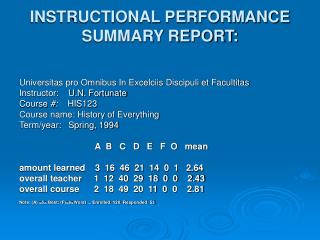
INSTRUCTIONAL PERFORMANCE SUMMARY REPORT: Universitas pro Omnibus In Excelciis Discipuli et Facultitas Instructor: U.N. Fortunate Course #: HIS123 Course name: History of Everything Term/year: Spring, 1994 A B C D E F O mean amount learned 3 16 46 21 14 0 1 2.64 overall teacher 1 12 40 29 18 0 0 2.43 overall course 2 18 49 20 11 0 0 2.81 Note: (A) =5= Best; (F)=6=Worst ... Enrolled: 120; Responded: 53
INSTRUCTIONAL PERFORMANCE SUMMARY REPORT: Universitas pro Omnibus In Excelciis Discipuli et Facultitas Instructor: U.N. Fortunate Course #: HIS123 Course name: History of Everything Term/year: Spring, 1994 A B C D E F O mean s d T group amount learned 3 16 46 21 14 0 1 2.64 0.88 27 low overall teacher 1 12 40 29 18 0 0 2.43 0.96 24 low overall course 2 18 49 20 11 0 0 2.81 0.93 33 low Note: (A) =5= Best; (F)=6=Worst ... Enrolled: 120; Responded: 53
Sample Size and Response Ratio Standards for Student Rating Data Class Size (N) Acceptable % 5-20 80 percent 21-30 75 percent 30-50 66 percent1 50-100 50 percent2 > 100 50 percent 1 = 75 percent recommended 2 = 66 percent recommended
Two evaluations of HIS 345 mean s d T group amount learned 3.35 0.87 45 low-mid term/yr= spring. 1995 instr = UNFortunate overall teacher 2.76 0.76 35 low course = his 345 resp/enr = 29/61 overall course 2.85 0.90 37low %resp=48 ______________________________________________________ amount learned 3.97 1.40 56 hi-mid term/yr= fall, 1995 Instr = UNFortunate overall teacher 3.57 1.30 47 mid course = his 345 resp/enr = 20/42 overall course 3.63 1.24 50 mid %resp=48
Enrollment profiles for HIS 345 in two semesters Fr So Jn Sn Tot original enr. 6 17 15 23 61 term/yr= spring, 1995 Instr = UN Fortunate final enr. 5 14 12 20 51 course = his 345 resp/enr = 29/51 eval respondents 5 13 11 0 29 %resp=57 original enr. 3 11 12 16 42 term/yr= fall, 1995 Instr = UN Fortunate final enr. 2 7 8 12 29 course = his 345 resp/enr = 20/29 eval respondents 2 4 5 9 20 %resp=69
Enrollment profiles for HIS 345 in two semesters Fr So Jn Sn Tot original enr. 6 17 15 23 61 term/yr= spring, 1995 Instr = UN Fortunate final enr. 5 14 12 20 51 course = his 345 resp/enr = 29/51 eval respondents 5 13 11 0 29 %resp=57 original enr. 3 11 12 16 42 term/yr= fall, 1995 Instr = UN Fortunate final enr. 2 7 8 12 29 course = his 345 resp/enr = 20/29 eval respondents 2 4 5 9 20 %resp=69
Good practice is … Comprehensive Takes into account full range of responsibilities and activities Systematic Is purposive, organized, standardized Public Has known criteria and procedures; is documented Flexible Can accommodate change & take advantage of individuals' talents & capabilities as well as serving the needs of the academic unit Evaluated Evaluation processes and products are monitored for efficiency and effectiveness
Guidelines #1 • Establish the purpose of the evaluation and the uses and users of ratings beforehand. • Include all stakeholders in decisions about evaluation process and policy. • Keep a balance between individual and institutional needs in mind. • Publicly present clear information about the evaluation criteria, process, and procedures.
Guidelines # 2 • Establish legally defensible process and a system for grievances. • Absolutely include resources for improvement and support of teaching and teachers. • Build a real "system" for evaluation, not a haphazard and unsystematic process. • Establish clear lines of responsibility/reporting for those who administer the system.
Guidelines # 3 • Invest in the evaluation system and evaluate it regularly. • Use, adapt, or develop instrumentation suited to institutional/individual needs use multiple sources of information from several situations;. • Keep ratings data and validate the instruments used. • Produce reports that can be easily and accurately understood.
Guidelines # 4 • Educate the users of ratings results to avoid misuse and misinterpretation. • Keep formative evaluation confidential and separate from summative decision making. • In summative decisions, compare teachers on the basis of data from similar situations. • Consider the appropriate use of evaluation data for assessment and other purposes. • Seek expert, outside assistance when necessary or appropriate.