Download
1 / 24
240 likes | 433 Vues
Explore the intricacies of the heart and cardiovascular system, a closed system integral for blood circulation. The heart, located between the lungs in the thorax and roughly the size of a fist, comprises four chambers and valves to ensure unidirectional blood flow. Learn about the pericardium, heart wall layers, and the importance of coronary circulation. Understand the heart's conduction system, featuring the SA and AV nodes, and how electrocardiograms (EKG/ECG) capture its electrical activity. This overview combines anatomy and physiology for a comprehensive understanding of the heart's essential role in nutrient and oxygen delivery.

E N D
The Heart Circulatory System
The Cardiovascular System • A closed system of the heart and blood vessels • The heart pumps blood • Blood vessels allow blood to circulate to all parts of the body • The function of the cardiovascular system is to deliver oxygen and nutrients and to remove carbon dioxide and other waste products
Closed system? • What does it mean to be a “closed system?”
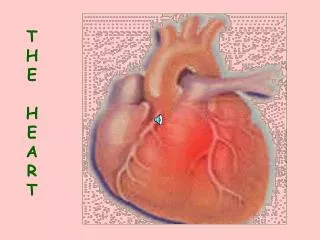
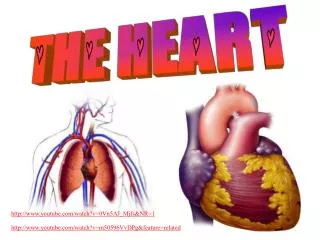
The Heart • Location: • In the thorax • Between the lungs • Pointed apex directed toward left hip • About the size of your fist • Less than 1 lb.
The Heart Figure 11.1
The Heart: Coverings • Pericardium – tissue like sac surrounding the heart • A double membrane made of: • A. Visceral pericardium – thin layer of tissue that hugs the heart • B. Parietal pericardium – fibrous outer layer to protect heart • Fluid fills the space between the layers of pericardium and allows the heart to beat without friction
The Heart: Heart Wall • 3 layers of heart tissue • Epicardium • Outside layer of connective tissue • Myocardium • Middle layer made mostly of cardiac muscle • This is the layer that actually contracts • Endocardium • Thin inner layer that lines heart chambers
The Heart: Chambers • Right and left side act as separate pumps • 4 chambers: • Atria (2) - Receiving chambers • Right atrium • Left atrium • Ventricles (2) - discharging chambers • Right ventricle • Left ventricle
The Heart: Associated Great Vessels • Vena cava – deoxygenated blood enters right atrium • Superior and Inferior • Pulmonary arteries – deoxygenated blood leaves right ventricle • Pulmonary veins (four) – oxygenated blood enters left atrium • Aorta – oxygenated blood leaves left ventricle
The Heart: Valves • Each of the hearts 4 chambers has its own valve • Valves allow blood to flow in only one direction • A. Atrioventricular(AV) valves – located between atria and ventricles • 1. Bicuspid or mitral valve (left side) – made of two flaps of endocardium • 2. Tricuspid valve (right side) – made of three flaps • B. Semilunarvalves – located at the base of two large arteries leaving the ventricles • 3. Pulmonary semilunar valve – made of 3 leaflets • 4. Aortic semilunar valve – made of 3 leaflets
How they work… • AV valves are open when the heart is relaxed and blood is passively filling into the ventricles • Held in place by tendon-like cords • As the ventricles contract, they press on the blood in their chambers which closes the AV flaps • This prevents backflow into the atria • The semilunar valves then open during ventricle contraction
So, does the heart need its own blood for nutrients and oxygen? • We know that the heart pumps blood, but does the heart need blood for itself too? • YES! Of course it does • BUT…. • Blood in the heart chambers DOES NOT nourish the myocardium (heart muscle cells) • So where does the heart get blood?
Cardiac Circulation • The heart has its own nourishing circulatory system • The blood supply that oxygenates and nourishes the heart is provided by: • Coronary arteries • Cardiac veins • Waste products in the blood are then emptied into the right atrium via the coronary sinus
The Heart: Conduction System Intrinsic Conduction System- Heart muscle cells contract, without action potentials, in a regular, continuous way • 1. Sinoatrial node (SA): group of myocytesin the right atirum that conduct AP’s • Also called the “Pacemaker” – generator of heart rhythm • 2. Atrioventricular node (AV) – myocytes located at the junction between the atria and ventricle
Heart Contractions Figure 11.5
The Heart: Conduction System • 3. Bundle of His - a collection of heart muscle cells that transmits AP’s from the AV node to the bundle branches • 4. Bundle branches – long muscle fibers that travel down the inner ventricular walls • 5. Purkinje fibers – muscle fibers located on the lower ventricular walls that allow the ventricles to contract
Heart Contractions Figure 11.5
Electrocardiograms (EKG/ECG) • An interpretation of the electrical activity of the heart captured and recorded by skin electrodes • Three formations: • P wave: impulse across SA node (P) • QRS complex: spread of impulse down AV node (Q), towards Bundle of His (R), down bundle branches, and around ventricles in Purkinje fibers (S) • T wave: end of electrical activity in ventricles