Data-Driven Function Approximation and Visualization in 1D and 2D using MATLAB
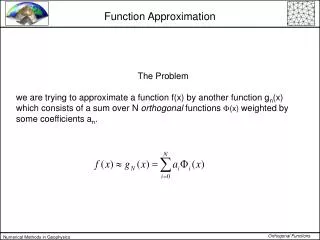
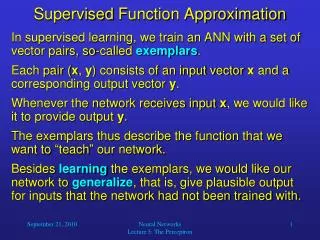
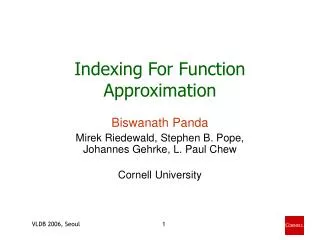
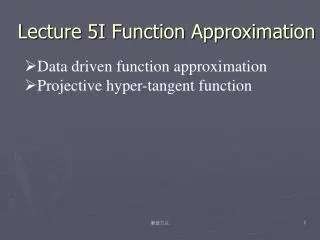
This guide demonstrates how to perform data-driven function approximation for arbitrary one-dimensional and two-dimensional functions using MATLAB. Key features include inputting functions such as (x^2 + cos(x)) and generating random samples for function evaluation. The approach uses neural networks for learning and approximating complex functions, visualizing outputs through plots and mesh graphs. This tool is beneficial for researchers and students in machine learning and applied mathematics, providing clear insights into function behavior through sampling and data visualization.

Data-Driven Function Approximation and Visualization in 1D and 2D using MATLAB
E N D
Presentation Transcript
Plot1d Plot an arbitrary one-dimensional function clear all fstr=input('input a function: x.^2+cos(x) :','s'); fx=inline(fstr); range=2*pi; x=linspace(-range,range); y=fx(x); max_y=max(abs(y)); plot(x,y/max_y); hold on;
Sampling N=input('keyin sample size:'); x=rand(1,N)*2*range-range; n=rand(1,N)*0.1-0.05; y=fx(x)/max_y+n; figure plot(x,y,'.');
Paired data Y X
Plot2d • Plot an arbitrary two-dimensional function fstr=input('input a 2D function: x1.^2+x2.^2+cos(x1) :','s'); fx=inline(fstr); range=pi; x1=-range:0.02:range; x2=x1; for i=1:length(x1) C(i,:)=fx(x1(i),x2); end mesh(x1,x2,C); hold on;
Sampling N=input('keyin sample size:'); x(1,:)=rand(1,N)*2*range-range; x(2,:)=rand(1,N)*2*range-range; n=rand(1,N)*0.1-0.05; y=fx(x(1,:),x(2,:))+n; plot3(x(2,:),x(1,:),y,'.');
Function guessing DDFA
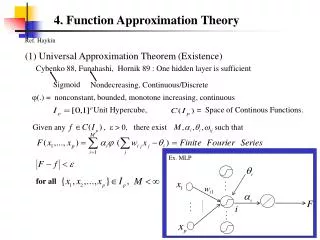
Neural Networks b1 tanh r1 b2 1 a1 tanh r2 a2 x ……. bM rM aM tanh rM+1 1
Neural Networks b1 tanh r1 b2 1 a1 tanh r2 a2 x bM ……. rM aM tanh rM+1 1
MLP_Tool.fig MLP_Tool.m
Mapping • Head: function y=eval_MLP2(x,r,a,b) • Body: M=size(a,1) y=r(M+1) for m=1:M Add r(m)*tanh(a(m,:)*x+b(m)) to y
Function Riddle DDFA
MLP learning [a,b,r]=learn_MLP2(x',y',M); MLP learning
High-dimensional function approximation The NNSYSID Toolbox
Example Black box plot1d.m x y observation Create paired data sampling.m DDFA learning.m
Example Black box plot2d.m observations Create paired data sampling2.m y=cos(x1)+sin(x2) DDFA M=input('M:'); [a,b,r]=learn_MLP(x',y',M); E=mean_square_error2(x,y,a,b,r)
Mean square error • Head: E=mean_square_error2(x,y,a,b,r) • Body: E = 0 n = size(x,2) for i=1:n • xi = x(:, i) • yi = eval_MLP2(xi,r,a,b) • ei=yi-y(i) • Add the square of ei to E E=E/n
DDFA demo_fa2d.m fa1d.m