natural numbers (a positive integer)
In the early days, one orange, 3 oranges, ..etc. any of the natural numbers, the negatives of these numbers, or zero. natural numbers (a positive integer). Root, Radix, Radicals. Real Number VS. Imaginary (complex) Number.

natural numbers (a positive integer)
E N D
Presentation Transcript
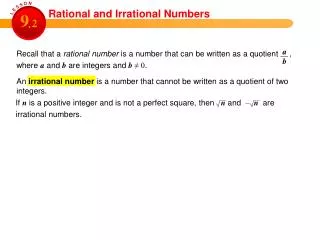
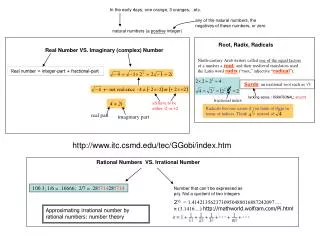
In the early days, one orange, 3 oranges, ..etc. any of the natural numbers, the negatives of these numbers, or zero natural numbers (a positive integer) Root, Radix, Radicals Real Number VS. Imaginary (complex) Number Ninth-century Arab writers called one of the equal factors of a number a root, and their medieval translators used the Latin word radix (“root,” adjective “radical”). Real number = integer-part + fractional-part Surds: an irrational root such as √3 lacking sense : IRRATIONAL; absurd fractional index 4 + 2i all have to be either -2 or +2 Radicals become easier if you think of them in terms of indices. Think instead of real part imaginary part http://www.itc.csmd.edu/tec/GGobi/index.htm Rational Numbers VS. Irrational Number 100.3; 1/6 = .16666; 2/7 = .285714285714 Number that can’t be expressed as p/q. Not a quotient of two integers 2½ = 1.4142135623730950488016887242097…. (3.1416…) http://mathworld.wolfram.com/Pi.html Approximating irrational number by rational numbers: number theory
How do you represent large multiples such as 2x2x2x2 takes too much space to print 2x2x2x2 = 24 the birth of exponential notation (base, exponent or index (indices)) Now we need a set of rules to figure out what things such as is 22 x 23 Or 23 x 32 Properties of exponents Logarithms: Math based on the exponents themselves, invented in the early 17th century to speed up calculations. Also from the result of the study of arithmetic and geometric series. (study tip: the exponent is the logarithm).
Page 29 example 9 1 x 25 = 1 x 5 x 5 5 + 5 = 10 16 x 1 = 4 x 4 4 + 4 = 8 Page 30 example 12, 13 1 x 12 = 3 x 4 3 + 4 = 7 2 x 15 = 2 x 3 x 5 = 6 x 5 6 - 5 = 1
Page 40 example 7 Page 39 example 6
Page 42 – Example 9 Page 42 – Example 10 Combine the numerator terms
Climbing the mountain on a straight slope On the 2nd day You climbed 4 miles vertically On the 2nd day, You covered 3 miles horizontally 3rd day end point 2nd day start point How far did we walk ?
Slope of a Straight Line tangent Equation of a straight line • We need to know two points (locations) • The second day’s starting location and ending location • Can you identify the right-triangle in the previous slide? • Can you identify the right-angle? • It is customary to denote the slope of a straight line by “m” Now that we know there is a right-triangle, how far did we walk ?
Given two point on a line, what is the distance between the two points? Vertical distance B 4 A We were only given points A and B. Using A and B we could simply figure out point C. Point C is same height as point A but it is (10 – 4) or 6 units away from A C (10,3) 6 Horizontal distance We can find AB using the Pythagoras’ theorem Mid-point of line segment AB
Equation of a line slope y-intercept x and y are variables -- various points along the line Slope of a line joining points (0,c) and (x,y) x can’t be 0 Point (0,c) lies on y axis
Properties of Set y = 0 to find the x-intercept Set x = 0 to find the y-intercept When m = 0 no incline, line is parallel to x-axis. No x intercept y = c M can’t be 0 y = c No gradient (undefined), straight up, perpendicular to the x axis. No y intercept. Parallel to y axis. x = k. c is y-intercept Ex: (1,2), (-1,2), (5,2)…
Typical problems involving straight lines? • Find whether 4 points form a parallelogram. • Method1: Calculate the distances between them to see if AB = DC and CB = DA • Method2: Using mid-points • If the mid-points of the diagonals AC and BD bisect each other then ABCD is a parallelogram • Mehtod3: Using gradients • If the gradients of AB and DC are same Matlab: plot([-1,1,5,3,-1],[-2,1,3,0,-2])
Example: given gradient, and a point on the line, find the line’s equation Slope of the line is given The lines passes through (2,1) P(x,y) y=2x-3 A(2,1) Try this: (-2,3); m = -1 y = -x + 1 Example: given two points on a line, find the line’s equation Step2: once m is known, use the same equation and one of the points to find the equation Step1: given two points, it is easy to find m Try this: (3,4), (-1,2) 2y = x + 5