Understanding the Law of Sines for Solving Oblique Triangles
In this chapter, we explore the Law of Sines, essential for solving oblique triangles, which are triangles without right angles. We classify oblique triangles as having either all acute angles or one obtuse angle. The process of solving these triangles involves finding the lengths of their sides and the measures of their angles. We introduce four cases based on known elements: one side and two angles (SAA/ASA), two sides and an opposite angle (SSA), two sides with the included angle (SAS), and three sides (SSS). The Law of Sines is applied specifically in cases SAA, ASA, and SSA.

Understanding the Law of Sines for Solving Oblique Triangles
E N D
Presentation Transcript
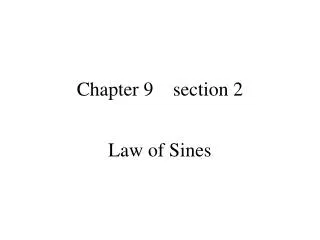
Chapter 9 section 2 Law of Sines
If none of the angles of a triangle is a right angle, the triangle is called oblique. All angles are acute Two acute angles, one obtuse angle
To solve an oblique triangle means to find the lengths of its sides and the measurements of its angles.
FOUR CASES CASE 1: One side and two angles are known (SAA or ASA). CASE 2: Two sides and the angle opposite one of them are known (SSA). CASE 3: Two sides and the included angle are known (SAS). CASE 4: Three sides are known (SSS).
A S A ASA S A A SAA CASE 1: ASA or SAA
S A S CASE 2: SSA
S A S CASE 3: SAS
S S S CASE 4: SSS
The Law of Sines is used to solve triangles in which Case 1 or 2 holds. That is, the Law of Sines is used to solve SAA, ASA or SSA triangles.
c b 5
b 12 a
3 a 5
3 5 a No triangle with the given measurements!