Download
1 / 12
150 likes | 267 Vues
Meiosis is a specialized form of cell division that results in the production of haploid gametes, specifically sperm in males and ova in females. In contrast to mitosis, meiosis involves two rounds of division, resulting in four haploid cells, each containing half the normal genetic material. This process includes important phases such as Meiosis I and Meiosis II, where homologous chromosomes exchange genetic material during crossing over. This genetic recombination enhances diversity in offspring, making sexual reproduction advantageous.

E N D
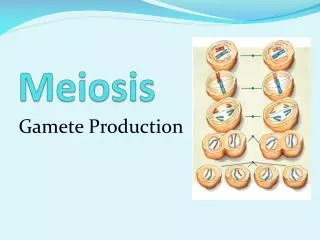
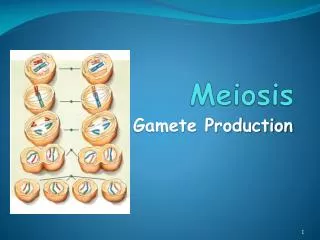
Meiosis Gamete Production
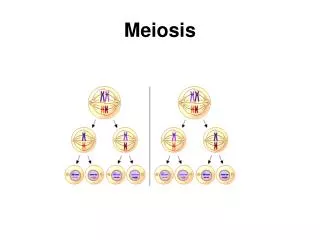
Meiosis • Similar in many ways to mitosis • Several differences however • Involves 2 cell divisions • Results in 4 cells with 1/2 the normal genetic information. • Vocabulary: • Diploid (2N) - Normal amount of genetic material • Haploid (N) - 1/2 the genetic material.
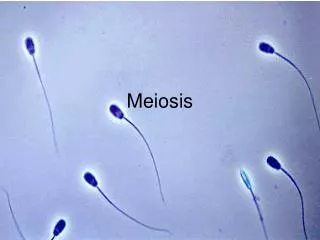
Meiosis • Meiosis results in the formation of haploid cells. • In Humans, these are the Ova (egg) and sperm. • Ova are produced in the ovaries in females • Process is called oogenesis • Sperm are produced in the testes of males. • Process is called spermatogenesis • Meiosis occurs in 2 phases: Meiosis I & Meiosis II
Spermatogenesis & Oogenesis Sperm formation Egg formation
Meiosis I • Prior to division (S phase), amount of DNA doubles
Metaphase I • During Metaphase Ihomologous chromosomes line-up along the metaphase plate or EQUATOR • Areas of homologous chromosomes connect at areas called CHIASMATA • Genes are exchanged at these connections
Crossing Over • Segments of homologous chromosomes break and reattach at similar locations. • Results in new genetic combinations of offspring. • This is the main advantage of sexual reproduction
Anaphase I • During Anaphase I, each HOMOLOGOUS CHROMOSOME is pulled to opposite sides of the cell. • Unlike mitosis, the CENTROMERES DO NOT BREAK. • Nuclei MAY OR MAY NOT reform following division. • CYTOKENESIS may or may not occur.
Meiosis II • DNA DOES NOT double • Chromosomes randomly line-up along metaphase plate like regular mitosis. • During Anaphase II, CENTROMERES BREAK and each SISTER CHROMATID is pulled to opposite sides of the cell. • Nuclei reform and cytokinesis usually occurs (although it is often unequal). Sister chromatids