SCIENTIFIC INQUIRY
This guide covers the essential components of scientific inquiry, explaining how scientists formulate questions, develop testable hypotheses, and design rigorous experiments. It outlines the importance of variables, including manipulated and dependent variables, and emphasizes the necessity of recording and analyzing data through effective presentation methods like graphs and tables. Finally, it explains how to draw conclusions from experimental results, determining the validity of hypotheses. This structured approach helps clarify the scientific method and enhances our understanding of the natural world.

SCIENTIFIC INQUIRY
E N D
Presentation Transcript
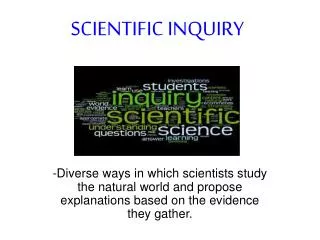
SCIENTIFIC INQUIRY -Diverse ways in which scientists study the natural world and propose explanations based on the evidence they gather.
PROBLEM • Posing a PROBLEM or QUESTION: Examples: • Why has my CD player stopped working? • What kind of music should I listen to on my CD player? - Which question above is not a scientific question?
DEVELOPING A HYPOTHESIS • A hypothesis is a possible explanation for a set of observations or answer to a scientific question. • In science , a hypothesis must be testable!
DESIGNING AN EXPERIMENT • Experiments must contain the following steps to be considered "good science." 1. A scientist must keep track of the information by recording the data. The data should be presented visually, if possible, such as through a graph or table. 2. A control must be used. That way, results can be compared to something. 3. Conclusions must be drawn from the results. 4. Errors must be reported.
VARIABLES • Variables are factors that can change in an experiment • Control experiment: An experiment in which only one variable is manipulated. • Ma nipulated/ Independent Variable: The one variable that is purposely changed to test the hypothesis • Responding/dependent Variable: The factor that may change in response to the manipulated variable/
COLLECTING AND ANALYZING DATA • Data are the facts, figures, and other evidence gathered through observation, • As data is collected, it should be presented neatly in a table.
GRAPHING RESULTS • Graphs are a useful tool to interpret data that has been collected. • Graphs reveal patterns or trends in data. • There are many forms of graphs and charts that can be used to interpret data.
DRAWING CONCLUSIONS • Conclusion: A summary of what you have learned from an experiment. • Conclusions state whether a hypothesis was correct or incorrect.