Essential Steps in Scientific Inquiry Process for 8th Grade Physical Science
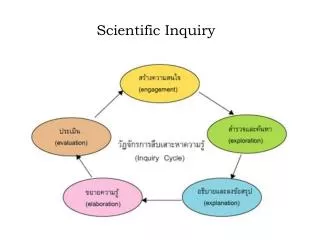
Introducing the fundamental components to the scientific inquiry process. Learn how to pose a question, develop a hypothesis, design an experiment, collect and interpret data, draw conclusions, and communicate findings effectively. Understand the importance of asking answerable questions and creating controlled experiments.

Essential Steps in Scientific Inquiry Process for 8th Grade Physical Science
E N D
Presentation Transcript
SCIENTIFIC INQUIRY 8TH GRADE PHYSICAL SCIENCE
Introducing the ______ components to the ________ inquiry process • Posing a __________ • Developing a __________ • Designing an _________ • Collecting and ___________ data • Drawing ______________ • ___________________
Posing a Question • question ________ be able to be answered by making ______________ • question cannot be based on _____________, values, or ____________
Developing a __________________ • a ____________ is a ____________ answer to a ___________ ________________or explanation for a set of ________________ • _____________________________________________________ • Example: If plants do not receive water, then they will die.
Designing an Experiment • ___________________ • a ____________ that can be _________________ w/ an experiment
_________________ an Experiment • ____________________ variable • comes from the word _______________l which means ___________ • ____________________________________________________________________________ • purposely changed during an experiment • temperature • pressure • type of ________________
Designing an Experiment • ___________________ ____________________ • the _____________ that reacts to the_______________variable
Designing an Experiment • controlled ___________________ • only ____________ parameter is manipulated • _______________________________________________________________________________________________________________
___________________ & ___________________ ___________ • ______________ • facts, figures, and other evidence collected through observation
Collecting & Interpreting Data • __________________ data • __________________________________________________________________________________________________
Collecting & Interpreting Data • _________________________ data • consists of ________________________ • displayed in tables or graphs
______________________ _________________________ • States_____________or not __________ ___________support the ________________
Communicating • use SI (System International) units so all investigators speak the same ___________________ __________________ • share ideas and conclusions w/ others through_____________and ____________________ • other scientists can_______________the investigation • results could be a theory becoming a law • leads to new: __________________ • ____________________ • _________________________