Download
1 / 9
90 likes | 210 Vues
This study focuses on the development of the KIGS model for predicting growth responses in children with idiopathic growth hormone deficiency (GHD) undergoing growth hormone replacement therapy. Data from 593 prepubertal patients were analyzed to create a prediction model. Monitoring growth responses over a four-year period revealed significant findings regarding height velocity and catch-up growth during puberty. The regression equations established aim to guide treatment and improve outcomes for children affected by GHD, elucidating the efficacy of GH therapy from initiation to final height.

E N D
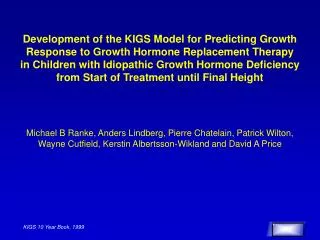
Development of the KIGS Model for Predicting Growth Response to Growth Hormone Replacement Therapy in Children with Idiopathic Growth Hormone Deficiency from Start of Treatment until Final Height Michael B Ranke, Anders Lindberg, Pierre Chatelain, Patrick Wilton, Wayne Cutfield, Kerstin Albertsson-Wikland and David A Price KIGS 10 Year Book, 1999
Selection criteria for the 593 children used to construct a prepubertal growth prediction model M B Ranke - KIGS 10 Year Book, 1999
(1/3) Characteristics (at the beginning of their GH replacement therapy) and growth responses of a cohort of prepubertal patients with idiopathic GHDa aFirst year: n=593; second year: n=573; third year: n=335; fourth year: n=180. b(n=330), c(n=181), d(n=94) M B Ranke - KIGS 10 Year Book, 1999
(2/3) Characteristics (at the beginning of their GH replacement therapy) and growth responses of a cohort of prepubertal patients with idiopathic GHDa aFirst year: n=593; second year: n=573; third year: n=335; fourth year: n=180. b(n=330), c(n=181), d(n=94) M B Ranke - KIGS 10 Year Book, 1999
(3/3) Characteristics (at the beginning of their GH replacement therapy) and growth responses of a cohort of prepubertal patients with idiopathic GHDa aFirst year: n=593; second year: n=573; third year: n=335; fourth year: n=180. b(n=330), c(n=181), d(n=94) M B Ranke - KIGS 10 Year Book, 1999
Regression equations for prediction of height velocity over the first year of GH replacement therapy M B Ranke - KIGS 10 Year Book, 1999
Regression equations for prediction of height velocity during the second-fourth years of GH replacement therapy M B Ranke - KIGS 10 Year Book, 1999
Differences between two growth prediction models in predicted height gain after the first year of GH therapy in 593 prepubertal children with idiopathic GHD M B Ranke - KIGS 10 Year Book, 1999
Growth responses to GH therapy during puberty of 195 children with idiopathic GHDa aValues shown are medians. Data from Ranke et al (1997) bAverage catch-up growth during puberty expressed as a percentage of the difference between target height and height at the onset of puberty cAverage catch-up growth from the start of GH therapy to the end of puberty expressed as a percentage of the total expected growth *p<0.001 vs spontaneous puberty M B Ranke - KIGS 10 Year Book, 1999