Plate Tectonics
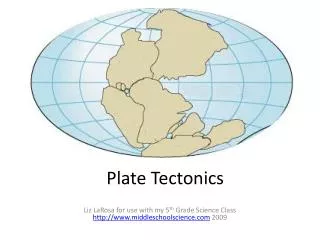
In Chapter 17 of the Plate Tectonics Court Monroe, we explore the pioneering ideas of Alfred Wegener, the father of continental drift. Wegener proposed that continents were once joined together, fitting like puzzle pieces, which is supported by geological landforms and fossil evidence. Despite his groundbreaking theories, Wegener faced skepticism due to a lack of understanding of the forces capable of moving continents. Tragically, he died during an expedition in Greenland, leaving behind a legacy that would later be embraced with the advent of modern plate tectonic theory in the 1960s.

Plate Tectonics
E N D
Presentation Transcript
Plate Tectonics Court Monroe Chapter 17, pages 443 - 463
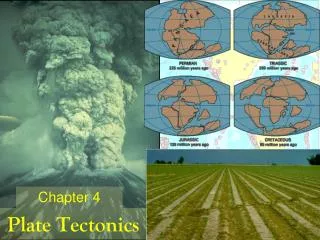
Wegener thought that the continents were once connected. Continents fit into each other Landforms, like mountains Fossils of continents meshed in key areas
Wegener thought that the continents were once connected. Continents fit into each other Landforms, like mountains Fossils of continents meshed in key areas People did not go along with theory, because they could not figure out what force would be strong enough to move a continent. Continents would crack if pushed through ocean Gravity would not make them go “downhill” Spin of the Earth was not fast enough
Wegener thought that the continents were once connected. Continents fit into each other Landforms, like mountains Fossils of continents meshed in key areas People did not go along with theory, because they could not figure out what force would be strong enough to move a continent. Continents would crack if pushed through ocean Gravity would not make them go “downhill” Spin of the Earth was not fast enough Wegener died on expedition to Greenland Probably died by falling into a crevice When digging in Greenland, when you are are deep as you are going to go, one yells “I’ve found Wegener”. Theory widely accepted in early 1960’s
www.ucmp.berkeley.edu/ tectonics/quakecenters.html http://www.classzone.com/books/earth_science/terc/content/visualizations/es0806/es0806page01.cfm?chapter_no=visualization
http://www.wwnorton.com/college/geo/egeo/animations/ch2.htm http://education.sdsc.edu/optiputer/flash/hotSpots.htm
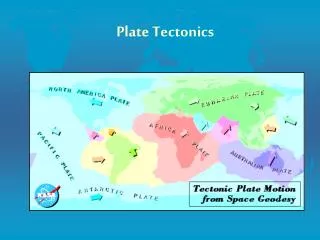
When plates converge, one of three things can happen. A continental plate (granite) can collide with oceanic plate (basalt), and the more dense goes under (subducts).
When plates converge, one of three things can happen. A continental plate (granite) can collide with continental plate (granite), and it crumples (mountains)
When plates converge, one of three things can happen. An oceanic plate (basalt) can collide with an oceanic plate (basalt), and it make an island arc (Japan)
The ocean comes apart at ridges. Most of these are in the middle of oceans. Fig 4.12
We know that the plates come apart here (called Sea Floor Spreading), because of magnetic anomalies. http://www.uwsp.edu/geo/faculty/ritter/glossary/s_u/sea_flr_spread.html
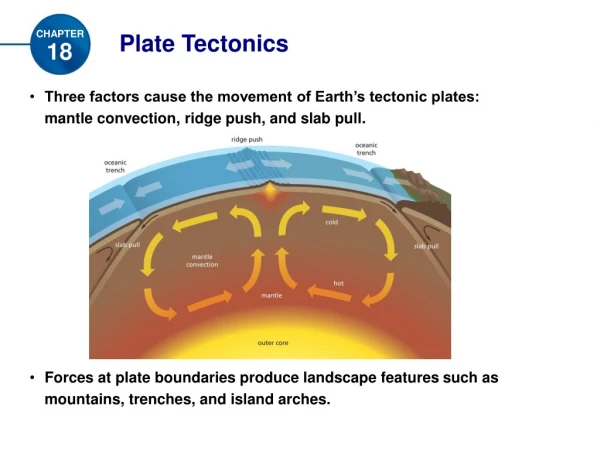
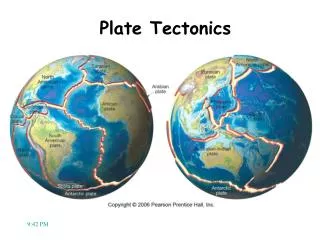
Break it down (Old School Style) Plates come together at PLATE BOUNDARIES CONVERGENT (Where they come together) a. Continent to continent (mountains like Himalayas) b. Ocean to Ocean (Island arcs like Japan, with TRENCH) c. Continent to Ocean (Rockies and Andes, with TRENCH and MOUNTAINS) DIVERGENT (Where they come apart) a. RIDGE (small hump where lava comes up) b. RIFT (where the canyon is between plates) c. SEA FLOOR SPREADING (where Ridges and Rifts are) d. NEWEST (land is born here) TRANSVERSE (Where they slide past each other) a. L.A. and San Francisco b. Crooked sidewalks All of this is energy driven a. Convection currents b. Heat from birth of Earth, gravitational pressure, radioactive decay
http://www.classzone.com/books/earth_science/terc/content/visualizations/es0804/es0804page01.cfm?chapter_no=visualizationhttp://www.classzone.com/books/earth_science/terc/content/visualizations/es0804/es0804page01.cfm?chapter_no=visualization