Decoding Working Memory from Human EEG: Insights from Modified DMS Task
110 likes | 250 Vues
This presentation by Alexander Backus explores the decoding of working memory content using human EEG recordings. Employing a modified delayed match-to-sample (DMS) task, the study investigates the mean EEG activity in the visual cortex and applies nonlinear signal analysis. The assumption is that the state of the dynamical system can be represented by an embedding vector, helping to identify recurrent states through time-delay embedding. The classifier training reveals performance metrics in various frequency bands, offering insights into working memory maintenance and potential applications in brain-computer interfacing.


Decoding Working Memory from Human EEG: Insights from Modified DMS Task
E N D
Presentation Transcript
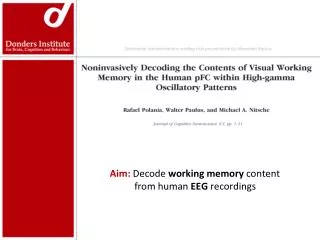
Distributed representations reading club presentation by Alexander Backus Aim: Decode working memory content from human EEG recordings
Methods Modified delayed match-to-sample (DMS) task
Methods Mean EEG activity in visual cortex
Methods • Nonlinear signal analysis • Assumption: State of the dynamical system (e.g. epoch of a given dipole) at any given moment may be represented by an embedding vector, where recurrent states are represented by similar embedding vectors • Bandpassfiltering (different gamma bands) • Construct time-delay embedding vector for each dipole • Detect recurrent states using autocorrelation integral • Construct binary vector that denotes recurrent states • Classifier training on 180/240 trials • Four-fold cross-validation • Stats: Bootstrapestimation(permutation testing); Bonferroni correction
Results Classifier performance in left pFCduring encoding 100-200 Hz 60-100 Hz 30-60 Hz
Results Classifier performance during WM maintenance
Results Cross-frequency analysis Theta-gamma phase-amplitude coupling
Discussion • Synchronous firing in gamma band in pFC during working memory maintenance is stimulus specific • Support for gamma feature-binding hypothesis • Potentially useful for brain-computer interfacing
Thanks for your attention Questions or remarks?