Understanding Diffusion of Innovations: Models and Patterns
Explore cumulative and individual adoption patterns, assumptions, probit models of adoption, and information cascades. Learn about network approaches, social thresholds, and critique of diffusion research.

Understanding Diffusion of Innovations: Models and Patterns
E N D
Presentation Transcript
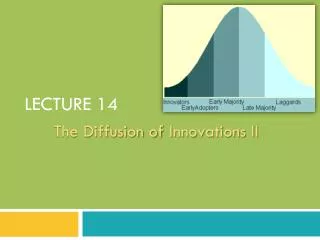
Lecture 14 The Diffusion of Innovations II
Assumptions of Simple Epidemic Models • Homophily • Individuals or groups tend to hang out with others who are similar to them (demographics, attitudes, etc) • N is usually constant • Speed of Diffusion usually constant
Transmission versus Persuasion • The epidemic analogy begins to break down when we do not equate transmission with persuasion. • Persuasion may be influenced by several factors– e.g., risk, ‘trustworthiness’ of persuader.
Accounting for Adoption Decisions • Probit models • Various characteristics (xi) affects the profitability of adoption a new technology Not Adopt Adopt X*
“Relevant Characteristics” • Probit models depend on specifying relevant characteristics which might influence potential adoption. • Potential Relevant Characteristics (Geroski 2000) • Firm Sizeas one of the most common– why? • Suppliers • Technological Expectations • Costs • Learning costs • Search Costs • Switching Costs • Opportunity Costs
Another Possibility: Information Cascades (Geroski) • What about the innovations that do not successfully diffuse? • “Information Cascades” involve the process of early inertia, potential adopter investment, and the adoption ‘bandwagon’ • Three phases: • Initial choice • Lock-in • bandwagon Photo: engadget.com
Rethinking ‘Classic’ Diffusion Models • Taking “the” new technology for granted • S-curves may not just be the starting point of an analysis of diffusion, but rather exist as one possible outcome.
The Network Approach: Valente (1996) • Two Network Approaches: • Relational Network Diffusion • Direct ties among individuals • Opinion Leaders, personal and network density, in-ties versus out-ties • Structural Network Diffusion • Considers the overall pattern in the network • Centrality, Number of “weak” versus “strong” ties Individuals’ contacts adoption behavior Pattern of network individual positions and roles
Relational Networks Relational: How do the direct ties affect adoption? In this case, ties could be “friendship”
Social Network Thresholds • Personal network thresholds (Valente 1996) • The number of members within personal network that must have adopted a given innovation before one will adopt • Accounts for some variation in overall adoption time • Opinion leaders have lower thresholds • Opinion leaders influence individuals with higher thresholds
Structural Network Diffusion • Weak Ties Revisited • Centrality • Structural Equivalence
Critiques of the Network Approach • Other factors may be more important than just the network structure: • Example: Tetracycline diffusion (Coleman, Katz et al. 1966) • Marketing may have been most important factor for explaining adoption. • Rationality of actors is not necessarily expressed– treated as a sort of “black box”
Overall, what does the diffusion of innovation research help us to understand? • Can be used at the micro-level to track individuals who are targeted members for an innovation • Can be used at the meso and macro-level to consider economic development, technological advances, or other processes.
Common Mistakes in Applying Diffusion Research • Treating diffusion only as dissemination or marketing • Confusing influence with status • Inadequate evaluation of the issue in its own context, as well as the surrounding social structure and perceptions of the innovation.
Current Research and Applications • Diffusion of Electronic Newspapers • Li, S. S. (2003). Electronic newspaper and its adopters: Examining the factors influencing the adoption of electronic newspapers in taiwan. Telematics and Informatics, 20(1), 35-49. • Diffusion of Internet Adoption • Forman, C. (2005). The corporate digital divide: Determinants of internet adoption. Management Science, 51(4), 641. • Diffusion of Wireless Applications • Grantham, A., & Tsekouras, G. (2005). Diffusing wireless applications in a mobile world. Technology in Society, 27(1), 85-104.
Assignment #1 • Overall Assessment… • Grading Decoded… • Thinking About Assignment 2… • Finally, no reading response due next week