Understanding Guidance, Discipline, and Behavior Management in Early Childhood Education
This instructor manual outlines key concepts in guiding children's behavior and encouraging personal responsibility. It defines discipline, guidance, and punishment, emphasizing their roles in helping children learn to understand right from wrong. Effective behavior guidance helps children control their actions and become independent and self-reliant individuals. The manual also explores modifying the environment and offers classroom management techniques to create a supportive learning atmosphere. Each lesson serves as a building block towards fostering positive behavior and comprehensive child development.

Understanding Guidance, Discipline, and Behavior Management in Early Childhood Education
E N D
Presentation Transcript
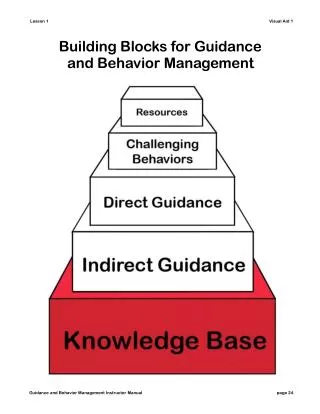
Lesson1 VisualAid1 BuildingBlocksforGuidance andBehaviorManagement GuidanceandBehaviorManagementInstructorManual
Lesson1 VisualAid2 Discipline,GuidanceandPunishmentDefinitions Discipline– Everything used to help children learn personal responsibility. Children ultimately learn to understand right and wrong for themselves (Fields, Perry & Fields, 2010). Behavior Guidance– is a process when all children learn to control and direct their behavior. Through the process children become independent and self-reliant (Morrison, 2011). Punishment– is a method that usually involves corporal punishment, shaming, scolding or withholding food. Punishment can be both physical and/or emotional (Hearron & Hilbebrand, 2009). GuidanceandBehaviorManagementInstructorManual
Lesson1 VisualAid3 ChildDevelopment: AllAreasArePartoftheWholeChild GuidanceandBehaviorManagementInstructorManual
Lesson2 VisualAid1 BuildingBlocksforGuidance andBehaviorManagement GuidanceandBehaviorManagementInstructorManual page56
Lesson2 VisualAid2 ModifyingtheEnvironment ADDING Add activities/material. Broaden areas. LIMITING Reduce options. Restrict space. CHANGING Reorganize items. Simplify things. GuidanceandBehaviorManagementInstructorManual
Lesson2 VisualAid3 ClassroomManagement Techniques GuidanceandBehaviorManagementInstructorManual
Lesson2 VisualAid8 DressedforSuccess GuidanceandBehaviorManagementInstructorManual
Lesson3 VisualAid1 BuildingBlocks forGuidanceandBehaviorManagement GuidanceandBehaviorManagementInstructorManual page82
Lesson4 VisualAid1 Building Blocks for Guidance and Behavior Management GuidanceandBehaviorManagementInstructorManual page112
Lesson4 VisualAid2 WHYDOCHILDREN MISBEHAVE? GuidanceandBehaviorManagementInstructorManual
Lesson5 VisualAid1 BuildingBlocks forGuidanceandBehaviorManagement GuidanceandBehaviorManagementInstructorManual page133