Download
1 / 34
340 likes | 483 Vues
This summary of the UIUC ATLAS TileCal Project covers the collaborative efforts in experimental particle physics as part of the larger ATLAS project at CERN. Key topics include background on the ATLAS Project, UIUC's role in sub-module fabrication and photomultiplier tube (PMT) testing, and the significance of hadron detection methods. The document outlines the technological developments in the glue machine and dark box modifications aimed at enhancing PMT testing efficiency, outlining the project's contributions to the upcoming Large Hadron Collider data collection.

E N D
The UIUC ATLAS TileCal Project Project Head - Dr. Steven Errede Niall Nethercote UIUC High Energy Physics Summer 1998
Contents • Background on Experimental Particle Physics • The World-Wide ATLAS Project • The UIUC ATLAS TileCal Project • Sub-Module Fabrication • Photomultiplier Tube (PMT) Testing • Our Web Site
Topic 1 Experimental Particle Physics
Particle Accelerating Facility • Accelerating Ring • Detector
How is a Particle Detected? • Accelerate some matter (e.g. the quarks of protons) • Collide the quarks (and get a mess of gluons) • Interesting particles may form (e.g. top quark) • Detect the residual particles (e.g. w/ a PMT)
Topic 2 The World-Wide ATLAS Project
CERN • CERN is the European Laboratory for Particle Physics • CERN is located in both France and Switzerland • It is very near Geneva, Switzerland
The LHC Project • Large Hadron Collider (LHC) Ring • Compact Muon Solenoid (CMS) Detector • AToroidal LHC Apparatus (ATLAS) Detector • CERN is upgrading in three major ways
The ATLAS Project • 144 institutes world-wide are collaborating on the ATLAS project • ATLAS is 5 stories tall! • ATLAS will detect proton-proton collisions • Its center of mass energy is 14 TeV! • ATLAS will start taking data in 2005
Topic 3 The UIUC ATLAS TileCal Project
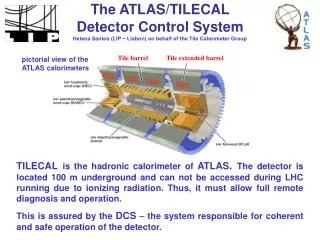
UIUC and ATLAS • What part of ATLAS does the UIUC group work with? • The Scintillating Tile Hadron Calorimeter (pictured green) • Sub-modules are made of alternating layers of steel and scintillating tile (shown in next slide) • Groups of sub-modules are modules • Groups of modules form the Hadron Calorimeter
What Does the UIUC Group Do? • The UIUC ATLAS project is two-folded • Sub-Module Fabrication • Photomultiplier Tube (PMT) Testing
Hadron Detection • How are hadrons detected with sub-modules and PMTs? • Hadron flies through scintillating tile and photons are released • Fiber optics route some photons to a PMT • Photons hit PMT and convert to photoelectrons (via photoelectric effect) • Electrons are multiplied inside PMT and a detectable signal results
Sub-Module Fabrication • UIUC’s sub-module assignment • Glue machine • Prototype sub-module production
The Sub-Module Assignment • UIUC is responsible for producing 200 extended barrel sub-modules • In the extended barrel 9 sub-modules make up a module (and also recall that there are 64 modules circling around the beam axis) • So when you do the math it turns out that we are making about 1/3 of an extended barrel
Glue Machine • The glue machine will be used to apply very precise amounts of glue to the sub-modules • It is currently being constructed and will be ready for early 1999 when we begin to make some more sub-modules • Dr. Errede and Fred Cogswell (our machinist) have put the most work into the glue machine
Sub-Module Prototype Production • During the Winter of 1996-1997 we constructed some prototype sub-modules
Photomultiplier Tube (PMT) Testing • General • UIUC’s PMT testing assignment • Our PMT testing setup • The work that we did this summer • Dark Box modification • PMT Aging experiments
The PMT Testing Assignment • When ATLAS begins data taking it will be using approximately 10,000 PMTs! • Here at UIUC it is our job to test over 3,000 of those PMTs (i.e. about 1/3 of ATLAS’s PMTs)
Our Laboratory • Here is a shot of Dr. Errede’s Laboratory • Note the crates and the dark box
Our Dark Box • Here the crates are on the left, the dark box is on the right, and that’s Jori walking into the lab • The mess of wires that run in and out of the dark box • The dry nitrogen system can also be seen
Inside the Dark Box • This is our PMT testing layout that is housed in the dark box
Dark Box Modification • Our group needs to prepare for the testing of the over 3,000 PMTs • The biggest task is modifying the dark box so that it can test 30-40 PMTs at one time • The dark box modification projects are: • Adjusting the layout of the dark box • Stepper Motor • Filter Wheel • Increasing the amount of light to the Photodiode • Faster Transistor for the Pulsing Circuit • Charge Cable • Optics
The Stepper Motor • The stepper motor will be used to move components around inside the dark box • Before this summer Jori Ruppert-Felsot worked with the stepper motor • Then when the summer began John Patti and Mike Griswold finished up the task
The Filter Wheel • The filter wheel will be used to vary the intensity of the light goes to the PMT • The stepper motor will rotate the filter wheel
The Photodiode Needs More Light • Three different attempts at supplying the Photodiode with more light have been attempted this summer • Mainly Jori Ruppert-Felsot, Dan Dombeck, and I have been working on this • For the most part all attempts have been unsuccessful • Using a faster transistor or a circuit that incorporates two transistors • Hooking a charge cable up to the LED • Setting up an optics system that can focus light onto the Photodiode
PMT Aging Experiment • About one month ago we received a new 4th generation PMT (8C28R3) from CERN • We proceeded to test its aging characteristics • The new PMT was pulsed at a number of different frequencies for one week • The tests on this PMT ran for time intervals of approximately 24 hours • During our testing, the PMT experienced an equivalent of 50 years of running at ATLAS • Important Quantities: Npe and the Gain
Conclusions and Then Continuation • We concluded that the gain of the new 4th generation PMT actually increased slowly while it was being pulsed for 50 equivalent years • This is rather odd. The PMT’s performance is seemingly improving as it ages?! • Possible explanation: charge may be collecting on the walls of the PMT, thus creating an electric field that focuses the e- • We then proceeded to perform more aging experiments on older 3rd generation PMTs that we had available in our lab
Topic 4 The UIUC ATLAS TileCal Web Site
A New Look • During the middle of the summer I completely revamped our ATLAS Web Site • The URL for our Site is:http://web.hep.uiuc.edu/atlas/ • But lets first check out what the Old Site looked like
Thank You’s • I would like to thank the following people for teaching me so much this summer: • Jori Ruppert-Felsot • John Patti • Mike Griswold • Daniel Dombeck • And especially: • Dr. Steven Errede
The Musings of John Patti • This was John’s reaction when I told him how much work I was going to put into my presentation