Minimal Spanning Tree
This document explores the concept of minimal spanning trees (MST) in undirected graphs, focusing on Prim's Algorithm. A minimal spanning tree connects all vertices with the least total edge weight possible. We describe how to implement Prim's Algorithm, which is similar to Dijkstra's Algorithm, by starting from an initial vertex and iteratively adding the minimal edge until all vertices are connected. The efficiency of the algorithm depends on its implementation, particularly the use of priority queues. We also discuss the minimal properties that ensure the algorithm leads to a valid MST.

Minimal Spanning Tree
E N D
Presentation Transcript
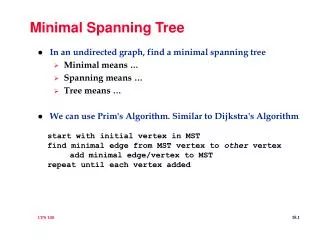
Minimal Spanning Tree • In an undirected graph, find a minimal spanning tree • Minimal means … • Spanning means … • Tree means … • We can use Prim's Algorithm. Similar to Dijkstra's Algorithm start with initial vertex in MST find minimal edge from MST vertex to other vertex add minimal edge/vertex to MST repeat until each vertex added
Prim's Algorithm • How do we know this algorithm works? • Suppose not, some graph for which algorithm yields non minimal spanning tree, is it not a tree? Not spanning? … • Assume we have such a graph, call it G, now we reason … • Will lead to contradiction (exploit minimal property) • How efficient is Prim's Algorithm? • Depends on implementation, look at Dijkstra and modify • What did Dijkstra's algorithm do? Problem solved?
Implementation, priority queue • Keep track of shortest distance from MST vertices to others, use chosen start vertex • Initially all are infinity except start is 0 from itself • Choose minimal edge between MST vertices and others • This is same as choosing minimal element in PQ • When choosing, modify distances by adding elements to PQ appropriately • When distance < current best modify current best (add new element to PQ) • How is this different from Dijkstra's algorithm? • How do we construct path?