Understanding Atoms and Isotopes: Calculations of Atomic Mass and the Mole Concept
This resource dives into fundamental concepts related to atomic structure, focusing on neutral atoms, isotopes, and their nuclear notations. It provides a comprehensive explanation of relative atomic mass, the significance of carbon-12 as a standard, and calculations for average atomic mass using isotopes. The concept of the mole, Avogadro's number, and molar mass are also explored, along with practical conversion factors for grams, moles, and atoms. This guide is essential for students seeking to understand the foundations of chemistry related to atomic composition.

Understanding Atoms and Isotopes: Calculations of Atomic Mass and the Mole Concept
E N D
Presentation Transcript
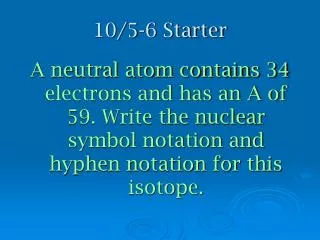
10/5-6 Starter A neutral atom contains 34 electrons and has an A of 59. Write the nuclear symbol notation and hyphen notation for this isotope.
Ch. 3 Atoms 3.3 Counting Atoms
Relative Atomic Mass • since masses of atoms are so small, it is more convenient to use relative atomic masses instead of real masses • to set up a scale, we have to pick one atom to be the standard • since 1961, the carbon-12 nuclide is the standard and is assigned a mass of exactly 12 amu
Relative Atomic Mass • atomic mass unit (amu)- one is exactly 1/12th of the mass of a carbon-12 atom • mass of proton= 1.007276 amu • mass of neutron= 1.008665 amu • mass of electron= 0.0005486 amu
Relative Atomic Mass • the mass number (A) and the relative atomic mass are very close but not the same because • relative atomic mass includes electrons • the proton and neutron masses aren’t exactly 1 amu
Average Atomic Mass • weighted relative atomic masses of the isotopes of each element • each isotope has a known natural occurrence (percentage of that elements’ atoms)
Calculating Average Atomic Mass • Naturally occurring copper consists of: • 69.71% copper-63 (62.929598 amu) • 30.83% copper-65 (64.927793 amu) (0.6971 x 62.929598)+(0.3083 x 64.927793) =63.55 amu
Calculating Average Atomic Mass • An element has three main isotopes with the following percent occurances: • #1: 19.99244 amu, 90.51% • #2: 20.99395 amu, 0.27% • #3: 21.99138 amu, 9.22% • Find the average atomic mass and determine the element.
The mole • a unit for measuring a very large amount- like number of atoms or molecules in a sample • like one dozen (1 dozen = 12 things) • except bigger: 1 mole = 6.022x10²³ things • Why 6.022x10²³ ? • 6.022x10²³ is the number of atoms in exactly 12 g of carbon-12
The mole • 6.022x10²³ is called Avogadro’s Number in honor of all of his contributions to chemistry • can be used as a conversion factor between a number of things and mole
Molar Mass • the mass of one mole of pure substance in grams per mole • numerically equal to average atomic mass • under the symbol on the periodic table • can be used as a conversion factor between moles and grams
Conversion Factors # Atoms Grams Moles Use Molar Mass: grams per mole Use Avog.’s Number: atoms per mole
C = 12 x 6 = 72 • H = 1 x 12 = 12 • O = 16 x 6 = 96 • 180 g/mol
Gram Moles • use molar mass • Ex. 32.3 g Na = ? mol Na • Ex. 0.56 mol Fe = ? g Fe
# Atoms Moles • use Avogadro’s Number • Ex: 1.40 mol Na = ? Na atoms • Ex: 3.4x10²³ atoms Fe = ? mol Fe
Grams # Atoms • use both: Avogadro’s # and molar mass • Ex: 0.0326 g N = ? atoms of N • Ex: 2.01x1041 atoms of H = ? g H
Mass Atom Conversion Practice • How many grams are in 1.50 X 10 23 atoms of Na? • How many grams are in 6.02 X 10 23 atoms of Oxygen? • How many atoms are in 35 grams of Lithium? • How many atoms are in 24 grams of C?
Mass Atom Conversion Practice • 5.73 g Na • 15.99 g O • 3.05 x 10 24 atoms Li • 1.20 x 10 24 atoms C