Understanding Acids, Bases, and the pH Scale for Grades 9 and 10 Science
Dive into the world of acids and bases with this comprehensive guide designed for Grade 9 and 10 science students. Learn about the characteristics of acids, such as hydrogen ion formation, and explore various examples including hydrochloric, sulfuric, and carbonic acids. Discover bases and their properties, including hydroxide ion formation with compounds like sodium and magnesium hydroxide. Uncover the pH scale's significance in indicating acidity and basicity through litmus paper tests. This essential knowledge is crucial for understanding chemical reactions and solutions.

Understanding Acids, Bases, and the pH Scale for Grades 9 and 10 Science
E N D
Presentation Transcript
Acids, Bases and the pH Scale Grade 9 and 10 Science Mr.MacMillan
Acids • Compounds that produce hydrogen ions, H+, when dissolved in water. • HCL H+ + Cl- • Hydrochloric acid is formed when hydrogen chloride gas is added to water.
Naming Acids • Binary Acids • Composed of hydrogen and a non-metal • HF – hydrofluoric acid • HBr – hydrobromic acid • HI – hydroiodic acid
Oxoacids • Composed of hydrogen, oxygen and another element • H2 SO4 – sulfuric acid • HNO3 - nitric acid • H3 PO4 – phosphoric acid • H2 CO3 – carbonic acid
Bases • Compounds that form hydroxide ions, OH- , when dissolved in water • NaOH Na+ + OH-
Naming Bases • NaOH – Sodium hydroxide • Mg(OH)2 – Magnesium hydroxide • Ca(OH)2 - Calcium hydroxide
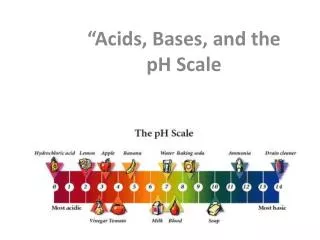
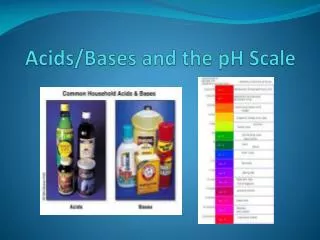
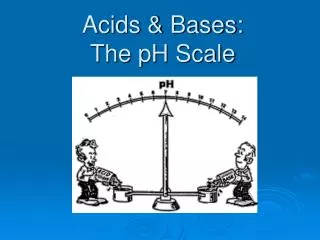
The pH Scale • pH Taste Test
Litmus Paper • A pH indicator that changes colour to show the concentration of hydrogen ions and hydroxide ions in a solution
Blue litmus paper turns red in an acidic solution • Red litmus paper turns blue in a basic solution • Neutral – no colour change