Pronunciation Course
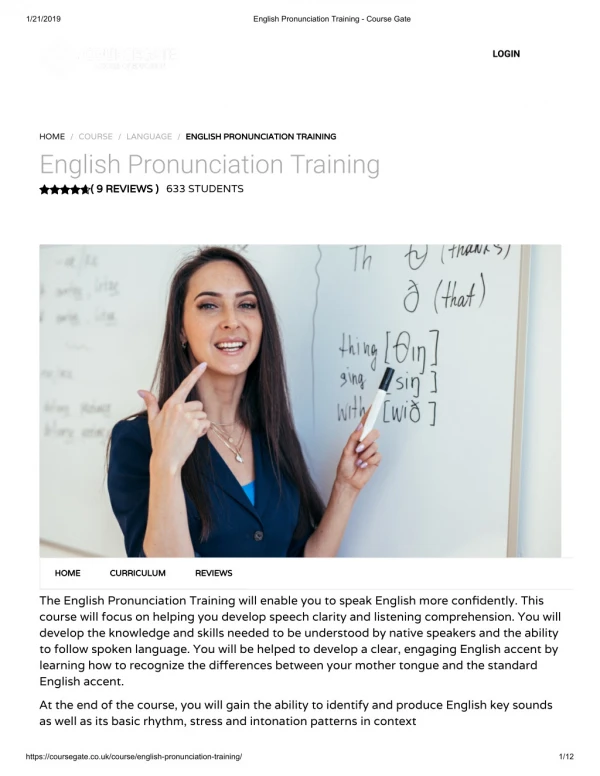
This pronunciation course focuses on the nuances of the /s/ and /z/ sounds in English, particularly for Brazilian speakers. It addresses common mistakes, such as the mispronunciation of plural forms and third-person possessives, due to differences in phonemic rules between Portuguese and English. Through engaging exercises, including audio examples from the movie "Marley and Me," learners will refine their pronunciation skills. The course also covers consonant clusters and the challenges of -ed endings, helping students achieve clearer and more accurate speech.

Pronunciation Course
E N D
Presentation Transcript
Pronunciation Course Class #7
Movie Marley and Me
/s/ and /z/ depending on part of speech /s/ and /z/ sounds The “s” letter can be pronounced with 3 different sounds: /s/ /z/ and /z/ Noun/Adjective Verb /s/ /z/ a use to use
A typical Brazilian mistake In English, if a word ends in an / s / sound, this sound will always be the same. Brazilian speakers tend to mispronounce this phoneme because, in Portuguese, the /s/ phoneme can change to /z/ depending upon the next phoneme: e.g. “pois é, pois não. mas eu, mas você” /s/ YES Yes, I do. Yes, he does. /z/ HIS It’s his car. It’s his umbrella.
/ / in the initial position Brazilian speakers also have a problem when the / s / phoneme is in an initial position. Because we don’t have this phonemic combination in our language, we tend to add an extra vowel sound when pronouncing words starting with an / s /.
Listening exercise – p.60 Wife’s (/s/) legs (/z/) sister’s (/z/) Those(/z/) places (/Iz/) gets (/s/) Pedicures(/z/) separators(/z/) That’s (/s/) looks (/s/) Colors(/z/) tips(/s/) Face (/s/) goes (/z/) Is(/z/) eyes (/z/) Stops(/s/) marks(/s/) Close (/z/)
Consonant Clusters In English, many words end with a consonant cluster. Observe: Ct pt ft nd Fact adapt gift send
When adding an –s to a consonant cluster… • Simplify! There is a tendency of simplifying the clusters /kt/, /pt/ or /ft/ and /nd/) by dropping the last sound before –s. Eg. Facts adapts gifts sends /fQks/ /adEps/ /gIfs/ /senz/
-ed Endings • -ed Endings are often very difficult for Brazilians because sounds don’t change based upon the previous sound. • There are three –ed ending sounds • /t/ • /d/ • /Id/