Exploring the Six Kingdoms of Life: Diversity and Characteristics
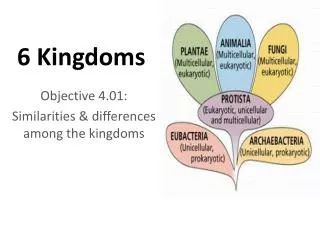
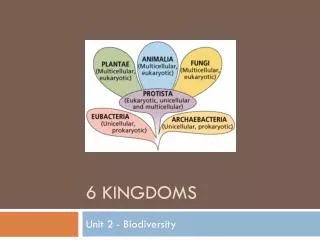
This article delves into the six kingdoms of life, highlighting the distinctive features of each. The Animal Kingdom comprises multicellular, motile, heterotrophic organisms, while the Plant Kingdom is characterized by cellulose-based cell walls and autotrophic characteristics. Eubacteria and Archaebacteria represent the prokaryotic kingdoms with unique properties. The Protista Kingdom consists of mostly unicellular, diverse organisms, and Fungi is noted for immobile, chitinous cell-walled structures. Understanding these kingdoms illustrates the vast biological diversity on our planet.


Exploring the Six Kingdoms of Life: Diversity and Characteristics
E N D
Presentation Transcript
The 6 Kingdoms By Madison Russell
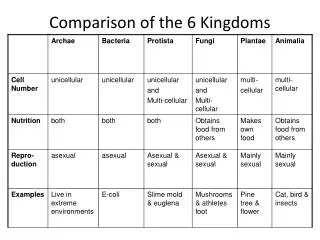
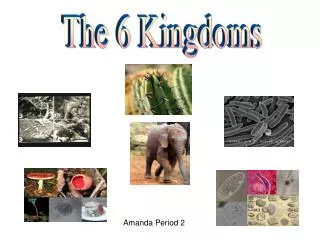
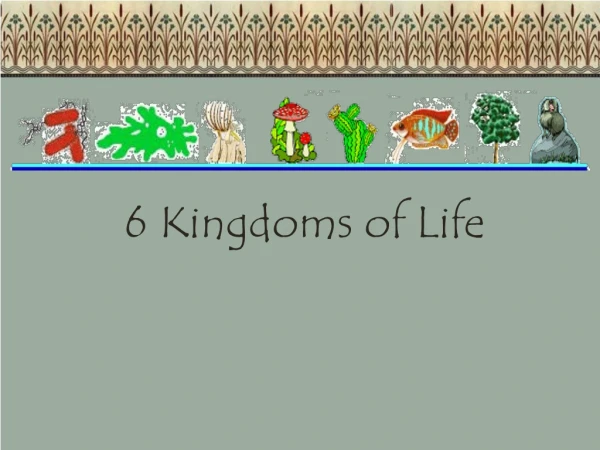
Animal Kingdom • All organisms must be eukaryotic. • Multicellular • Heterotrophs • All motile except coral • Lack cell walls • Heterotrophic through ingestion • Separated into categories: omnivore, herbivore, carnivore, and parasite • Oldest animal fossil is 665 million years old
Plant Kingdom • Cell walls with cellulose • Multicellular • Reproduce asexually • Eukaryotic • autotrophic • 85-90% are flowering plants • 300-315 thousand species • Green plants provide most of the world’s oxygen
Eubacteria • Single-celled • Prokaryotic • Microscopic • Enclosed by a cell wall • Reproduce asexually • Reproduce quickly • Can be good or bad • Impressive range of biological diversity
Protista Kingdom • Eukaryotic • Mostly unicellular • Organisms that don’t fit into any other kingdom • Some are multicellular with no specialized tissues • Live in environment with liquid water • Term first used in 1866 by Ernst Haeckel • Many are vital primary producers in ecosystems • Taxonomy of Protists is still changing
Fungi • Eukaryotic • Cell walls contain chitin • Heterotrophic • Immobile • Lack chloroplasts • Mushrooms are a type of fungus • The term fungus comes directly from the Latin term fungus which means mushroom • Mycology is the study of Fungi
Archaebacteria • Single-celled • Prokaryotic • Cell membrane contains pseudomurein • Flagellin protein structure • No peptidoglycan • Classification of archae is very controversial • First classified as a separate group in 1977 • Many live in hot springs and other extreme temperatures