Overview of the Six Kingdoms: Prokaryotes to Eukaryotes in Life’s Domains
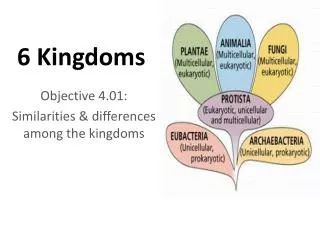
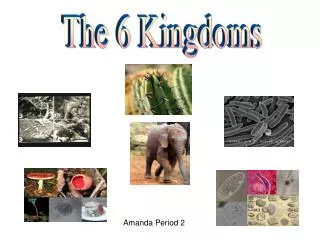
This guide explores the six kingdoms of life divided into two primary domains: Prokaryotes and Eukaryotes. Prokaryotic kingdoms include Eubacteria and Archaebacteria, characterized by unicellular organisms without membrane-bound organelles. Eukaryotic kingdoms consist of Protists, Plantae, Fungi, and Animalia, which have complex cell structures, multicellular organizations, and various nutritional methods. Each kingdom's unique reproductive strategies and environments are also discussed, providing a comprehensive overview of biological classification.

Overview of the Six Kingdoms: Prokaryotes to Eukaryotes in Life’s Domains
E N D
Presentation Transcript
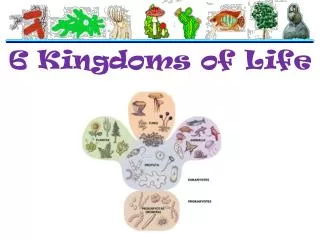
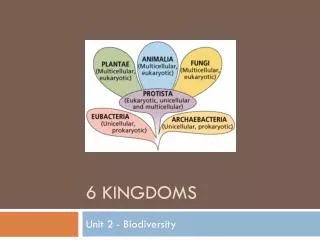
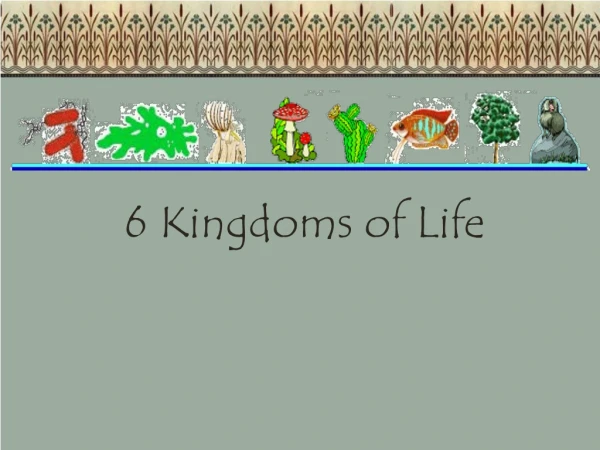
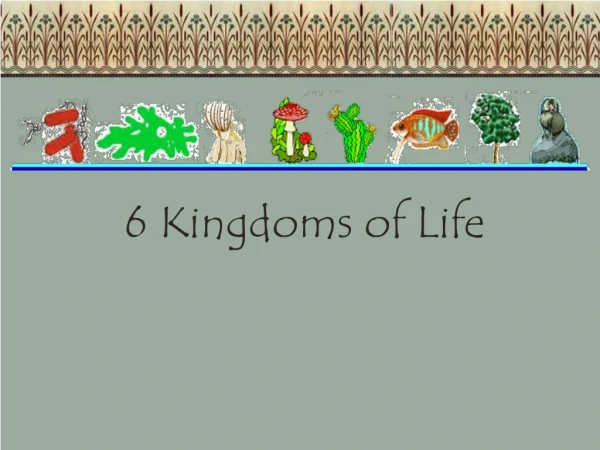
Two Domains ProkaryaEukarya EubacteriaProtista ArchaebacteriaPlantae Fungi Animalia
Eubacteria • Cell Type – Prokaryote • Cell structures – No membrane bound organelles only cytoplasm, membrane, cell wall, ribosomes, cell wall contains peptidoglycan • Organization – Unicellular • Nutrition – absorb or photo-/chemio- synthesis • Reproduction – binary fission, form spores with ability to remain dormant for long periods • Environment – ubiquitous: soil, water, other organisms --pathogenic • Examples – salmonella, tetnus, E. coli
Archaeabacteria • Cell Type – Prokaryote • Cell structures – No membrane bound organelles only cytoplasm, membrane, cell wall, ribosomes, cell wall lacks peptidoglycan • Organization – Unicellular • Nutrition – absorb or photo-/chemio- synthesis • Reproduction – binary fission, do not form spores • Environment – extreme conditions heat, salt, pressure, anaerobic -- non pathogenic Examples – Thermoproteus, Halococcus
Protists • Cell Type – Eukaryote • Cell structures – Nucleus, mitochondria, ribosome, etc • Organization – Unicellular (some multi but not specialized into tissues) • Nutrition – absorb, ingest or photosynthesis • Reproduction – asexual, sexual • Environment – aquatic (marine or fresh) • Examples – amoeba, Euglena, Paramecium
Plants • Cell Type – Eukaryote • Cell structures – Cell wall of cellulose, chloroplasts, nucleus, mitochondria, ribosome, etc • Organization – Multicellular • Nutrition –photosynthesis • Reproduction – asexual, sexual • Environment – terrestrial • Examples – dandelion, blue spruce tree
Fungi • Cell Type – Eukaryote • Cell structures – Cell wall (contains chitin) nucleus, mitochondria, ribosome, etc • Organization – Multicellular often multi nucleate, • Nutrition – absorb – extra cellular digestion, decomposer • Reproduction – asexual, sexual • Environment – terrestrial (trees), aquatic, on plants and animals • Examples – mushroom, mold, yeast
Animalia • Cell Type – Eukaryote • Cell structures – Nucleus, mitochondria, ribosome, etc • Organization – Multicellular • Nutrition – ingest • Reproduction – asexual, sexual • Environment – terrestrial, aquatic, soil • Examples – sponge, starfish, butterfly, human