Exploring Seed Germination: A Scientific Method Example
Understand the scientific method through an experiment on seed germination. Follow steps from observation to conclusion to learn how hypotheses are tested. Explore the effect of light on seed germination.

Exploring Seed Germination: A Scientific Method Example
E N D
Presentation Transcript
Science: • Is a particular way to investigate the world, a systematic attempt to understand the universe
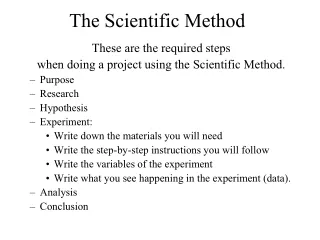
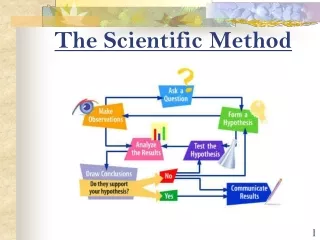
Observation • The fundamental activity in science. • Formulate a problem • Ask a question: why? how? • Example:“The Effect of Light on SeedGermination”.
Make observations • Suppose you noticed that corn seeds left on the surface of soil fail to germinate as readily as those buried in the soil.
Hypothesis • A proposal that might be true • Light at the surface might be preventing the germination of the seeds.
Prediction • Make a prediction based on the hypothesis. • If corn seeds are exposed to light, then they will not germinate as well as seeds placed in the dark.
Conduct an Experiment • Test prediction. • Design an experiment.
Assemble Two Sets • Experimental setup • Control
Assemble Two Sets • Obtain 20 corn seeds; soak all seeds in water for 1 hour only. • Divide the seeds into 2 groups of 10. • Wet 2 paper towels. • Place one wet, folded paper towel into each of 2 Ziploc bags. • Place 10 seeds on top of the paper towel and seal the bags.
Experimental Setup • The setup to which the variable is applied • Variable: that setup that is intentionally altered in an experiment. • This setup is the bag you place exposed to light for one week.
Control • The setup in an experiment in which conditions are not altered. • The control is the bag you place in a location where is not exposed to light of any sort for one week.
Results • Analyze and interpret results in light of the original hypothesis. • After one week, count and record the number of germinating seeds in each set.
Reach Conclusion • Accept hypothesis OR • Reject hypothesis and propose new one. • Based on your results, does light prevent the germination of the seeds?
Theory • A hypothesis supported by great deal of evidence
Review • The fundamental activity in science. ?? • That setup in an experiment in which conditions are not altered. It allows a standard of comparison for the experimental group. • A possible answer to a scientific question. • A procedure designed to test a hypothesis.
Question 1 • The experimental setup in an experiment: • A. makes the experiment valid. • B. is an additional replicate for statistical purposes. • C. reduces the experimental errors. • D. the setup to which the variable is applied. • E. allows a standard of comparison for the experimental group.
Question 2 • What should we propose and test in order to arrive a solution to a problem? • A. laws. • B. theory. • C. hypothesis. • D. facts. • E. principles.
Answers Question 1: D. the setup to which the variable is applied. Question 2: C. hypothesis.