Understanding Atomic Particles, Nuclear Reactions, and Energy Sources
100 likes | 252 Vues
This resource provides a detailed overview of atomic particles, including their charge and mass, highlighting the electron, proton, and neutron. It covers essential concepts in nuclear energy, including the nucleus, radioactivity, and key experiments such as Rutherford's. The document explores nuclear fission, chain reactions, and the role of control rods, as well as the impact of materials like plutonium in fission bombs. Additionally, it delves into reactor types, waste types, and the principles underlying nuclear fusion.


Understanding Atomic Particles, Nuclear Reactions, and Energy Sources
E N D
Presentation Transcript
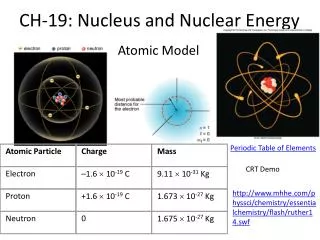
Atomic Particle Charge Mass Electron –1.6 10-19 C 9.11 10-31 Kg Proton +1.6 10-19 C 1.673 10-27 Kg Neutron 0 1.675 10-27 Kg CH-19: Nucleus and Nuclear Energy Atomic Model Periodic Table of Elements CRT Demo http://www.mhhe.com/physsci/chemistry/essentialchemistry/flash/ruther14.swf
Nuclear Fission Neutral neutron is ideal for splitting nucleus. http://en.wikipedia.org/wiki/Uranium-235 http://www.wolframalpha.com/input/?i=krypton+91 http://www.wolframalpha.com/input/
Chain Reaction Control rods are used to regulate nuclear chain reaction.
Useful Websites http://www.world-nuclear.org/info/inf32.html http://www.duke-energy.com/about-energy/generating-electricity/nuclear.asp http://www.scientificamerican.com/article.cfm?id=how-to-cool-a-nuclear-reactor http://library.thinkquest.org/17940/texts/nuclear_waste_types/nuclear_waste_types.html http://www-formal.stanford.edu/pub/jmc/progress/nuclear-faq.html
Boiling water reactor Pressurized water reactor http://www.euronuclear.org/info/encyclopedia/boilingwaterreactor.htm http://www.euronuclear.org/info/encyclopedia/p/pressurized-water-reactor.htm