Understanding Geographic Datums: Foundations of Spatial Coordinate Systems
Geographic datums define the size, shape, and orientation of Earth, providing a crucial reference for coordinates to hold meaning. Originating from specific ellipsoid models, such as Clarke 1866 and the Geodetic Reference System of 1980 for NAD83, datums shape survey networks vital for accurate measurements. However, while abstract datums can seem error-free, applying them to real-world situations introduces potential inaccuracies. This overview explores the significance of datums in geographic coordinate systems, and their role in spatial data representation.

Understanding Geographic Datums: Foundations of Spatial Coordinate Systems
E N D
Presentation Transcript
Datum • Defines the size, shape, and orientation of Earth • Provides.. • Origin: starting place that allows coordinates to be meaningful • Clearly defined surface that the coordinate system is applied to. • No datum = playing checkers without a checkerboard • Defined by an ellipsoid model
X Ellipsoid Models • Provide a reference for the datum and contribute to thedatum’s definition • Requires survey • measurements to define the shape ofthe earth • Clarke 1866 Ellipsoidbecame the standardreference model forNAD27 • Geodetic ReferenceSystem of 1980 is thefigure for NAD83
Datum Realization • Creation of the physical network ofreference points on Earth • NGS established network of bronzedisks
Datum Error • Errorless in abstract(when not connected to reality) • no distortion • every point has a unique and accurate coordinate • Error introduced when applied to reality • cannot measure perfectly from origin • ambiguity of finding center of objects
NAD83 • Improved based on survey accuracy advances • GPS • Remote Sensing
Coordinate Systems • Where are we? • 8800 Grossmont College Drive, El Cajon, CA 92020 • Building 30, Room 252 • 32° 49’ 00.7”N Latitude 117° 00’ 27”W Longitude • UTM, Zone 11, 0499297 Easting 3630983 Northing
Coordinate Systems • Cartesian Coordinates • Rene Descartes (latin: RenatusCartesius) • first used graphs to plot/analyze math functions • setup rules for 2-D coordinate system • Basis for UTM system, State Plane • Geographic Grid • Spherical Grid System (illustrations)
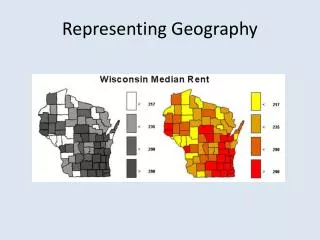
Data Representation • All spatial data converted to digital form is represented as… • Points • Lines • Areas (polygons) • Discrete Objectsvs Continuous Fields



![Geog 176B Lecture 2: Representing Geography [Text: Ch. 3]](https://cdn2.slideserve.com/4142527/geog-176b-lecture-2-representing-geography-text-ch-3-dt.jpg)