Humidity Controlled Oven Capstone Team 2012
160 likes | 280 Vues
The Boeing Capstone Team developed a retrofit-able sealant oven to precisely control humidity and temperature, improving efficiency in curing processes. The oven targets a relative humidity of 50% and temperature of 130°F, addressing limitations of existing methods. The design incorporates an ultrasonic humidifier for fine mist application, ensuring optimal performance and longevity (5+ years). This project evaluates various methods, including atomizing water and steam injection, to balance cost, complexity, and efficiency. Final design solutions are documented, showcasing advancements in manufacturing processes.


Humidity Controlled Oven Capstone Team 2012
E N D
Presentation Transcript
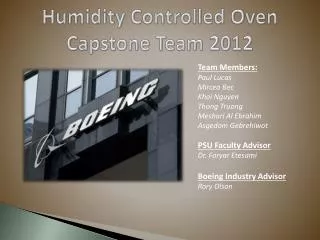
Humidity Controlled OvenCapstone Team 2012 Team Members: Paul Lucas MirceaBec Khoi Nguyen Thong Truong Meshari Al Ebrahim AsgedomGebrehiwot PSU Faculty Advisor Dr. FaryarEtesami Boeing Industry Advisor Rory Olson
Outline • Project Background • Mission Statement • Basic Requirements • Temperature Vs. RH Plot • External Search • Design Evaluation • Humidifier Sizing • Parts Illustration • Final Design • Conclusion • Questions
Project Background • Objective: • Produce a retrofit-able sealant oven capable of controlling humidity and temperature that allows for more efficient flow control • Current Methods: • Large size - Inefficient flow control • Anchored to floor - Costly to move
Mission Statement • The Boeing Capstone Team will design an efficient curing oven that can embrace the advantages of each of the current sealing methods known as “lean” and “traditional”. The goal is to control the humidity and temperature to a certain level that allows for a better flow control. The final design will be prototyped and documented, with all of its performance characteristics quantified.
Basic Requirements • Humidity: RH 50 ± 5% • Temperature: 130 ± 5 o F • Water tank must be un-plumbed and less than 35 lb in weight. • Power source must be 120v AC at 60Hz. • The oven must be lasted for at least 5 years
External Search Atomizing Water Method: • Advantages • Inexpensive • Suitable for lower temperature and lower humidity • Disadvantages • Droplet/Moisture formation • Temperature change
External Search Cont. Steam Injection Method: • Advantages • Higher RH (100%) • Dry process • No temperature change • Disadvantages • Delay initial steam supply • More complex design • Expensive (steam generator) • Mass flow rate from 4 lbm/hr to 60 lbm/hr
External Search Cont. • Stulz-Ultrasonic Humidifier: (Current Design) • Advantages: • Very fine mist: 1micro average diameter • Small Size (10.71” x 8.27’’) • Long service life • Mass flow-rate from 2 to 4 lbm/hr
Design Evaluation • Concept Scoring Matrix
Humidifier Sizing State 1: (Room condition) • P1,a = 101.33 kPa • T1 = 25oC = 278.15 K • RH = 65% • P*Air (25oC) = 3.17 kPa • V = 36 ft3 = 1.02 m3 State 2: (Required condition) • Poven = ? • T2 = 57oC = 330.15 K • RH = 50% • P*Air (57oC)=17.85 kPa • V = 36 ft3 = 1.02m3 Poven = 157.5 kPa
Humidifier Sizing Cont… Ultrasonic Humidifier condition • T = 100oC • P = 160 kPa • Inlet area = 0.0041 m2 • Assume Vvapor= 0.03 m/s Mass flow rate: 1.46 lbm/hr
Final Design Ultrasonic Humidifier was mounted to the oven
Conclusion Project Requirement Achieved: • Performance • Life in Service • Ergonomics