

SlideServe
Menu
Préférences
© SlideServe · v2026

Population Theories

dimaia avatar
13 diapositives · 396 Views · Jul 20, 2014

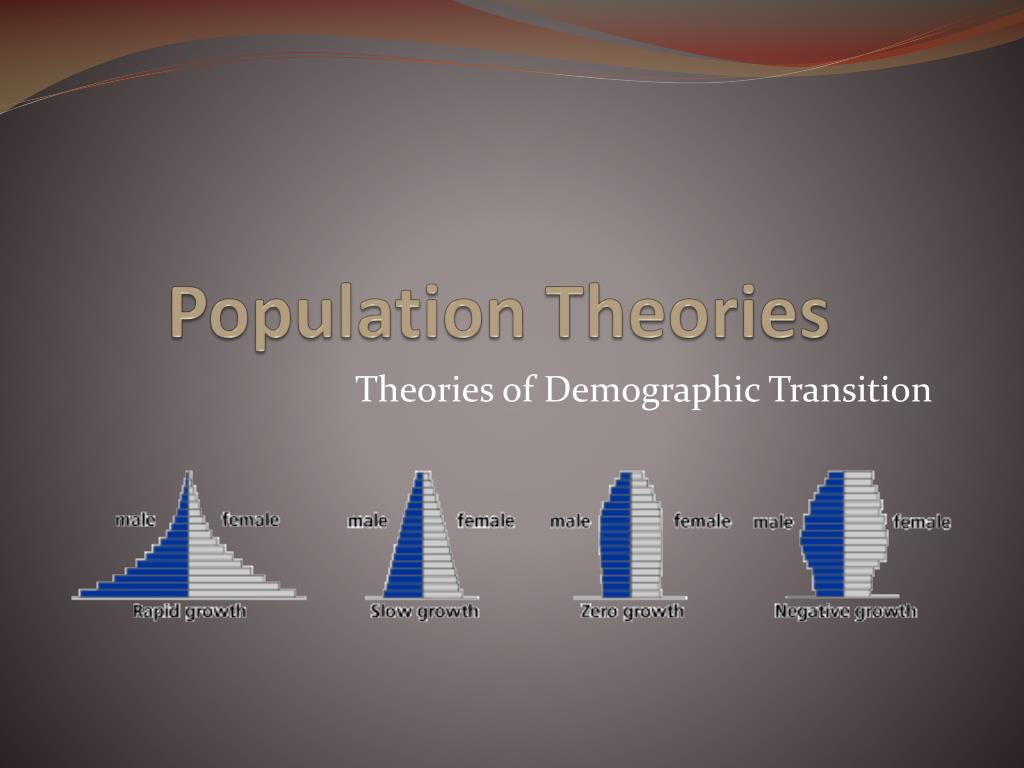
Population Theories. Theories of Demographic Transition. Demographic Transition is the phenomenon of a country’s death and birth rates changing over time from high to low. Over time, the average family size has decreased in every country of the world.
Population Theories - slide 1
01 / 13Population Theories
1 / 17

Télécharger la présentation

Population Theories
Une image / un lien ci-dessous est fourni (tel quel) pour télécharger la présentation

Politique de téléchargement : le contenu du site vous est fourni TEL QUEL pour votre information et votre usage personnel ; il ne peut être vendu, concédé sous licence ni partagé sur d’autres sites sans l’accord de son auteur.Le contenu vous est fourni TEL QUEL, pour votre information et votre usage personnel uniquement. Téléchargez la présentation en cliquant sur ce lien. Lors du téléchargement, si vous ne parvenez pas à télécharger une présentation, l’éditeur a peut-être supprimé le fichier de son serveur.Pendant le téléchargement, si vous ne parvenez pas à obtenir une présentation, le fichier a peut-être été supprimé par l’éditeur.

F I N

Plus de contenu associé

Transcription de la présentation
  1. Population Theories Theories of Demographic Transition

  2. Demographic Transitionis the phenomenon of a country’s death and birth rates changing over time from high to low. • Over time, the average family size has decreased in every country of the world. • In approximately 60 countries, the total fertility rate has fallen to less than 2.1. Canada is one of these countries.

  3. Stage 1: Pre-transition • Stable population • High birth rate and death rate • Fertility rate of 8 or more • Extremely high infant mortality rate • Many young children, very few older people • No country in the world is still at the pre-transition stage.

  4. Stage 2: Early Transition • Very rapid increase in population • Death rate declines rapidly • Fertility rate remains high • Infant mortality rate declines • High birth rate • Many young people • Early Transition is marked by death control

  5. Stage 3: Late Transition • Population growth slows down • Birth rate declines rapidly • Death rate declines slowly • Fertility rate declines • Increasing number of older people • Late Transition is marked by birth control

  6. Stage 4: Post-transition • Stable or slow population increase • Low birth rate and death rate • Fertility rate less than 2.1 • Many older people which leads to a high dependency load

  7. Stage 5:? (doesn’t fit the model, but is happening now!) • Declining population • Extremely low birth rate • Death rate is low • Fertility rate less than 2 • A lot of older people • Is it permanent or just a temporary trend???

  8. Differing Ideas About Population Growth Optimistic vs. Pessimistic

  9. Optimistic Views • Historically, large families and a growing population have been desirable for various reasons. • Religious Reasons: More Children = More Followers and More Followers = More Political/Social Power • Non-Religious Reasons: Leaders needed larger numbers to support their economic and military expansionist desires.

  10. Cornucopians • Cornucopians believe that humans have the ability to find technological innovations that will increase the earth’s carrying capacity. • The Agricultural and Industrial Revolutions would be their evidence. • A cornucopian may say that the next major human innovation will solve our energy crisis without damaging the environment.

  11. Bogue (1960’s) • D.J Bogue’s theory of demographic regulationstated that over an extended period of time, a society will naturally limit its own population in accordance to the Earth’s ability to support it. • Bogue’s theory is supported by the demographic transition model and in the fact that some countries have tried to limit their population growth in recent years.

  12. Pessimistic Views • Critics have all made the same basic point – Earth is of finite size and has an ability to support only a certain level of population.

  13. Thomas Malthus William Catton • Warned of population problems in his writing in 1798. • Pop. grows in a geometric sequence (1,2,4,8,16. . .) while food grows arithmetically (1,2,3,4 . . .) • Only result is onset of “misery”. (famine, disease, war) • Expanded on Malthus’ views in 1980’s. • Introduced idea of Earth’s carrying capacity; it can only be exceeded at the expense of the environment. • Suggests we’re beyond the carrying capacity now only because we’re using up the world’s fixed stock of natural resources for future generations.