
SlideServe
Menu
Préférences
© SlideServe · v2026

Population Theories

lorettagordon avatar
12 diapositives · 264 Views · Jan 04, 2020

Explore the stages of the Theory of Demographic Transition and contrasting perspectives such as Malthusian pessimism and Cornucopian optimism. Learn about carrying capacity, population regulation, and global population dynamics.
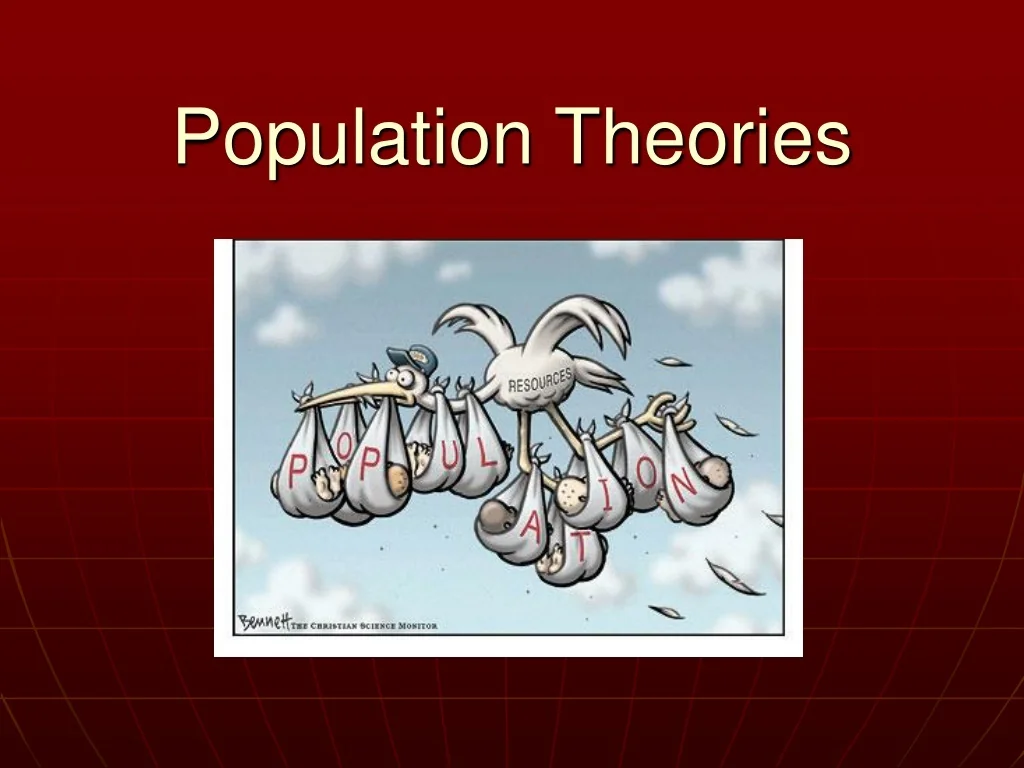
Population Theories - slide 1
01 / 12Population Theories
1 / 17

Télécharger la présentation

Population Theories
Une image / un lien ci-dessous est fourni (tel quel) pour télécharger la présentation

Politique de téléchargement : le contenu du site vous est fourni TEL QUEL pour votre information et votre usage personnel ; il ne peut être vendu, concédé sous licence ni partagé sur d’autres sites sans l’accord de son auteur.Le contenu vous est fourni TEL QUEL, pour votre information et votre usage personnel uniquement. Téléchargez la présentation en cliquant sur ce lien. Lors du téléchargement, si vous ne parvenez pas à télécharger une présentation, l’éditeur a peut-être supprimé le fichier de son serveur.Pendant le téléchargement, si vous ne parvenez pas à obtenir une présentation, le fichier a peut-être été supprimé par l’éditeur.

F I N

Plus de contenu associé

Transcription de la présentation
  1. Population Theories

  2. Theory of Demographic Transition • Demographic Transition-The phenomenon of population changes in a country over time

  3. Stage 1 Pre-Transition • High, stable birth rate • High, fluctuating death rate • No natural increase • Rural/Agricultural society • No countries in the world are at this stage

  4. Stage 2-Early Transition • High birth rate • Falling death rate-“Germ Theory of Disease Control” • Large natural increase • Rural/Agricultural society

  5. Stage 3-Late Transition • Falling birth rate (birth control) • Low death rate • Decreasing natural increase • Urban/Manufacturing society

  6. Stage 4-Post Transition • Low birth rate • Low death rate • No natural increase • Urban/Service sector based society

  7. Stage 5?? Post-Post Transition? • Death rate>Birth rate= Natural Decrease

  8. Pessimistic Views-Thomas Malthus (1766-1834) • Political economist who recorded concerns about changes occurring in Europe in the early nineteenth century • -Europe at the time was entering a period of rapid industrialization, but also very rapid population growth. • -According to Malthus, the population appeared to be growing in a geometric sequence (1,2,4,8,16…)- too quickly for the food supply which could only increase arithmetically (1,2,3,4…) .He felt that population, if uncontrolled, would be "checked" by certain things: • "Positive" Checks • 1. Disease-"The Black Death" • 2. War-Napoleon, Crusades... • 3. Famine-India • "Negative" Checks • -predicted that mankind would consciously prevent births through: • 1. Choice • 2. Delayed marriage

  9. Present Day "Positive" Checks • 1. Aids, Ebola • 2. Africa’s situation (Life expectancy-38 years) • Malthus could never have predicted: • -Global access to medicine, water, food • -Widespread birth control • -Global awareness • -Fear of nuclear destruction

  10. William Catton • Introduced the concept of the earth’s carrying capacity • He suggests that the earth has been exceeding its carrying capacity for many years; this has been possible because we have been using up non-renewable resources that future generations will need • This is known as a “phantom carrying capacity”-while allowing a higher population, is ultimately non-sustainable and the economic and ecological systems will collapse

  11. Optimistic Views • Cornucopians-have faith in the human ability to find technological innovations that will increase the earth’s carrying capacity • D.J. Bogue-Theory of Demographic Regulation-over an extended period of time, a society naturally limits its population. The population will grow only in response to the Earth’s ability to support it.

  12. Population Cartogram