Deoxyribonucleic Acid (DNA)
This overview explores the fundamental concepts of Deoxyribonucleic Acid (DNA), detailing its role in storing and transmitting genetic information. Key contributors like Oswald Avery, Alfred Hershey, Rosalind Franklin, and Watson & Crick are mentioned for their pivotal discoveries. The structure of DNA, including nucleotides, base pairing rules, and the double helix shape, is explained. Additionally, the basics of DNA replication, essential enzymes like helicase and DNA polymerase, and the formation of chromosomes are covered, providing a comprehensive understanding of DNA's significance in biology.

Deoxyribonucleic Acid (DNA)
E N D
Presentation Transcript
Deoxyribonucleic Acid (DNA) Ms. Napolitano & Mrs. Haas CP Biology
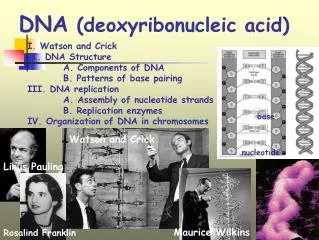
Contributions to DNA • Oswald Avery – DNA stores & transmits genetic information • Alfred Hershey & Martha Chase – genetic material of bacteriophages (type of virus) is DNA, not proteins • Erwin Chargaff – base pairing rules • Rosalind Franklin – DNA is a helical • James Watson & Francis Crick – first DNA model (1953), DNA is double helix
Nucleotides • Basic unit of DNA • 3 components: • 5-carbon sugar (deoxyribose) • Phosphate group • Nitrogenous base
Types of Nitrogenous Bases • Purines– 2 ring structure • Adenine (A) • Guanine (G) • Pyrimidines - 1 ring structure • Thymine (T) • Cytosine (C)
DNA Backbone • DNA backbone = sugar & phosphate groups of each nucleotide bonded together
Base Pairing • Thank you, Chargaff! • Aalways pairs with T • Calways pairs with G
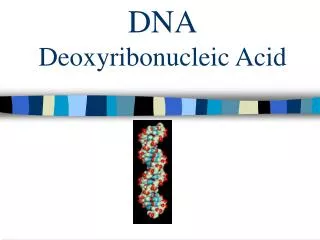
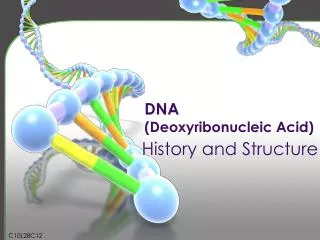
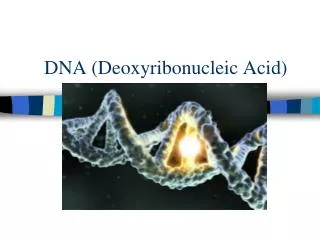
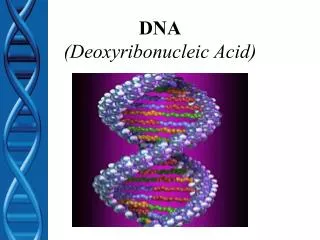
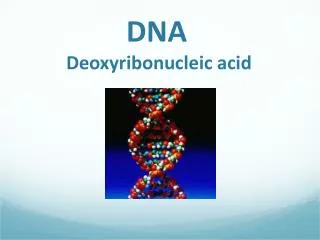
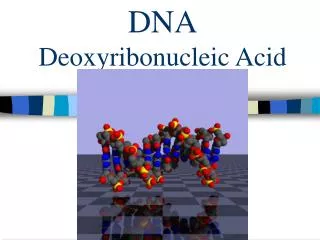
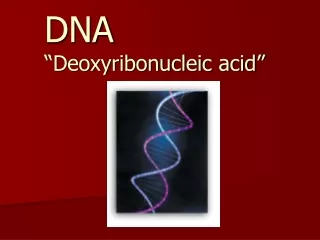
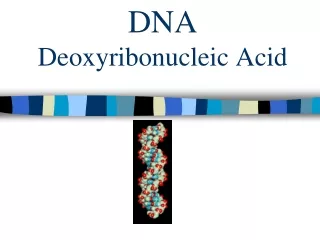
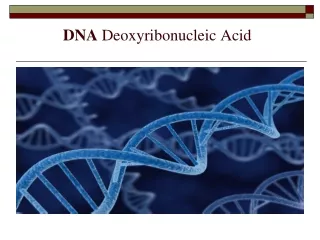
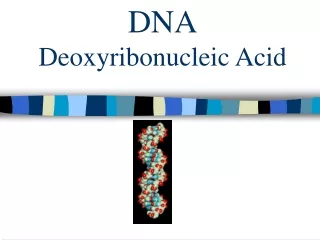
The Double Helix • Thank you, Franklin, Watson, & Crick! • Looks like a twisted ladder
DNA Coiling Chromosomes • Chromatin – tightly coiled DNA around proteins called histones • Chromatin condenses even more during mitosis to make chromosomes
DNA Replication • Complementary strands – one strand can be used to make the other strand • Replication - duplicating DNA • Happens during the S phase (remember that?!) • Occurs at replication forks • DNA splits into 2 strands, which produce 2 new complementary strands • Follows rules of base pairing • Each strand is a DNA template for the new strand
Important Enzymes • Helicase – unzips DNA strand • DNA polymerase – 2 functions • Joins nucleotides to the original DNA strand • Proofreads for errors