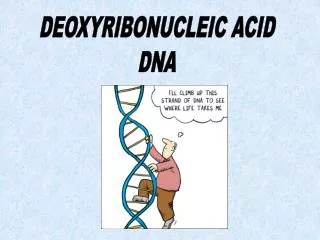
The Discovery of DNA: Understanding Its Structure and Role in Genetics
100 likes | 205 Vues
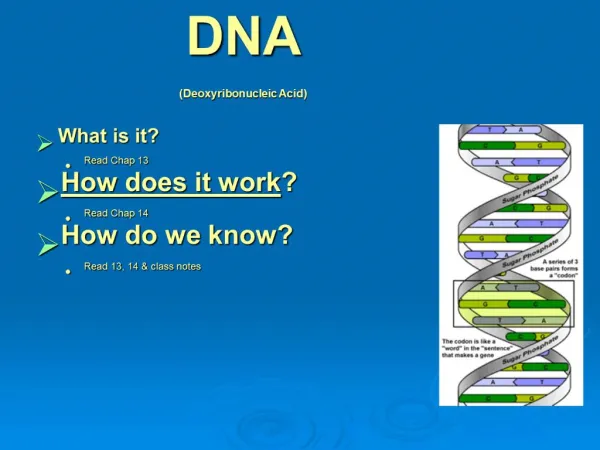
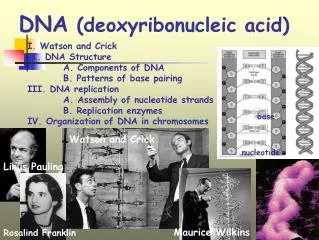
The discovery of DNA's structure in 1953 by James Watson, Francis Crick, Rosalind Franklin, and Maurice Wilkins marked a pivotal moment in biology. DNA, short for deoxyribonucleic acid, serves as the essential blueprint for life, carrying genetic information within the cell nucleus. Its structure resembles a twisted ladder or double helix, composed of sugar-phosphate backbones with nitrogen base pairs (adenine, thymine, guanine, and cytosine). DNA plays a crucial role in replication and protein synthesis, guiding the formation of proteins essential for various biological functions.


The Discovery of DNA: Understanding Its Structure and Role in Genetics
E N D
Presentation Transcript
DNA Discovery - 1953 • James Watson & Francis Crick • Rosalind Franklin & Maurice Wilkins • Important discovery
What is DNA? • Definition • DNA & chromosomes • Cell nucleus • Genetic information • Proteins
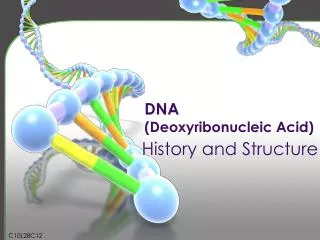
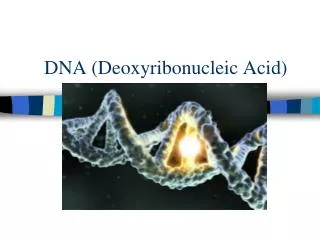
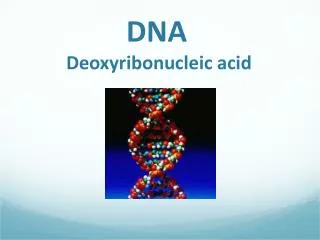
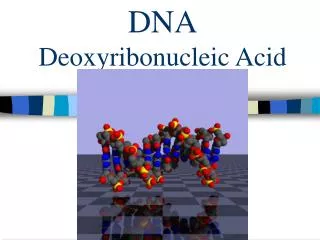
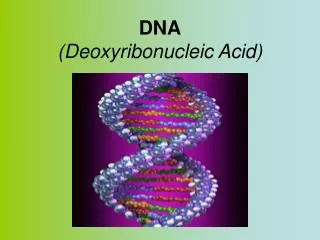
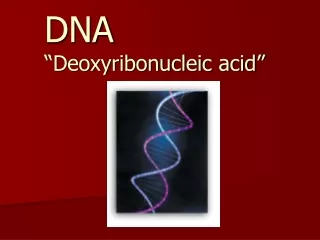
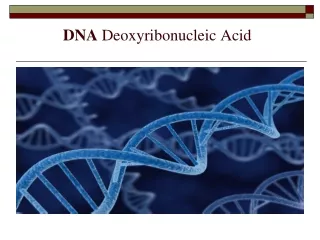
DNA Structure • Double helix • 1. Twisted ladder • 2. Compact • Sides of ladder • 1. Sugars and • phosphates • 2. No inheritance • function
DNA Structure (cont.) • Rungs of ladder • 1. Two nitrogen bases • 2. Adenine, thymine, guanine • cytosine • 3. Base pairs • 4. Pattern of base • pairs
DNA Replication • DNA unzips • Nucleotide • 1. Sugar, phosphate and • nitrogen base • 2. Cell nucleus • Nucleotides/unzipped • strands • Sugar & phosphates
Protein Synthesis • Base sequence • 1. Definition • 2. 100-1,000 bases long • 3. Forms a code • 4. Examples (condensed) AGTTC = human muscle protein CGAGTTCG = human skin protein TAGGCT = earthworm protein CCAGATCGA = bacteria protein
HUMAN INSULIN agaagaggcc atcaagcaga tcactgtcct tctgccatgg ccctgtggat gcgcctcctg cccctgctgg cgctgctggc cctctgggga cctgacccag ccgcagcctt tgtgaaccaa cacctgtgcg gctcacacct ggtggaagct ctctacctag tgtgcgggga acgaggcttc ttctacacac ccaagacccg ccgggaggca gaggacctgc aggtggggca ggtggagctg ggcgggggcc ctggtgcagg cagcctgcag cccttggccc tggaggggtc cctgcagaag cgtggcattg tggaacaatg ctgtaccagc atctgctccc tctaccagct ggagaactac tgcaactaga cgcagcccgc aggcagcccc ccacccgccg cctcctgcac cgagagagat ggaataaagc ccttgaacc
Protein Synthesis (cont.) • Problem • 1. DNA in nucleus • 2. Proteins built in cytoplasm • RNA – ribonucleic acid • 1. Ribose sugar • 2. One side of ladder • 3. Uracil not thymine
Protein Synthesis (cont.) • Building a protein • 1. DNA unzips • 2. RNA reads code • 3. RNA brings code • to cytoplasm • 4. Protein built • on ribosome