Download
1 / 19
190 likes | 309 Vues
This document outlines significant shifts in water management, focusing on the decline of rainwater harvesting and the increasing demand for groundwater due to irrigation and water-intensive crops. It highlights the struggles faced by farmers, including debt and suicides, and introduces the Farmer Water Schools (FWS) concept. Through experiential learning, farmers are empowered to understand groundwater management, adapt practices, and collectively address challenges. The role of facilitators and community engagement is emphasized, aiming for sustainable water resource management and improved crop strategies.

E N D
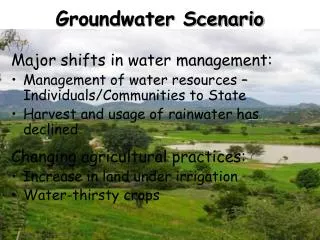
Groundwater Scenario Major shifts in water management: • Management of water resources – Individuals/Communities to State • Harvest and usage of rainwater has declined Changing agricultural practices: • Increase in land under irrigation • Water-thirsty crops
Groundwater Scenario… • Water wars (inter- & intra-state) • Depleting groundwater levels • Hardly 1/10th of the total rainwater recharges aquifers • Farmers in debt trap – large scale suicides and increased out-migration
FWS conceptualization APFAMGS adopted FFS approach: • Discovery and experiential learning process • Farmers master concepts of groundwater management • Empower to effectively manage collective resource.
Adaptation of FFS to CWB • FFS facilitators – subject knowledge and facilitation skills • FFS-TOT May 2005, build skills of the project staff – master facilitators. • By mid 2005, Farmers: • familiar with the PHM activities and • able to record PHM data into HMR books. • GMCs formed • capacities strengthened to monitor the PHM activities at habitation and HUN level. • Experiment adaptation of FFS to CWB Exercise.
Farmer Water Schools [FWS] Participants discuss: • groundwater concepts & availability, • impact on crop growth, • role of institutions in sustainability, and • gender equity.
Hydro-ecosystem Analysis Observe • Recharge factors, like amount of rainfall, surface water, and rock & soil formation. • Discharge factors – no. of borewells, pumping hours/days, average discharge Analyze data [Discussion / Sharing] Reach decisions on crop plans & management of groundwater
FWS objectives: • Empower farmers with knowledge and skills to measure recharge & draft • Sensitize farmers on the need for collective action • Sharpen the farmers’ ability to make critical and informed decisions on crop plans • Sensitize farmers on new ways of thinking and resolving issues
Planning for FWS Staff Training: • Organize TOT / TOF course on FWS • Staff orientation on FWS and its core components – HESA, Short Studies, Group • Subject specific inputs • Curriculum • Session guides • Relevant materials, visuals/posters
Planning for FWS… Village/Habitation Level • Selection of village/area • Needs assessment • Selection of participants • Ballot box exercise • Curriculum finalization with farmers • Session planning with staff and participants • Development of materials, visuals, models • Prior intimation to the selected participants about FWS session • Group kits
FWS: Multi-cycle approach Reach large number of farmers; Simultaneous learning-teaching process: Farmer participants of first cycle facilitate 2nd cycle. FWS cycles one and two run simultaneously with gap of two to four days First cycle: FWS – 34; Second cycle: FWS– 272
PNGO Teams • identified content appropriate to local needs • involved farmers in development of session guides, identifying methods and dev. Models • made efforts to make farmer training sessions an exercise in discovery-learning • organized sessions where farmers could observe geological formations and structures • encouraged farmers to recap learnings at the start of each session.
Typical FWS: • Lasts a full hydrological year [June–May] • Between 25 and 30 farmers participate in an FWS • Farmers meet once every 15/20 days • Primary learning material: HU & farmer field • Field school close to the farming plots • Participants learn together in small groups of five to maximize participation • FFS educational methods are experiential, participatory and learner-centered
Typical FWS [contd.]: • Each FWS meeting includes at least three activities: hydro-ecosystem analysis, a special topic, and group dynamics activity • FWS participants conduct a study comparing farmer and experimental plots • FWS often includes several additional field studies depending on local field problems • Ballot Box Exercise: Pre- and post-test are conducted • Field Day: share learning and results of their studies
FWS & GMC/HUN • GMCs involved in FWS preparation meetings to determine needs, recruit participants and discuss logistics • Farmer participants share their learning from each FWS session at GMC meetings • HUNs take lead in the organization and conduct of Field Day
Role of facilitator: Facilitator – crucial • Organizes the field school • Facilitates the activities associated with 16 meetings of the field school • Takes care of administrative issues • Maintains constructive communications with local govt. officials, NGOs, and other agencies • Determine site for FWS and identify study fields • Identify potential participants
FWS Content: FWS Sessions: • Introduction, BBE, and set-up LTE • Knowing the HU • Participatory Hydrology Monitoring • Groundwater recharge • Estimation of groundwater recharge • Estimation of draft & groundwater balance • CWB workshop
FWS Content [contd.]: • Review of farmer decisions & alternate irrigation practices • Crop adoption results • Alternate irrigation practices • Soil moisture retention • PHM data analysis • FWS impact • Actual groundwater situation & post-BBE • Planning for Field Day • FWS Field Day
Quality Control • Curriculum • Session guides [Manual] • Relevant materials, visuals/posters [Tool kit] • Planning Checklist – • Session Guides, • Materials, • Logistics, • Venue • Monitoring Checklist • Qualitative [logistics, participants, facilitation] • Quantitative [no. participants, no. facilitators, duration, farmer questions]