Download
1 / 19
190 likes | 328 Vues
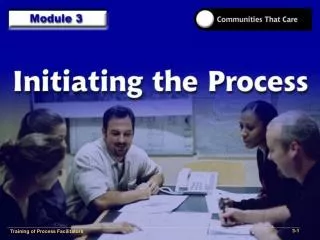
This training overview emphasizes the crucial role of Communities That Care Process Facilitators in guiding communities through Phase One of the process. Participants will learn to describe the facilitator's role, address key issues and benchmarks, and transition communities to Phase Two. Essential skills include communication, mentoring, and effective facilitation. The training also outlines steps to identify issues, engage community leaders, and implement solutions. This foundational training prepares facilitators to support their communities in addressing youth and family challenges effectively.

E N D
3-1 Training of Process Facilitators
Provide an overview of the role and skills of a Communities That Care Process Facilitator, and facilitate the effort through Phase One. 3-2 Training of Process Facilitators
Participants will be able to: • Describe the role of the Process Facilitator. • Help communities address Phase One milestone and benchmark issues. • Help a community move to Phase Two. 3-3 Training of Process Facilitators
Skills • • Communication • • Facilitation • • Mentoring • Expertise • • Knowledge • Qualities • • Openness • • Commitment 3-4 Training of Process Facilitators
uses effective group facilitation skills • helps identify and resolve common issues and barriers for each phase of the Communities That Care process • helps apply the steps for each phase of the Communities That Care process • helps communities to address issues and challenges. A Process Facilitator: 3-5 Training of Process Facilitators
The Coordinator: • provides staff support to the Community Board and its working groups • works with the Communities That Care trainer to arrange training and technical assistance • handles Community Board meeting preparation and follow-up • documents the Communities That Careeffort by keeping files of all related activities • prepares reports as needed. 3-6 Training of Process Facilitators
The trainer: • explains the prevention-science research base and how to put it into practice • uses effective instructional methods • ensures that training participants have the knowledge and skills required to achieve the Communities That Care milestones and benchmarks • delivers the Communities That Caretraining system. 3-7 Training of Process Facilitators
Purpose: Begin the Communities That Care process. Identify: • people • scope • readiness • resources. Support: Strategic Consultation; Tools for Community Leaders: A Guidebook for Getting Started 3-8 Training of Process Facilitators
introduction • a description of the Communities That Care system • a description of the research foundation • the process of implementation • the Communities That Care system at work • sources for further reading 3-9 Training of Process Facilitators
Step 1—Complete preliminary organization tasks. • Step 2—Define the scope of the prevention effort. • Step 3—Address community readiness issues. • Step 4—Plan for Phase Two: Organizing, Introducing, Involving. 3-10 Training of Process Facilitators
Define the issue as clearly and accurately as possible. • Identify the people or groups that can help address the issue, and bring those people together. • Brainstorm potential solutions for the issue. • Evaluate and select a solution(s) that all people or groups feel will best address the issue. • Implement the solution. • Check to see how well the solution worked. 3-11 Training of Process Facilitators
Identify a Champion (a community leader) to guide the process. • Inventory existing community services addressing youth and family issues. • Identify a lead agency committed to supporting the project. • Secure a Coordinator (to work at least half time). • Form a core work group to activate the process. • Develop a roster of Key Leaders to involve in the process. • Prepare an initial work plan and time line for getting started. • Identify and secure the resources needed to get started. 3-12 Training of Process Facilitators
Define key aspects: • - Define the community to be organized. • - Identify the health and behavior issues to be addressed. • - Agree on what is involved in the “prevention” response. • - Identify legislative/funding supports or constraints. • - Agree on the Community Board’s role. • - Begin to define how the Community Board will operate in the community. • Summarize issues related to the key aspects. • Develop an action plan to address outstanding issues related to the key aspects. 3-13 Training of Process Facilitators
Investigate community readiness issues. • Ensure agreement on issues to be addressed. • Ensure that community members have a common definition of “prevention.” • Ensure that the community values collaboration. • Ensure that community-wide support exists for a risk- and protection-focused, data-driven, research-based, outcome-focused prevention approach. • Obtain school district support for the Communities That Care Youth Survey. Administer the survey as early as possible. • Plan for coordination among existing initiatives and planning efforts. • Identify community stakeholders. • Identify other community readiness issues. 3-14 Training of Process Facilitators
Securing survey support may be difficult if: • the Catalyst, Champion or core work group has a poor relationship with key players in the school district • the school district has historically used a different survey • some administrators have concerns about potential controversy surrounding the survey. 3-15 Training of Process Facilitators
Common issues: Identifying the right Catalyst, Champion and lead agency Finding the time and resources to get Phase One work done 3-16 Training of Process Facilitators
Common issues: Grant parameters Data collection considerations 3-17 Training of Process Facilitators
Common issues: Racial/ethnic/cultural divisions Time commitment Agency collaboration Perception of duplication 3-18 Training of Process Facilitators
3-19 Training of Process Facilitators