
SlideServe
Menu
Préférences
© SlideServe · v2026

Consequentialist Ethical Theories

dsophie avatar
4 diapositives · 261 Views · Jan 06, 2020

This exploration of consequentialist ethical theories delves into Egoism and Utilitarianism. Egoism posits that the good is defined by what promotes individual long-term interests and pleasure, while Hedonism emphasizes the pursuit of pleasure devoid of pain. We also examine the objections to Egoism, such as its inability to resolve conflicts of interest and its lack of a moral viewpoint. Utilitarianism, on the other hand, advocates for the greatest happiness for the greatest number, highlighting both act and rule variations with their respective criticisms.
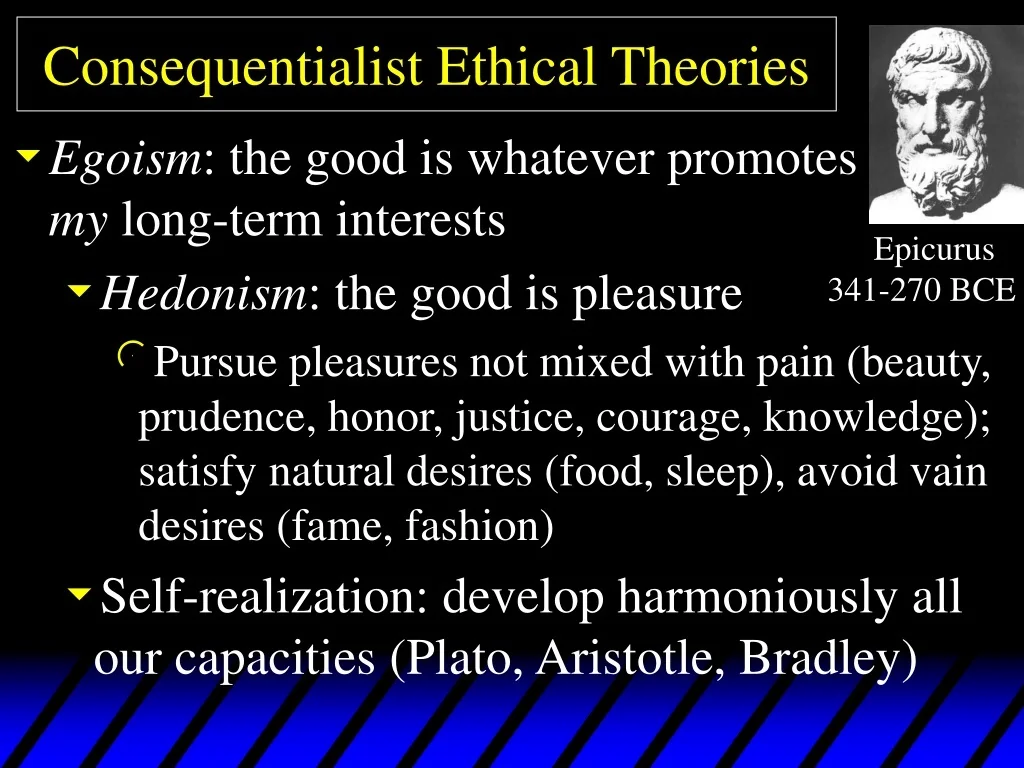
Consequentialist Ethical Theories - slide 1
01 / 4Consequentialist Ethical Theories
1 / 17

Télécharger la présentation

Consequentialist Ethical Theories
Une image / un lien ci-dessous est fourni (tel quel) pour télécharger la présentation

Politique de téléchargement : le contenu du site vous est fourni TEL QUEL pour votre information et votre usage personnel ; il ne peut être vendu, concédé sous licence ni partagé sur d’autres sites sans l’accord de son auteur.Le contenu vous est fourni TEL QUEL, pour votre information et votre usage personnel uniquement. Téléchargez la présentation en cliquant sur ce lien. Lors du téléchargement, si vous ne parvenez pas à télécharger une présentation, l’éditeur a peut-être supprimé le fichier de son serveur.Pendant le téléchargement, si vous ne parvenez pas à obtenir une présentation, le fichier a peut-être été supprimé par l’éditeur.

F I N

Plus de contenu associé

Transcription de la présentation
  1. Consequentialist Ethical Theories • Egoism: the good is whatever promotes my long-term interests • Hedonism: the good is pleasure • Pursue pleasures not mixed with pain (beauty, prudence, honor, justice, courage, knowledge); satisfy natural desires (food, sleep), avoid vain desires (fame, fashion) • Self-realization: develop harmoniously all our capacities (Plato, Aristotle, Bradley) Epicurus 341-270 BCE

  2. Objections to Egoism • Egoism cannot resolve conflicts of interest (which moral theories should do) • Egoism allows for no “moral point of view” of an ideal, impartial, informed observer who identifies with those in the situation • Reply: no one is completely impartial, nor should moral decisions be dispassionate

  3. Utilitarianism: we ought to promote the greatest amount of happiness for the greatest number • Bentham: the hedonic calculus is based on the intensity, duration, certainty, immediacy, fecundity, purity, & number of people affected • J. S. Mill: the quality of pleasures needs to be considered, determined by competent judges • Objections: this is elitist; why not use the criterion for evaluating pleasures to judge morality itself? J. Bentham (1748-1843) J. S. Mill (1808-73)

  4. Variations of Utilitarianism • Act utilitarianism: we are obligated to do the specific act that produces the greatest amount of happiness (regardless of rules or justice) Objections: • consequence calculation is difficult • this implies that the end justifies the means • Rule utilitarianism: we should follow moral rules that, when acted upon, generally produce the greatest amount of happiness Objections: • what about when rules conflict? • in some cases, why not exceptions? Reply: then why have any theory at all?