Understanding Muscle Naming Conventions: From Shapes to Functions
60 likes | 193 Vues
This chapter delves into the basic naming conventions of muscles, highlighting key terms and characteristics that describe their shapes, sizes, locations, and functions. For instance, "deltoid" is named for its triangular shape, while "biceps" indicates a two-headed muscle attached to the femur. The chapter also discusses terms like "major/minor" for size differentiation and "longus/brevis" for length. Understanding these conventions is essential for students and professionals in anatomy and physiology, providing clarity on muscle identification and function.


Understanding Muscle Naming Conventions: From Shapes to Functions
E N D
Presentation Transcript
How the Muscles are Named Chapter8
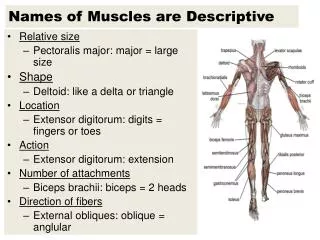
Basic Naming Conventions Deltoid - shaped like a triangle Orbicularis - orbit, circular muscle Major/Minor - large/small or sometimes upper and lower Vastus - large Dorsi or Dorsal - backside Infra / Supra - lower and upper Longis / Brevis- long/ short (brief) Medialis / Lateralus- medial (toward the inside), lateral (toward the outside)
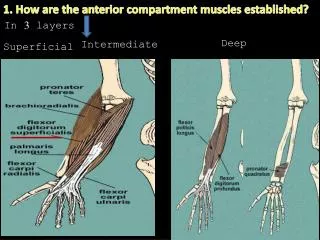
Basic Naming Conventions Some are named based on the region or bone they are attached to: biceps femoris- two headed muscle attached to the femur extensor carpi radialislongus- long muscle that runs the length of the radius (bone) to the carpals (wrist bones) that extends the fingers