Maps, Map Components, and Latitude and Longitude
270 likes | 414 Vues
Mr. Reed. Maps, Map Components, and Latitude and Longitude. Quick Review. What is a hemisphere? What is the line of latitude that divides the earth in half (north and south)? What is the line of longitude that divides the earth in half (east and west)?


Maps, Map Components, and Latitude and Longitude
E N D
Presentation Transcript
Mr. Reed Maps, Map Components, and Latitude and Longitude
Quick Review • What is a hemisphere? • What is the line of latitude that divides the earth in half (north and south)? • What is the line of longitude that divides the earth in half (east and west)? • What hemispheres is the United States located in?
Quick Review • Hemisphere: Half of the Earth • Line that divides north and south: Equator • Line that divides east and west: Prime Meridian • Hemispheres of United States: North and West
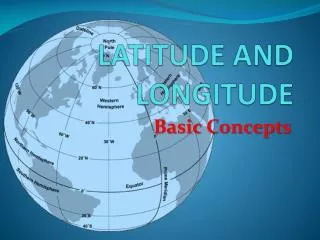
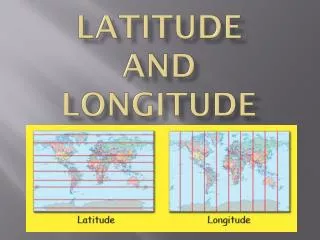
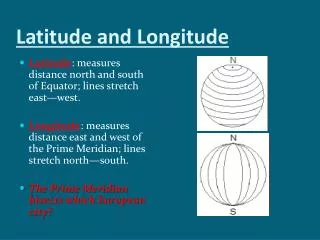
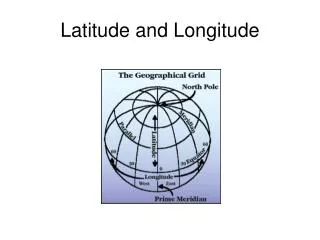
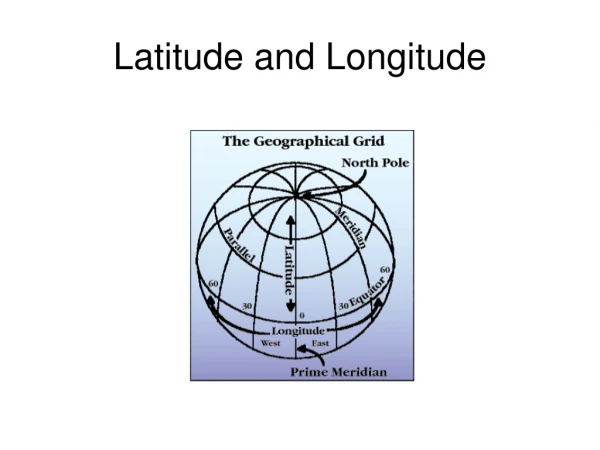
Latitude • Line of Latitude measure the distance (in degrees) north and south of the equator • The equator is 0 degrees • They run east and west • Think “ladder” for latitude
Longitude • Lines of longitude measure the distance (in degrees) east and west of the prime meridian • Prime meridian is 0 degrees • International dateline is 180 degrees • What is the international dateline? • They run north and south
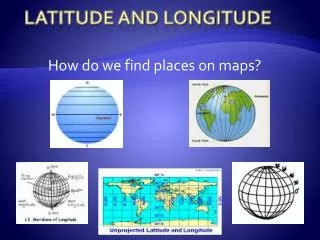
Latitude and Longitude • What does the combination of both coordinates give you? • Answer: Absolute location • Example: Kansas City is 39 degrees N, 98 degrees W • Practice: Approximate the coordinates of Denver, CO using the map on the screen • Do the same with Springfield, IL
Maps and Globes • Globe: 3D representation of the earth • Pros: see the earth as it really is • Cons: only see half at a time • Map: 2D representation of the earth • Pros: See the whole world • Cons: Can be distorted depending on type of map • A cartographer is someone who makes maps
Political Maps • Representation of a countries boundaries, territories, cities, capitals, etc. • Shows features that were created by humans • May include roads/train lines, etc. • Uses: • Mapping trips • Examining regions • Analyzing human characteristics
Physical Maps • Representation of the earths physical/natural features, such as elevation, landforms, bodies of water, etc. • Uses: • Analyzing geographic features • Hiking
Thematic • Focuses on one type of information • Can go beyond physical geography • Uses: • Show a very specific type of information
Map Components • There are some components most maps will share • They are: • Title • Compass rose • Legend/key • Scale • Latitude/Longitude