Weight management
This chapter explores the critical aspects of weight management, highlighting the alarming statistics of obesity among American adults and its related health risks. With projections indicating that the majority of adults will be overweight or obese by 2030, it emphasizes the importance of energy balance, body composition, and healthy lifestyles. Key factors contributing to excess body fat are discussed, along with effective strategies for adopting healthier habits, promoting physical activity, and enhancing emotional wellbeing. This comprehensive guide aims to empower individuals on their weight management journeys.

Weight management
E N D
Presentation Transcript
Weight management Chapter 11
Introduction • National Institutes of Health • 66% of American adults are overweight • Including more than 33% of adult men and 35% of adult women are obese. • 2015 • 75% of adults will be overweight and 41% will be obese • 2030 • Estimated that the entire American adult population will be overweight or obese
3 Figure 11-1 Obesity prevalence, by age and sex, of American adults
Basic Concepts of Weight Management • 1 pound of fat = 3500 calories • Body Composition • Fat-free mass or Lean Body Mass • Body Fat • Subcutaneous fat 3-5% of total fat in men, 8-12% in women • Visceral fat-(storage) –Located behind the abdominal wall • Depends on many factors: • Gender • Age • Heredity • Metabolism • Diet • Activity level • Women: <8% at risk, Average 23%, > 32% at risk • Men: < 5% at risk, Average 15%, > 25% at risk
Energy Balance • Crucial to keep a healthy ratio of fat and lean body mass • Energy • Consumption and/or expenditure of calories • Control over intake of calories • Negative energy balance • Positive energy balance • Neutral energy balance
Evaluating Body Weight and Body Composition • Overweight – total body weight above recommended range for good health • Obesity – a more serious degree of overweight • Height-Weight charts • Body Mass Index (BMI) • BMI = [Weight / Height in inches (squared)] X 703
Body Composition Analysis • Hydrostatic (underwater) weighing and BOD POD • Most accurate • Skinfold measurements • Thickness of fat under the skin • Electrical Impedance Analysis • Electricity prefers lean tissue • Scanning procedures • CT scan, MRI, Dual-energy X-ray, Dual-photon absorptiometry, Infrared reactance and total body electrical conductivity
Excess Body Fat and Wellness • The Health Risks of Excess Body Fat • Obese individuals have a mortality rate twice that of non-obese • Reduces life expectancy by 10-20 years • Associated with: Unhealthy cholesterol and triglycerides, impaired heart function, and death from cardiovascular disease • Other health factors: hypertension, cancer, impaired immune function, gallbladder and kidney disease, skin problems, impotence, sleep disorder back pain, arthritis • Strong association – Type II diabetes
Body Fat Distribution and Health • Apple shape • Android obesity • Upper regions of their bodies • Increase risk of high blood pressure, diabetes, early-onset heart disease, stroke, and cancer • Pear shape • Gynoid obesity • Fat storage in the hips, buttocks and thighs • Assessed by measuring waist circumference • Risk if total waist measurement is more than 40 inches for men and 35 inches for women
Body Image • Collective picture of the body as seen through the mind’s eye. • Perceptions • Images • Thoughts • Attitudes • Emotions
Problems Associated with Very Low Levels of Body Fat • Less than 8-12% for women and less than 3-5% for men. • Extreme has been linked to problems with: • Reproductive • Circulatory • Immune system disorders • Female Athlete Triad • Abnormal eating patterns • Amenorrhea • Decreased bone density
Factors Contributing To Excess Body Fat • Genetic Factors • Nutrigenomics • Study of how nutrients and genes interact • 25 to 40% of an individual’s body fat • 600 genes have been linked to obesity • Physiological Factors • Metabolism (RMR) • Hormones • Fat Cells
Lifestyle Factors • Eating • Physical Activity • Psychosocial factors • Emotions • Distraction from difficult feelings • Helps regulate emotions • Coping strategies • Socioeconomic status • Family and cultures
Adopting A Healthy Lifestyle For Successful Weight Management • “Normal” body weight • Diet and Eating Habits • Total Calories • MyPyramid suggestions • Best approach for weight loss is combining an increase of exercise with moderate calorie restriction • Do not go on a crash diet
Adopting A Healthy Lifestyle For Successful Weight Management (Continued) • Portion Sizes • Energy (calorie) Density • Eating Habits • Processed foods • “Fat-free” • Stick to recommendations by: • Dietary Guidelines for Americans • MyPyramid • DASH Diet
Physical Activity and Exercise • 30 minutes or more of moderate-intensity physical activity, everyday • Walking • Gardening • Housework • Walking 1 mile in 15-20 minutes
Thinking and Emotions What do you think of yourself? Self-esteem Negative emotions “Ideal self” Beliefs and attitudes you hold
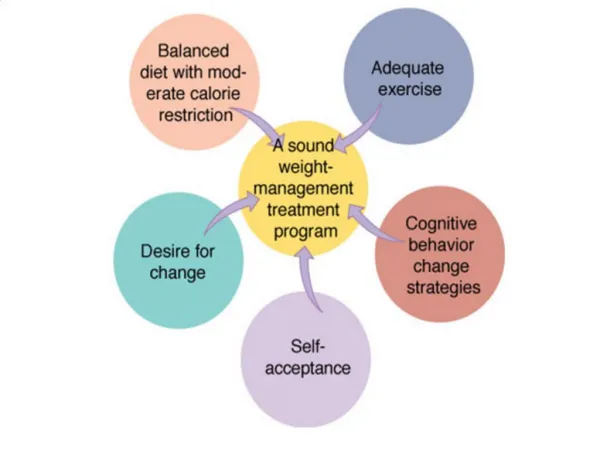
Coping Strategies • Adequate and appropriate strategies • Healthy lifestyles and proper stress management techniques will naturally and easily result in a reasonable body weight • Good nutrition • Good communication • Adequate exercise • Positive thinking and emotions • Effective coping strategies and behavior patterns
Approaches to Overcoming A Weight Problem • Doingit yourself • 0.5-2.0 pounds per week • Initial weight loss from fluids. • Very low calorie diets need to be avoided. • Diet Books: • Reject books with gimmicks or rotating levels of calories. • Accept books that advocate a balanced approach. • Diet Supplements and Diet Aids • Formula drinks and food bars • Herbal supplements • Other supplements
Weight-Loss Programs • Noncommercial • TOPS (Take Off Pounds Sensibly) • OA (Overeaters Anonymous) • 12-step program with spiritual orientation • Commercial • Online • Clinical
Weight-Loss Programs • Prescription Drug • Appetite Suppressants • Produce a 5-15% weight reduction by controlling appetite. • Once drugs are stopped most return to original heavy weight. • Good option for very obese who need help getting started - permanent life style change.
Surgery • Severely obese – • One in 50 adult Americans has “morbid obesity” • NIH recommends gastric bypass for individuals with a BMI of 40 or higher or are 100 pounds or more over recommended weight. • Roux-en-Y-gastric bypass • Vertical banded gastroplasty (VBG) • Lap-Band – variation of VGB • Adjustable band • Liposuction • Weight loss from surgery generally ranges between 40% and 70% of total body weight over a years time.
Body Image • Severe body image problems • Body dysmorphic disorder (BDD) • Affects about 2% of Americans • Usually before age 18 • Muscle dysmorphia • Knowing when the limits to healthy change have been reached. • Knowing the unrealistic cultural ideal. • Acceptance and change • Knowing what is a healthy lifestyle change
Eating Disorders Problems with body weight and weight control. Characterized by severe disturbances in body image, eating patterns, and eating-related behaviors. Disordered eating affects an estimated 10 million American females and 1 million males.
Eating Disorders • Anorexia Nervosa- Failure to eat enough food… • Affects 3 million people – 95% are female • Typically develops between the ages of 12 and 18 • Characteristics • Fear gaining weight. • Distorted self-image. • Compulsive behaviors and rituals. • Excessive exercise • Health Risks of Anorexia Nervosa • Stop menstruation • Intolerant of cold • Low blood pressure and heart rate • Dry skin • Hands and feet may swell and take on a blue tinge • Depression and suicide • Medical complications • Disorders of the cardiovascular, gastrointestinal, endocrine, and skeletal systems
Eating Disorders • Bulimia Nervosa - recurring episodes of binge eating followed by purging. • Begins in adolescence or young adulthood • Increasingly younger (11-12 years) and older (40-60 years) ages. • Characteristics: • Rapidly consumes food, then purges. • Done in secret. • After a binge - feels ashamed, disgusted and physically and emotional drained. • Health Risks: • Erodes tooth enamel • Deficient calorie intake • Liver and kidney damage • Cardiac arrhythmia • Chronic hoarseness • Esophageal tearing • Rupture of the stomach • Menstrual problems • Increased depression
Eating Disorders • Binge-Eating - Similar to Bulimia except no Purging behavior. • Eating patterns - very rapid, eating until uncomfortably full. • Often eat as a way of coping. • Likely to be obese. • High rates of depression and anxiety
Treating Eating Disorders • Combination of psychotherapy and medical management • Address both eating disorder, misuse of food and manage emotions • Anorexia Nervosa • Averting a medical crisis • Adequate body weight • Psychological aspects • Bulimia Nervosa • Stabilizing the eating patterns • Identify and changing the patterns of thinking • Improve coping skills • 2006, JAMA study found: • Topiramate (anti-seizure drug) helped with Bulimia Nervosa • Binge-Eating • Similar treatment protocol as Bulimia Nervosa
Weight Management Chapter 11