SlideServe
Menu
Préférences
© SlideServe · v2026

Neck fragmentation

dutch avatar
24 diapositives · 435 Views · Aug 21, 2014

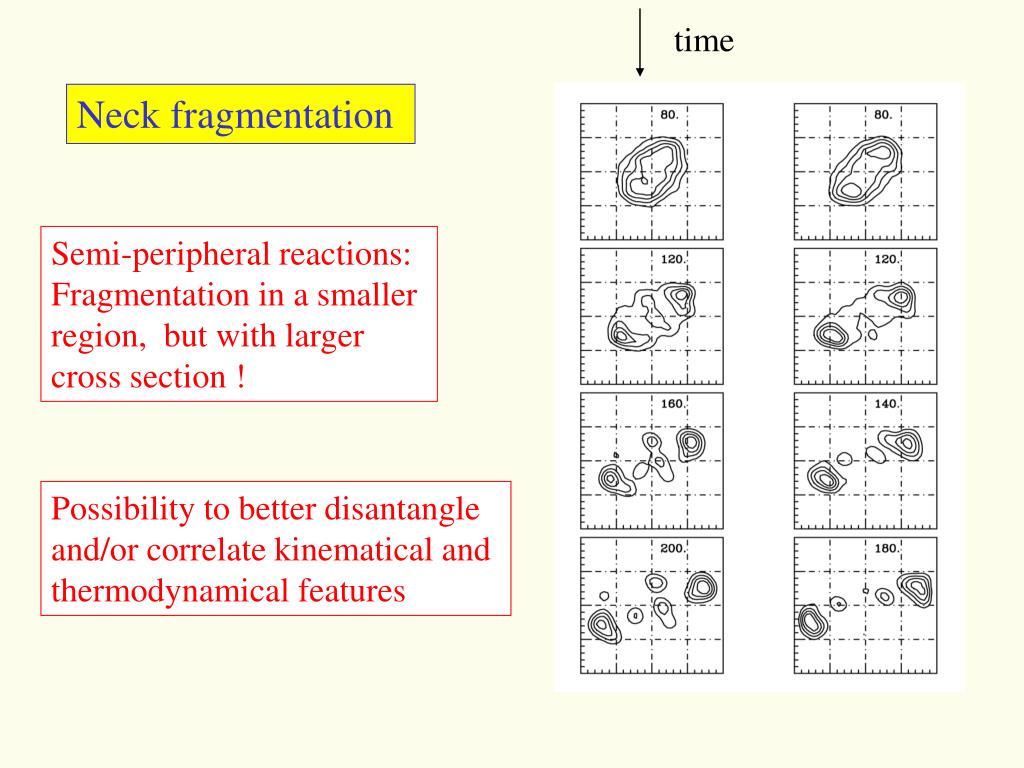
time. Neck fragmentation. Semi-peripheral reactions: Fragmentation in a smaller region, but with larger cross section !. Possibility to better disantangle and/or correlate kinematical and thermodynamical features. Impact parameter dependence. E/A = 35 AMeV; b=6 fm. free cross sections.
Neck fragmentation - slide 1
01 / 24Neck fragmentation
1 / 17

Télécharger la présentation

Neck fragmentation
Une image / un lien ci-dessous est fourni (tel quel) pour télécharger la présentation

Politique de téléchargement : le contenu du site vous est fourni TEL QUEL pour votre information et votre usage personnel ; il ne peut être vendu, concédé sous licence ni partagé sur d’autres sites sans l’accord de son auteur.Le contenu vous est fourni TEL QUEL, pour votre information et votre usage personnel uniquement. Téléchargez la présentation en cliquant sur ce lien. Lors du téléchargement, si vous ne parvenez pas à télécharger une présentation, l’éditeur a peut-être supprimé le fichier de son serveur.Pendant le téléchargement, si vous ne parvenez pas à obtenir une présentation, le fichier a peut-être été supprimé par l’éditeur.

F I N

Plus de contenu associé

Transcription de la présentation
  1. time Neck fragmentation Semi-peripheral reactions:Fragmentation in a smaller region, but with larger cross section ! Possibility to better disantangle and/or correlate kinematical and thermodynamical features

  2. Impact parameter dependence E/A = 35 AMeV; b=6 fm free cross sections half free cross sections P=Nternary/Ntotal 124Sn+64Ni 112Sn+58Ni

  3. NECK FRAGMENTATION: CM Vz-Vx CORRELATIONS Large dispersion also along transversal, x, direction TLF 124Sn + 64Ni 35 AMeV <0 IMF PLF >0 Alignement + Centroid at Clear Dynamical Signatures !

  4. DEVIATIONSFROMVIOLASYSTEMATICS r - ratio of the observed PLF-IMFrelative velocityto the corresponding Coulombvelocity; r1- the same ratio for the pair TLF-IMF TheNeck-IMF is weakly correlated with both PLF and TLF V.Baran, M.Colonna, M.Di Toro NPA 730 (2004)

  5. Gating the reduced plot for light IMFs: (exp. data)

  6. BNV REDUCED VELOCITY PLOTS: (exp. data) Note: BNV model accounts only for the “prompt” component of IMF’s V. Baran et al. Nucl. Phys A730 (2004) 329 Chimera 124Sn+64Ni 35AMeV data, same E_loss selections

  7. Angular distributions: alignment characteristics Out-of-plane angular distributions for the “dynamical” (gate 2) and “statistical” (gate 1) components: these last are more concentrated in the reaction plane. plane is the angle, projected into the reaction plane, between the direction defined by the relative velocity of the CM of the system PLF-IMF to TLF and the direction defined by the relative velocity of PLF to IMF (Chimera data)

  8. Stochastic mean field (SMF) calculations b = 4 fm b = 6 fm b = 2 fm Pre-equilibrium emission Fragment formation Sn124 + Sn124, E/A = 50 MeV/A

  9. Frammentazione in sistemi ricchi di neutroni • Convalidare il meccanismo di frammentazione. Nuovi aspetti legati a transizioni di fase in sistemi • asimmetrici • Dedurre informazioni sul comportamento dell’energia • di simmetria in condizioni di densita’ diverse da quelle • normali (bassa densita’)

  10. Symmetry Energy Expansion around r0 Asy-stiff Esym(rB) (MeV) Pressure & compressibility Asy-soft 0 1 2 3 rB/r0 Pressure gradient

  11. Mean Field & Chemical Potentials symmetry part of the mean field neutron-proton chemical potentials neutron neutron proton proton stiff 124Sn “asymmetry” I = 0.2 soft

  12. Fragment isospin properties: the iso-distillation Asy-stiff Central collisions 124Sn+ 124Sn 50 AMeV: average asymmetry Asy-soft 25 % reduction

  13. Comparison of isotopic distributions with data Stochastic BNV calculations T.X.Liu et al., PRC69(2004) 124Sn+ 124Sn 50 AMeV: central collisions

  14. Semi-peripheral collisions Asy-stiff: neutron enrichment of light IMFs 124Sn+ 124Sn 50 AMeV: average asymmetry Isospin migration Asy-soft V.Baran et al., NPA703(2002)603 NPA730(2004)329

  15. Fe + Fe @ 47 AMeV Ni + Ni, @ 47 AMeV d IMF’s properties vs. alignement R.Lionti et al., PLB 625 (2005) 33

  16. Transverse velocity dependence of fragment asymmetry asy-soft asy-stiff Sn124 + Sn124, E/A = 50 MeV/A b = 6 fm n-rich / n-poor ratio

  17. Asymmetry distributions in velocity bins 0 < v_tra /c < 0.02 v_tra /c > 0.02 asy-stiff asy-soft 0<A<10 asy-stiff asy-soft

  18. Fragment isotopic distributions • P(δρn – δρp) ~ exp – [ (δρn – δρp)² / (f(ρ,T) ρ/V) ] • P(N,Z) ~ exp –{ [(N-Z)-(Nº-Zº)]² / (ρV f(ρ,T)) } = • exp –{ a(N-Z)²- bN-cZ} • b = (4(Zº/ Aº)² - 1) / σ ; c = (4(Nº/ Aº)²-1) /σ • Isoscaling analysis (Y2(N,Z)/Y1(N,Z)) : exp(α N + β Z) • α = 4 [ (Zº/ Aº)²1 - (Zº/ Aº)²2 ] / σ σ = f(ρ,T) (ρV)/Aº • f(ρ,T) ~ T / Esym(ρ)(ρV)/Aº < 1 • ρ is the density of the initial low density (unstable) system

  19. Isoscaling: a way to analyze isotopic distributions Z=1 Z=7 primary Central collisions final α = 4 [ (Zº/ Aº)²1 - (Zº/ Aº)²2 ]/σ² α exp = 0.35 T.X.Liu et al., PRC2004

  20. Extraction of Esym from isoscaling analysis α = 4 [ (Zº/ Aº)²1 - (Zº/ Aº)²2 ] / σ σ ~ f(ρ,T) f(ρ,T) ~ T / Csym(ρ) Isoscaling in AMD (anti-symmetrized molecular dynamics) calculations A.Ono et al.

  21. In conclusione …. • Segnali che indicano transizione di fase liquido-gas: • Espansione radiale (bassa densita’) + bassa temperatura • Curva calorica • Bimodalita’ • Calore specifico negativo • Distillazione di isospin • Segnali che supportano il meccanismo spinodale: • Tempi di frammentazione (100 fm/c) • Formazione di frammenti di taglia tipica (segnale che sopravvive • solo in alcuni eventi) • Buona corrispondenza fra le osservabili cinematiche dei frammenti • e proprieta’ legate a massa e N/Z descrizione corretta della • dinamica di frammentazione

  22. Competition between reaction mechanisms: fusion vs deep-inelastic a) -- soft b) -- stiff neutron-rich Elab = 30 Mev/A, b = 4 fm proton-rich M.Colonna et al., PRC57(1998)1410

  23. Binary vs ternary reactions (neck emission) Reactions at low energy: Elab < 10 MeV/A (SPIRAL2) TDHF calculations: Davies et al, PRC20(1979)1372 139 86 Kr + La, l=100 Elab = 710 MeV Dynamical emission of small clusters at mid-rapidity

  24. asy-stiff More dissipative neck dynamics with asy-stiff ! 132 64 Sn + Ni Elab = 10 MeV/A b = 7 fm, t = 500 fm/c asy-soft