Understanding DNA: Structure, Function, and Chromosome Organization
This chapter explores the essential roles of DNA, highlighting how genes transmit information and determine the heritable traits of organisms. It delves into the components of DNA, detailing nucleotides made of a sugar, phosphate, and nitrogenous bases. The structure of DNA resembles a twisted ladder, and key figures like Chargaff, Franklin, Watson, and Crick contributed significantly to understanding it as a double helix. Additionally, it covers the organization of DNA into chromosomes, detailing how DNA is tightly wound around histones to form chromatin, and differentiates between prokaryotic and eukaryotic chromosomes.

Understanding DNA: Structure, Function, and Chromosome Organization
E N D
Presentation Transcript
DNA’s Responsibilities • Genes carry information from one generation to the next • Genes determine the heritable characteristics of organisms • Genes can be replicated or copied exactly
DNA’s Components • DNA is a nucleic acid • It has monomers called nucleotides • Each nucleotide is composed of three basic parts: 5 carbon sugar – deoxyribose • A phosphate group • A nitrogenous base
Nitrogenous Bases • There are four nitrogenous bases categorized into two groups Purines: (two rings) • Adenine (A) • Guanine (G) Pyrimidines: (one ring) • Cytosine (C) • Thymine (T)
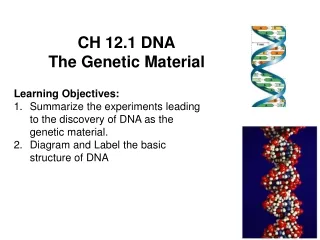
DNA’s Structure • DNA can be considered to be like a ladder The sugar and phosphate groups make up the backbone of the molecule, or the sides of the ladder • They alternate along the sides The nitrogenous bases stick out of the sides of the sugar • They make up the rungs of the ladder
Erwin Chargaff • Realized the number of A’s equals the number of T’s and that the number of G’s equals the number of C’s • Base pairing rule A = TG = C PurinesPyrimidines
Rosalind Franklin Used x-ray diffraction to gather information about DNA structure • Revealed that DNA is in helix form (coil or twisted ladder)
Watson and Crick • Made 1st 3-D model of a DNA molecule • Used the work of Chargaff and Franklin to create this model • DNA structure is called a double helix, in which two strands are wound around each other The two strands are connected by hydrogen bonds
DNA and Chromosomes Chromosomes are tightly wound up DNA strands • Increased organization allows for the tremendous length of DNA to fit into the nucleus of the cell
Chromosome Structure • DNA is tightly wound around proteins called histones 8 histones + DNA = nucleosome • These form chromatin • Chromatin tightly wound up makes a chromosome • http://www.youtube.com/watch?v=yqESR7E4b_8&feature=related
Prokaryotic Chromosomes • Prokaryotic chromosomes are located floating in the cytoplasm of the cell (not in the nucleus) They are circular in shape (not “X shape” like in eukaryotes)