
Course Logistics
E N D
Presentation Transcript
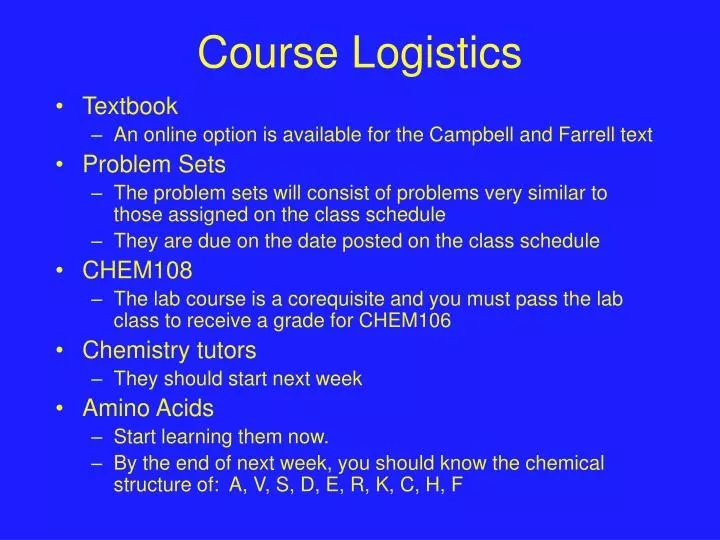
Course Logistics • Textbook • An online option is available for the Campbell and Farrell text • Problem Sets • The problem sets will consist of problems very similar to those assigned on the class schedule • They are due on the date posted on the class schedule • CHEM108 • The lab course is a corequisite and you must pass the lab class to receive a grade for CHEM106 • Chemistry tutors • They should start next week • Amino Acids • Start learning them now. • By the end of next week, you should know the chemical structure of: A, V, S, D, E, R, K, C, H, F
Law of Conservation of Matter • “Matter can neither be created nor destroyed” – Antoine Lavoisier, 1774 If a complete chemical reaction has occurred, all of the reactant atoms must be present in the product(s)
Law of Conservation of Matter a) b) • Stoichiometric coefficients are necessary to balance the equation so that the Law of Conservation of Matter is not violated • 6 molecules of Cl2 react with 1 molecule of P4 • 3 molecules of Cl2 react with 2 molecules of Fe
Balancing Chemical Reactions • Let’s look at Oxide Formation • Metals/Nonmetals may react with oxygen to form an oxide with the formula MxOy • Example 1: Iron reacts with oxygen to give Iron (III) Oxide Fe (s) + O2 (g) → Fe2O3 (s)
How do we solve it? Fe (s) + O2 (g) → Fe2O3 (s) • Step 1: Look at the product. There are 3 atoms of oxygen in the product, but we start with an even number of oxygen atoms. • Let’s convert the # of oxygens in the product to an even number Result: Fe (s) + O2 (g) → 2Fe2O3 (s)
How do we Solve It? Fe (s) + O2 (g) → 2Fe2O3 (s) • Then, balance the reactant side and make sure the number/type of atoms on each side balance. Balanced Equation: 4Fe (s) + 3O2 (g) → 2Fe2O3 (s)
How do we Solve It? • Example 2: Sulfur and oxygen react to form sulfur dioxide. S (s) + O2 (g) → SO2 (g) • Step 1: Look at the reaction. We lucked out! Balanced Equation: S (s) + O2 (g) → SO2 (g)
How do we Solve It? • Example 3: Phosphorus (P4) reacts with oxygen to give tetraphosphorus decaoxide. P4 (s) + O2 (g) → P4O10 (s) • Step 1: Look at the reaction. The phosphorus atoms are balanced, so let’s balance the oxygens. Balanced Equation: P4 (s) + 5O2 (g) → P4O10 (g)
How do we Solve It? • Example 4: Combustion of Octane (C8H18). C8H18 (l) + O2 (g) → CO2 (g) + H2O (g) • Step 1: Look at the reaction. Then: • Balance the Carbons C8H18 (l) + O2 (g) → 8CO2 (g) + H2O (g)
How do we Solve It? C8H18 (l) + O2 (g) → 8CO2 (g) + H2O (g) • Step 2: Balance the Hydrogens C8H18 (l) + O2 (g) → 8CO2 (g) + 9H2O (g) • Step 3: Balance the Oxygens • Problem! Odd number of oxygen atoms • 12.5 Oxygens on reactant side • Solution: Double EVERY coefficient (even those with a value of ‘1’)
How do we Solve It? C8H18 (l) + 12.5O2 (g) → 8CO2 (g) + 9H2O (g) • Step 3 (cont’d): Balance the Oxygens 2C8H18 (l) + 25O2 (g) → 16CO2 (g) + 18H2O (g) • Step 4: Make sure everything checks out
Aqueous Solutions and Precipitation Reactions Terminology: • Soluble substance: A substance that dissolves to a significant extent in a specific solvent • Electrolytes: Strong acid, strong base, soluble ionic compounds • Insoluble substance: A substance that does not dissolve significantly in a specific solvent Soluble K2CrO4 (yellow) Soluble AgNO3 (clear) Insoluble Ag2CrO4 (red)
Electrolytes • Remember that when dealing with strong acids and strong bases, the two will react to make a salt and water • Strong acids: • Any hydrohalogen acid • Nitric, Chloric and sulfuric acids • Strong bases: • Group I hydroxides • Group 2, Period 3 or higher hydroxides • Group 1/Group 2 Oxides • To determine how much strong acid or base to add necessary to neutralize a strong base or acid, you’ll need to know what?
Precipitation Reactions • In a Precipitation Reaction, an insoluble product forms when we mix two electrolyte solutions • What determines if something precipitates when the solutions are mixed? • Intermolecular forces between the solute and solvent • The entropy change that occurs as a result of solvation If we mix the soluble solutions NaCl (aq) and AgNO3 (aq)
How do we determine if a precipitate forms? Step 1: Write the balanced chemical equation for the double displacement reaction AB + CD --> AD + BC • Remember the charges on the ions Step 2: Using the Solubility rules, determine if either product is insoluble • If all products are insoluble, then no reaction occurs Step 3: Write the Complete and Net Ionic equations for the reaction
Complete and Net Ionic Equations • A Complete Ionic Equation shows all chemical species present in the reaction • A Net Ionic Equation shows the net change taking place in the reaction • The Net Ionic Equation is made by taking the Spectator Ions out of the complete ionic equation
Solubility Equilibria • When we put an ionic compound in a solvent, even if it is considered to be insoluble, some small number of ions dissolve into the bulk phase • For an ionic solid of formula AB, this can be expressed as the equilibrium reaction: AB (s) A+ (aq) + B- (aq)
Solubility Product • The equilibrium constant for the solubility equilibrium of an ionic solid is called the solubility product, Ksp AB(s) mA+ (aq) + nB- (aq) Ksp = [A+]m [B-]n We don’t put [AB] in the denominator, why?
Solubility Product • The smaller the value of Ksp, the less soluble an ionic solid is • We calculate Ksp using Molar Solubility • Molar concentration of the compound in a saturated solution
Solubility Product • We can use the solubility products and molar solubilities to predict how precipitation will proceed • Remember: Low Ksp, Low Solubility
The Common Ion Effect We can use Le Chatelier’s Principle to find a way to remove ions from solution • Application: Heavy metal cleanup CdCO3 Cd2+ + CO32- If we add potassium carbonate to the solution, what will happen? The decrease in CdCO3 soubility caused by addition of another carbonate salt is an example of The Common Ion Effect