
Empowering Communities to Combat Childhood Obesity Through Collaborative Approaches
E N D
Presentation Transcript
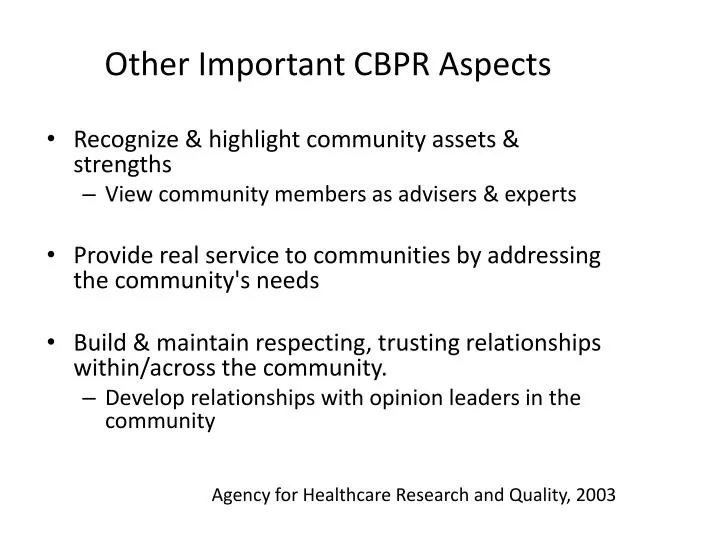
Other Important CBPR Aspects • Recognize & highlight community assets & strengths • View community members as advisers & experts • Provide real service to communities by addressing the community's needs • Build & maintain respecting, trusting relationships within/across the community. • Develop relationships with opinion leaders in the community Agency for Healthcare Research and Quality, 2003
Cultural responses to Obesity (wellness) CBPR in Brownsville, texas
Children BORN TODAY HAVE A LOWER LIFE EXPECTANCY THAN THEIR PARENTS • 1 in 3 will develop diabetes • 3/5 if African American • ½ if Hispanic • > ½ if Native American
Toxic Environment • Availability & affordability of high fat/high carbohydrate food (fast food, soft drinks) • Large portion sizes • Marketing to children • Fewer family meals • TV, computers, video games • Safety issue • Decrease in physical education Schwartz MB & Brownell KD, 2007
Dollars spent on U.S. food advertising in 2005 • Food, beverages, candy $7,313,200,000 • Restaurants & fast food $5,061,000,000 Advertising Age, 2006
Obesity is caused by long-term positive energy balance FatStores ~ 600 calories per day
Obesity Interventions • Current strategies are not containing the “diabesity” (sedentary) epidemic • Need to shift away from clinical view of obesity as personal disorder requiring medical Rx • Understanding, measuring, & altering the “obesogenic” environment is critical • Society has a key role in sharing with individuals the high “costs” of a healthy lifestyle change (maintenance)
The Truth About TV (True or False) • The average child watches about one hour of TV a day. TRUE or FALSE • By the age of eighteen, the average child has seen about two-thousand murders on TV. TRUE or FALSE • Children who watch three or more hours of TV a day are more likely to be overweight than children who watch less than two hours a day. TRUE or FALSE • Children who have a TV in their bedrooms are more likely to be overweight. TRUE or FALSE
What is Screen-Time? • Time spent in front of a screen: • TV (videos or DVDs) • Computer (surfing the Internet, emailing, playing games) • Handheld (instant messaging, playing games)
American Academy of Pediatricians Guidelines for Children’s Media Use No TV viewing for children < 2 years old No more 2 hours/day for older children Monitor programming
Over Exposed The Role of Media in Childhood Obesity, 2004 • Average of 5½ hours a day using media • Preschoolers (< 6 years old) • Time with screen media • Playing outside
TV Viewing & Behavior Problems Mistry et al., Pediatrics, 2007 • Healthy Steps for Young Children • Age 2.5 & 5.5 • 20% watched 2+ hrs • Behavioral problems • 41% kids had a TV in their bedroom • Poor sleep
TV Advertisements & Kids Illustration:: Cathy Wilcox The Role of Media in Childhood Obesity, 2004 • 40,000 ads a year on TV • Elaborate advertising campaigns • Candy • Soda • Snacks
TV Watching & Over Eating Credit iStock Francis & Birch, J Am Diet Assoc, 2006 • 24 children 3-5 years old • High socioeconomic status • > 1.5 hours of TV daily ate more while watching TV
What To Do about the TV? Set family goal to reduce screen-time “No eating while watching TV” rule Remove the TV from child’s bedroom Reward family with fun - EXERCISE
Physical Activity www.cdc.gov Reduces the risk for many diseases Helps control weight Strengthens muscles, bones, & joints Reduces feelings of depression & anxiety
Physical Activity & Academic Achievement Vail, Am School Board J, 2006; Grissom, 2004 Healthier students do better in school Students who do better on achievement tests tend to be more physically fit than peers Exercise alleviates stress & anxiety, improves asthma, boosts self-esteem – FACTORS that influence school attendance & performance