
Bell Ringer
E N D
Presentation Transcript
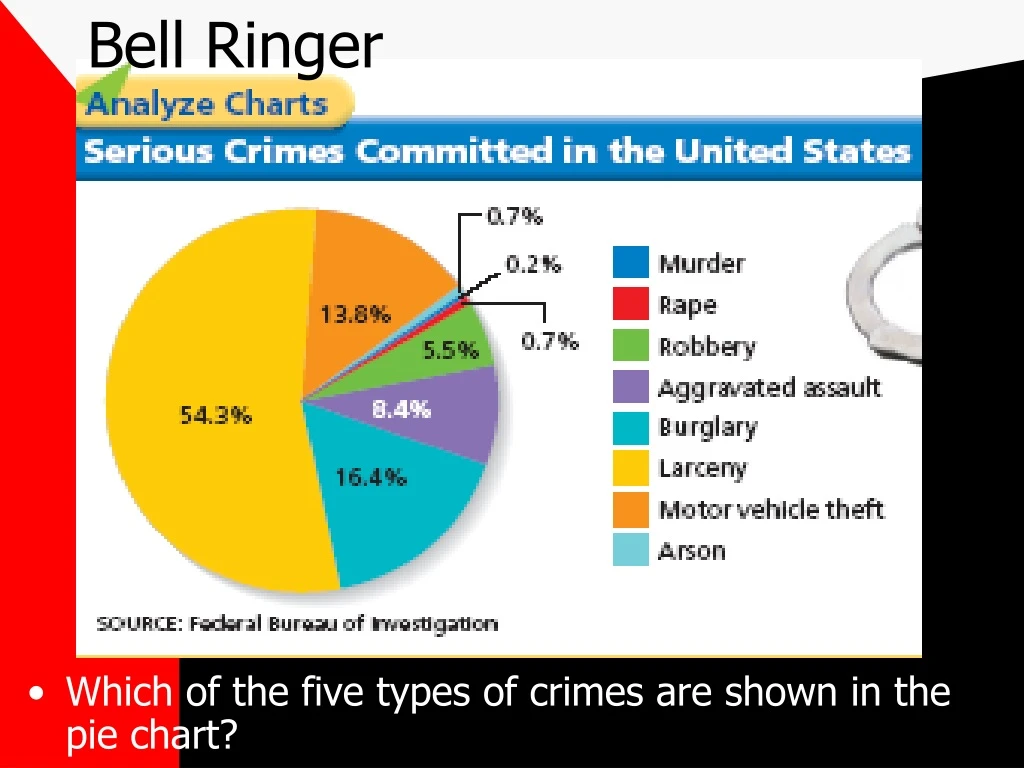
Bell Ringer • Which of the five types of crimes are shown in the pie chart?
The Criminal Justice System Chapter 20, Section 2
By the end of today’s lesson, you should be able to: • Describe the steps in criminal court proceedings.
Sequence of Events in the Criminal Justice System • Arrest • Preliminary or Initial Hearing • Grand Jury • Pretrial Motions • Plea Bargaining or Trial • Sentencing
#1 - Arrest • Arrest: taken into police custody • To arrest Jack the police must either have: • Probable Cause: a good reason to believe that a suspect has committed a crime • Warrant: legal paper that is issued by a court giving people permission to make an arrest, seizure, or search • Miranda rights
#2 – Preliminary or Initial Hearing • Suspect appears before a judge • Suspect is known as the defendant • Prosecutor convince the judge that there is enough evidence to continue with the case or the judge will dismiss the case and set the defendant free • Suspect enters a plea of guilty or not guilty • Bail is set • Bail: money that a defendant gives the court as a kind of promise that he or she will return for the trial
#3 – Grand Jury • Constitution requires that in cases involving serious federal crimes (felonies) that a grand jury is used. • States use grand juries too • Grand Jury is a group of 16-23 citizens that decide whether there is probable cause to believe a defendant committed the crime. • If they believe there is probable cause, the grand jury issues an indictment: a formal charge against the accused • The grand jury does not decide guilt or innocence! • If indicted, the defendant is formally charged at an arraignment.
#4 – Pretrial Motion • Evidence hearings • Illegally obtained evidence is thrown out • Admissions of guilt made under duress or by coercion can’t be used • Defendant must have been notified of all Miranda rights • If evidence or confessions are thrown out, the prosecutor may have to drop the charges against the defendant due to lack of sufficient evidence.
#5 – Plea Bargaining • Most cases never go to trial because of plea bargaining. • Plea Bargain: accused person pleads guilty but to a lesser charge or lighter sentence • Defendant gets less time in jail • Government saves the cost of a trial and is guaranteed some punishment for the defendant
#5 - Trial • Constitution requires that trials be speedy, public, have a jury, defendant has right to call witnesses, defendant has an attorney, and that the defendant not be required to testify
Trial Sequence • Jury Selection – both the prosecutor and the defense attorney can eliminate jurors they believe would be biased in some way • Opening Statements • Witnesses questioned by both attorneys • Closing Statements • Jury Deliberation • Outcome Announced
Hung Jury: jury can’t agree on the verdict which results in a mistrial; the accused can be tried again. Acquittal: Jury votes not guilty because they were not convinced beyond reasonable doubt that the accused committed the crime Guilty Verdict: Sentencing trial will determine the punishment. Possible Outcomes in a Criminal Trial
#6 - Sentencing • If the jury rules the defendant is guilty, there will be a sentencing hearing to decide how long the defendant will be punished. • Law generally sets maximum and minimum sentences for crimes • Judge can make considerations for age, attitude, and prior criminal record
Penalties for Crime • Punished more severely for felonies than misdemeanors • Penalties serves the purpose of punishment the criminal, protecting society, and to keep others from committing the same crime. • Federal Law has a 3 strikes you’re out sentencing.
Correctional Institutions • Jails are ran by cities and counties. • Prisons are ran by both the state and federal government. • Parole: letting an inmate go free to serve the rest of his or her sentence outside of prison • Lack of $ for prisons
Comprehension Check • What is an indictment? • A formal charge against a person accused of a crime
Comprehension Check • Why would a defendant plead guilty? • To get a lighter sentence or lesser charge
Comprehension Check • What type of cases does the Constitution require a grand jury hear? • Serious federal crimes
Comprehension Check • At which step does the judge decide whether to try the defendant? • Initial Hearing (Preliminary Hearing)
Comprehension Check • Why do judges set bail? • To ensure the defendant will return for the trial
Comprehension Check • What happens if a judge decides that evidence can not be used in a trial? • The prosecutor might have to drop charges against the accused
Comprehension Check • What are the requirements for an arrest? • Probable Cause or a Warrant