Download
1 / 28
280 likes | 394 Vues
This document presents a detailed exploration of atmospheric neutrinos, focusing on their primary spectrum and hadronic interactions. It emphasizes the fluxes of muons and neutrinos, particularly at high energies, and discusses the implications of various models and calculations on their behavior. Key topics include the symmetry in detector responses, flavor ratios at production, and the treatment of primary spectra, with contributions from significant experiments like Super-Kamiokande. This comprehensive analysis aims to understand atmospheric neutrino characteristics and their role in astrophysical investigations.

E N D
Atmospheric neutrinos Primary spectrum Hadronic interactions Fluxes of muons and neutrinos Emphasis on high energy Tom Gaisser
p p m e ne nm Atmospheric neutrino beam • Up-down symmetric except for geomagnetic effects • One detector for both • long baseline • short baseline • 1 < L/E < 105 km/GeV • nm/ne ~ 2 for En < GeV at production D. Ayres, A.K. Mann et al., 1982 Tom Gaisser Also V Stenger, DUMAND, 1980
Overview of the calculation Tom Gaisser
Summary of Atmospheric Neutrino Calculations A Tom Gaisser
A C B C/A B/A Comparison of 3 calculations used by Super-K nm + nm • Differences come from • Assumptions about primary spectrum • Treatment of hadronic interactions Y. Ashi et al. (Super-K Collaboration) hep-ex/0501064 Tom Gaisser
Flavor ratio at production • r =nm/ne at production sets background for search for effects of solar and s13 mixing • De = P2(r cos2q23 -1) Peres & Smirnov, 2004 • 0 for r = 2, q23=45o • rsub-GeV ~2.04 – 2.1 Tom Gaisser
Range of n flux calculations Tom Gaisser
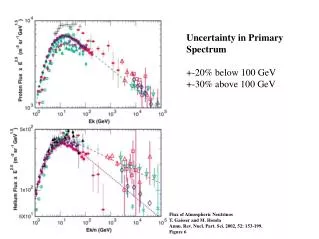
Protons Helium Primary spectrum • Largest source of overall uncertainty • 1995: experiments differ by 50% (see lines) • Present: AMS, BESS within 5% for protons • discrepancy for He larger, but He only 20% of nucleon flux • CAPRICE lower by 15-20% Tom Gaisser
Primary spectrum: new standard? • Fit BESS and AMS • Include small contributions from heavy elements • Extrapolate to high E • Use m and n measurements as constraints Tom Gaisser
e (or m) ne (or nm) nm Classes of atmospheric n events m Contained (any direction) n-induced m (from below) Tom Gaisser
Super-K atmospheric neutrino data (hep-ex/0501064) CC ne CC nm 1489day FC+PC data + 1646day upward going muon data Tom Gaisser
Fit 2 flavor mixing: sin2q23 = 1.0 dm2 = 2.1x10⁻³ eV2 38 parameters represent uncertainties in flux of atmospheric neutrinos Super-K fits Tom Gaisser
nm-induced upward m Super-KAMIOKANDE MACRO Tom Gaisser
High-energy n in Super-K • In Super-K fit, primary spectrum shifts: • Overall normalization up 11% • Slope < 100 GeV changes: -2.74 -2.71 • Slope > 100 GeV changes: -2.71 -2.66 • K/p decreases by 6% • Can we use Super-K measurements (together with muon measurements) to constrain extrapolation of neutrino spectrum to high energy? • Work in progress with P. Lipari, T. Stanev & G. Barr Tom Gaisser
Neutrino response to primary spectrum Primary energy / nucleon Neutrino energy Tom Gaisser
/nucleon) All-nucleon spectrum Tom Gaisser
n = nm + nm Analytic approximations for E>10 GeV Similar forms for muons but … Zpm = 0.67 Tom Gaisser
Atmospheric n-induced m QGSjet 0.167 0.081 0.032 0.028 0.0047 0.0032 No oscillations With oscillations Paolo Lipari calculation with standard Z-factors Tom Gaisser
----TG calculation, Primary spectrum: N(E) = 1.7 E-2.70 Agrawal et al., PRD53 (1996) 1314 Lipari, standard Z-factors, Primary spectrum: N(E) = 1.75 E-2.71 Vertical muon flux Tom Gaisser
vertical 60 degrees Importance of kaons at high E • Importance of kaons • main source of n > 100 GeV • p K+ + L important • Charmed analog important for prompt leptons at higher energy Tom Gaisser
Differences in kaon production Tom Gaisser
Comparison of n flux calculations: Importance of K at high energhy A B C Tom Gaisser
n / anti-n ratios Tom Gaisser
histogram : NUSIM histogram : CORSIKA line : Lipari dots: AMANDA-II data line : Bartol Unfolded neutrino energy spectrum (2000) line : Honda ~x2 atmospheric neutrinos Paolo Desiati can we use AMANDA-II atmospheric neutrino data to probe these uncertainties ? E3·dN/dE (cm-2 s-1 sr-1GeV2) Log10(Eν) CORSIKA ~ - 30:50% than NUSIM/Lipari Tom Gaisser
Calibration with atmospheric n • MINOS, etc. • Neutrino telescopes • Example*** of nm / ne • flavor ratio • angular dependence ***Note: this is maximal effect: horizontal = 85 - 90 deg in plots Tom Gaisser
Plot shows sum of neutrinos + antineutrinos Possible E-2 diffuse astrophysical spectrum (WB bound / 2 for osc) nm ne Current AMANDA upper limit 2.6 x 10⁻⁷ GeV/cm2 sr s Solar n RPQM for prompt n Bugaev et al., PRD58 (1998) 054001 Slope = 2.7 Prompt m Slope = 3.7 Global view of atmospheric n spectrum Tom Gaisser
W-B flux accounting for oscillations Diffuse signal vs charmed background in IceCube E-2 “signal” spectrum: E2dN/dE=10-7 GeV/cm2sr s IceCube Collaboration J. Ahrens et al., Astropart.Phys. 20 (2004) 507-532 Tom Gaisser
Concluding comments • Discovery of neutrino oscillations depends on measured ratios; therefore robust • Super-K fits suggests relatively hard spectrum • Air-shower data also suggests hard spectrum • Z-factors “explain” differences of calculations • Uncertainty in level of charm production limits sensitivity to diffuse astrophysical neutrinos Tom Gaisser