
SlideServe
Menu
Préférences
© SlideServe · v2026

Framework for Risk Assessment in Pedestrian-Friendly Environments

edward-cleveland avatar
1 diapositives · 217 Views · Nov 06, 2014

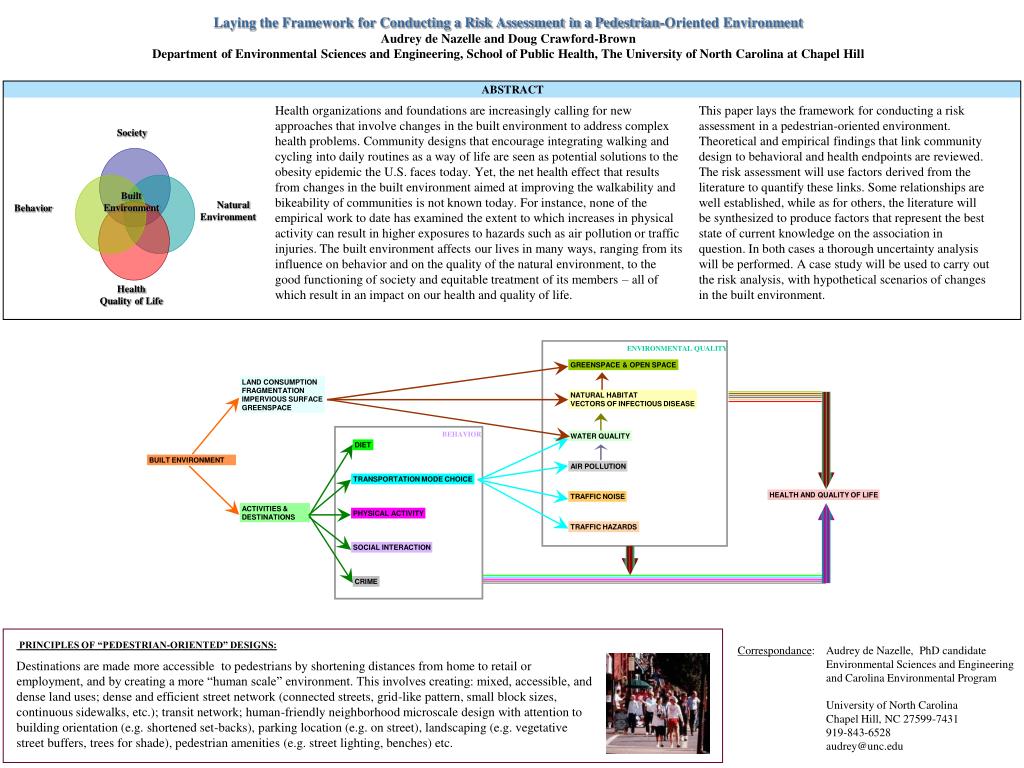
This paper presents a framework for conducting a risk assessment aimed at enhancing pedestrian-oriented environments. With increasing focus on built environments that promote walking and cycling to combat obesity, there is a lack of empirical data on the health impacts of these changes. The study reviews literature linking community design to health outcomes and proposes a methodology to quantify these relationships through risk analysis. A hypothetical case study will illustrate how changes in built environments can affect public health and exposure to hazards.
Framework for Risk Assessment in Pedestrian-Friendly Environments - slide 1
01 / 1Framework for Risk Assessment in Pedestrian-Friendly Environments
1 / 17

Télécharger la présentation

Framework for Risk Assessment in Pedestrian-Friendly Environments
Une image / un lien ci-dessous est fourni (tel quel) pour télécharger la présentation

Politique de téléchargement : le contenu du site vous est fourni TEL QUEL pour votre information et votre usage personnel ; il ne peut être vendu, concédé sous licence ni partagé sur d’autres sites sans l’accord de son auteur.Le contenu vous est fourni TEL QUEL, pour votre information et votre usage personnel uniquement. Téléchargez la présentation en cliquant sur ce lien. Lors du téléchargement, si vous ne parvenez pas à télécharger une présentation, l’éditeur a peut-être supprimé le fichier de son serveur.Pendant le téléchargement, si vous ne parvenez pas à obtenir une présentation, le fichier a peut-être été supprimé par l’éditeur.

F I N

Plus de contenu associé

Transcription de la présentation
  1. Laying the Framework for Conducting a Risk Assessment in a Pedestrian-Oriented Environment Audrey de Nazelle and Doug Crawford-Brown Department of Environmental Sciences and Engineering, School of Public Health, The University of North Carolina at Chapel Hill ABSTRACT Health organizations and foundations are increasingly calling for new approaches that involve changes in the built environment to address complex health problems. Community designs that encourage integrating walking and cycling into daily routines as a way of life are seen as potential solutions to the obesity epidemic the U.S. faces today. Yet, the net health effect that results from changes in the built environment aimed at improving the walkability and bikeability of communities is not known today. For instance, none of the empirical work to date has examined the extent to which increases in physical activity can result in higher exposures to hazards such as air pollution or traffic injuries. The built environment affects our lives in many ways, ranging from its influence on behavior and on the quality of the natural environment, to the good functioning of society and equitable treatment of its members – all of which result in an impact on our health and quality of life. This paper lays the framework for conducting a risk assessment in a pedestrian-oriented environment. Theoretical and empirical findings that link community design to behavioral and health endpoints are reviewed. The risk assessment will use factors derived from the literature to quantify these links. Some relationships are well established, while as for others, the literature will be synthesized to produce factors that represent the best state of current knowledge on the association in question. In both cases a thorough uncertainty analysis will be performed. A case study will be used to carry out the risk analysis, with hypothetical scenarios of changes in the built environment. Society Built Environment Behavior Natural Environment Health Quality of Life ENVIRONMENTAL QUALITY GREENSPACE & OPEN SPACE LAND CONSUMPTION FRAGMENTATION IMPERVIOUS SURFACE GREENSPACE NATURAL HABITAT VECTORS OF INFECTIOUS DISEASE BEHAVIOR WATER QUALITY DIET BUILT ENVIRONMENT AIR POLLUTION TRANSPORTATION MODE CHOICE HEALTH AND QUALITY OF LIFE TRAFFIC NOISE ACTIVITIES & DESTINATIONS PHYSICAL ACTIVITY TRAFFIC HAZARDS SOCIAL INTERACTION CRIME PRINCIPLES OF “PEDESTRIAN-ORIENTED” DESIGNS: Destinations are made more accessible to pedestrians by shortening distances from home to retail or employment, and by creating a more “human scale” environment. This involves creating: mixed, accessible, and dense land uses; dense and efficient street network (connected streets, grid-like pattern, small block sizes, continuous sidewalks, etc.); transit network; human-friendly neighborhood microscale design with attention to building orientation (e.g. shortened set-backs), parking location (e.g. on street), landscaping (e.g. vegetative street buffers, trees for shade), pedestrian amenities (e.g. street lighting, benches) etc. Correspondance: Audrey de Nazelle, PhD candidate Environmental Sciences and Engineering and Carolina Environmental Program University of North Carolina Chapel Hill, NC 27599-7431 919-843-6528 audrey@unc.edu