Celestial Mechanics: Exploring the Motion of Heavenly Bodies
Delve into celestial mechanics through calculating planetary orbits and elucidating Kepler’s laws. Uncover the significance of elliptical geometry, spherical trigonometry, and the celestial sphere in understanding planetary motion.

Celestial Mechanics: Exploring the Motion of Heavenly Bodies
E N D
Presentation Transcript
Celestial Mechanics Zhao Chen, Jamie Dougherty, Charlene Grahn, Meghan Kane, Richard Li, David Pan, Matthew Salesi, Katelyn Seither, Akash Shah, Sanjeev Tewani, Robert Won Advisor: Dr. Steve Surace Assistant: Jessica Kiscadden http://www.akhtarnama.com/CCD.htm
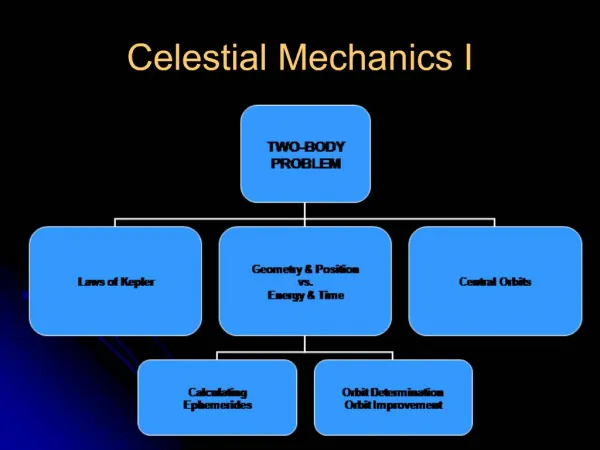
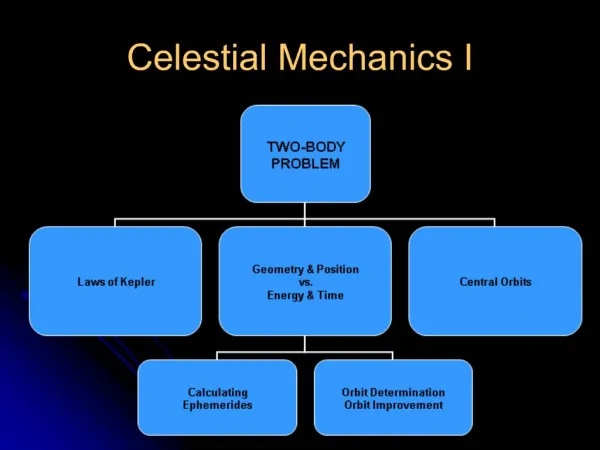
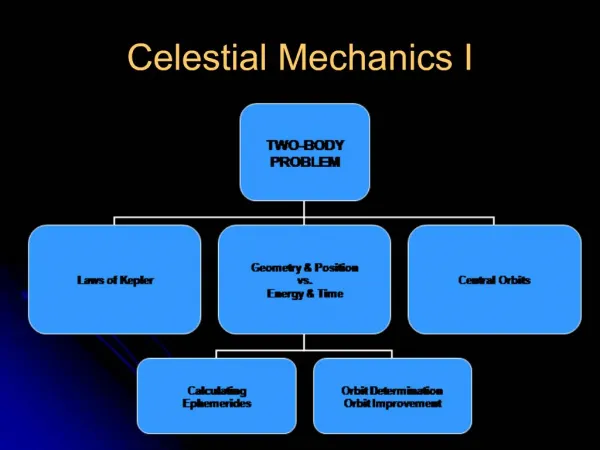
What is Celestial Mechanics? • Calculating motion of heavenly bodies as seen from Earth. • 6 Main Parts • Geometry of an Ellipse • Deriving Kepler’s Laws • Elliptical Motion • Spherical Trigonometry • The Celestial Sphere • Sundial
Elliptical Geometry • Planetary orbits are elliptical • Cartesian form of ellipse planet r r = (rcos θ, rsin θ) Sun • Shifting left c units and converting to polar form gives
Elliptical Geometry • Solving for r yields
Kepler’s Laws of Planetary Motion • 1. Planetary orbits are elliptical with Sun at one focus • 2. Planets sweep equal areas in equal times • 3. T 2/a 3 = k “Kepler’s got nothing on me.”
Kepler’s First Law • Starting with Newton’s laws and gravitational force equation • Doing lots of math: • Yields the equation of an ellipse
Kepler’s Second Law • Equal areas in equal times • Area in polar coordinates
Kepler's Second Law • Differentiating both sides yields • Expanding with chain rule and substituting
Kepler's Third Law • T 2/a 3 = k • From constant of Kepler’s Second Law • Substituting and simplifying yields
Kepler’s Laws and Elliptical Geometry • Easier to work with circumscribed circle • Use trigonometry • or
Finding Orbit • Define M = E – e sin E • Differentiating and substituting • Solving differential equation with E =0 at t =0,
Spherical Trigonometry • Studies triangles formed from three arcs on a sphere • Arcs of spherical triangles lie on great circles of sphere Points A, B, & C connect to form spherical triangle ABC
Spherical Trigonometry Given information from sphere • Derive Spherical Law of Cosines • Derive Spherical Law of Sines
Law of Cosines • Solve for side c’ in triangles A’OB and A’B’C
Spherical Law of Cosines • c’ equations equated and simplified to obtain Spherical Law of Cosines
Spherical Law of Sines • Manipulated Spherical Law of Cosines into • Equation is symmetric function, yielding Spherical Law of Sines.
Applying Spherical Trigonometry • Real world application-Calculating shortest distance between two cities • Given radius and circumference of Earth and latitude and longitude of NYC and London we found distance to be 5701.9 km
Where is the Sun? • Next goal: Find equations for the coordinates of Sun for any given day • Definitions • Right Ascension (α) = longitude • Measured in h, min, sec • Declination (δ) = latitude • Measured in degrees
Where is the Sun? • Using Spherical Law of Sines for this triangle, derived formula calculating declination of Sun • sin δ = (sin λ)(sin ε ) • On August 3, 2006 • λ = 2.3026 • δ = 17° 15’ 25’’
Where is the Sun? • Using Spherical Law of Cosines to find formula for right ascension and its value for Sun • August 3, 2006 • λ = 2.3026 • α = 8h 57min 37s
Predicting Sunrise and Sunset • H = Sun’s path on certain date • On equator at vernal equinox • Key realizations • Angle H • Draw the zenith
By Golly Moses! That’s Amazing! Predicting Sunrise and Sunset • Find angle H using Spherical Law of Cosines • H = 106.09° = 7 hours 4 minutes • Noon now: 1:00 PM (daylight savings) • Aug. 3, 2006 • Sunrise - 5:56 AM • Sunset - 8:04 PM
Constructing a Sundial • The coordinates are: Stick: (0, 0, L) Sun: (-Rsin15°, Rcos15°, 0) • A 15o change in the sun’s position implies a change in 1 hour
Constructing a Sundial • Coordinates in Rotated Axes Stick (0, -Lcosφ, Lsinφ) Sun (-rsin15°, rcos15°sinφ, rcos15°cosφ)
Constructing a Sundial • Solving for the equation of the line passing through the sun and the stick tip, we have • Where η is the arc degree measure of the sun with respect to the tilted y axis
Sundial Constructed • Finally, by plugging in different values for η, we arrive at the following chart. Time θ 9:00 AM -48.65° 10:00 AM -33.27° 11:00 AM -20.75° 12:00 PM -9.97° 1:00 PM 0° 2:00 PM 9.97° 3:00 PM 20.75° 4:00 PM 33.27° 5:00 PM 48.65°
[Math] is real magic, not like that fork-bending stuff. - Dr. Surace Once you’ve seen one equation, you’ve seen them all.- Dr. Miyamoto