
SlideServe
Menu
Préférences
© SlideServe · v2026

Evolution of Amphibians and Tetrapods: From Transition to Diversification

eferro avatar
24 diapositives · 453 Views · Jan 04, 2020

Explore the fascinating journey of amphibians, from their ancestral origins in water to their successful transition onto land, showcasing the diverse forms and evolutionary adaptations that shaped these unique creatures. Discover the anatomical changes in lungs and circulatory systems, the traits of early land tetrapods, and the respiratory mechanisms of modern amphibians. From Gymnophiona to Caudata and Anura, learn about the diverse orders and species within the amphibian class.
Evolution of Amphibians and Tetrapods: From Transition to Diversification - slide 1
01 / 24Evolution of Amphibians and Tetrapods: From Transition to Diversification
1 / 17

Télécharger la présentation

Evolution of Amphibians and Tetrapods: From Transition to Diversification
Une image / un lien ci-dessous est fourni (tel quel) pour télécharger la présentation

Politique de téléchargement : le contenu du site vous est fourni TEL QUEL pour votre information et votre usage personnel ; il ne peut être vendu, concédé sous licence ni partagé sur d’autres sites sans l’accord de son auteur.Le contenu vous est fourni TEL QUEL, pour votre information et votre usage personnel uniquement. Téléchargez la présentation en cliquant sur ce lien. Lors du téléchargement, si vous ne parvenez pas à télécharger une présentation, l’éditeur a peut-être supprimé le fichier de son serveur.Pendant le téléchargement, si vous ne parvenez pas à obtenir une présentation, le fichier a peut-être été supprimé par l’éditeur.

F I N

Plus de contenu associé

Transcription de la présentation
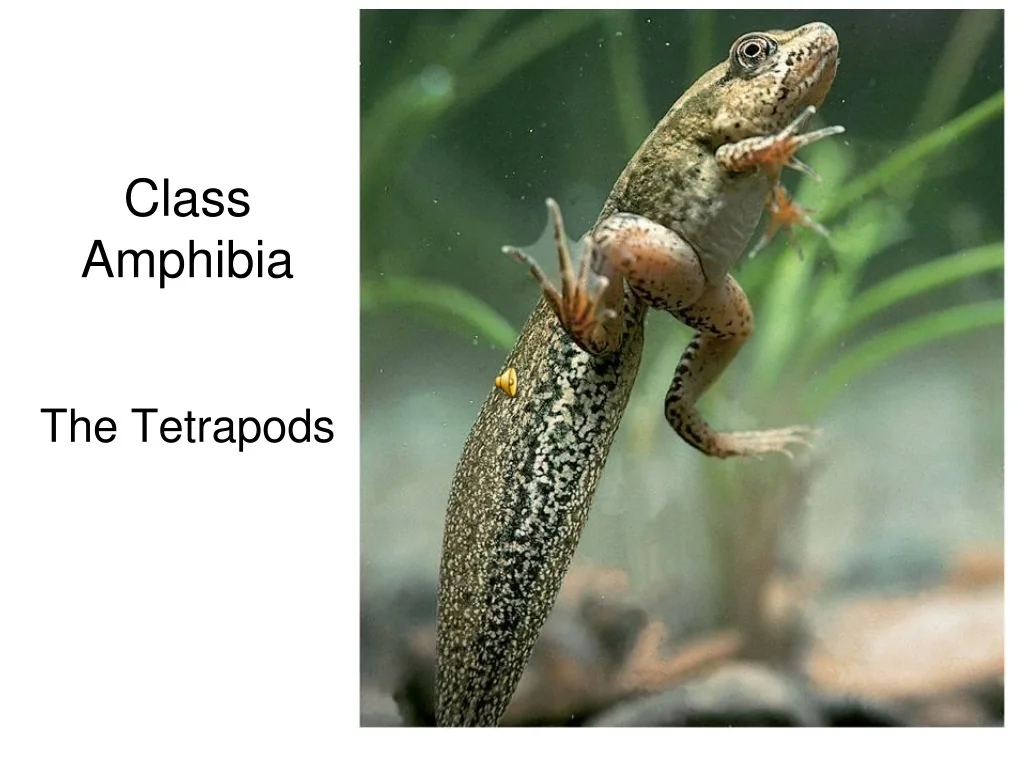
  1. Class Amphibia The Tetrapods

  2. Moving Ashore

  3. Transitional Forms

  4. Early Land Tetrapods

  5. Evolutionary Lung Forms

  6. Changes in Lung Anatomy In Tetrapods

  7. Amphibian Respiration

  8. Changes in Vertebrate Circulatory Systems

  9. Amphibian Heart Anatomy

  10. General Amphibian Traits • Tetrapods • 3-5 digits on forelimb (most 4) • 5 digits on hind limb • No dermal scales • Glandular epidermis • Most with indirect development, some with tadpole larvae • Gills as larvae/juveniles, lungs present but may degenerate, some with dermal respiration

  11. Order Gymnophiona • ~160 species • Legless • Burrowing or aquatic • Tropical • Internal fertilization • Oviparous & viviparous species • Direct development in most

  12. Order Gymnophiona (Apoda) Caecilians

  13. Order Caudata (Urodela) • AKA Salamanders • Have a tail • Divergence in respiratory mechanisms • Paedomorphosis prevalent • Internal fertilization

  14. Salamander/Newt Lifecycle

  15. Some Urodeles Necturus maculosus Giant Japanese Salamander Southern dusky salamander Ambystoma mexicanum (Axolotl)

  16. Order Anura • Frogs & Toads • No tail • External fertilization • Indirect development in most

  17. Frog or Toad? • Frogs – Associated with more aquatic habitats • Toads – Thicker skins – Dryer habitats

  18. Her Royal Highness • Xenopus laevis • Developmental model system

  19. Typical Anuran Lifecycle

  20. Really Weird Surinam Toad

  21. Local Species Acris crepitans Rana catesbeiana Bufo speciosus Bufo woodhousii Pseudacris clarki Rana pipiens