mutations
DNA mutations can occur during the copying process, leading to crucial changes in genetic material. There are two main types of mutations: point mutations, which involve a change at a single point in the DNA sequence, and frameshift mutations, which shift the entire sequence due to base addition or deletion. Each type can result in various outcomes, including silent mutations that do not alter proteins, missense mutations that change an amino acid, and nonsense mutations that can lead to significant issues in protein synthesis. Understanding these mutations is vital for genetics and biology.

mutations
E N D
Presentation Transcript
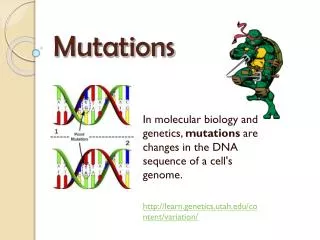
Defined • Sometimes, mistakes are made while copying DNA. If those mistakes are not repaired, it leads to a… • Mutation • An error in DNA
2 Kinds of Mutations • Point Mutation • An error occurring at a single point in the DNA • One base is changed to different base • EX: • Original strand: TAC GGA ATT CGC ATC CCC • Copied strand: TAC GGA ATT CTC ATC CCC
2 Kinds of Mutations • Frameshift Mutation • An error causing a shift in the DNA sequence • Addition of a new base or deletion of a base in DNA • EX: • Original: TAG CCT AAC ATG GCA TAT • Mutated: TAG CCT GAA CAT GGC ATA T • Original: TAG CCT AAC ATG GCA TAT • Mutated: TAG CCA ACA TGG CAT AT
Results • A point mutation or a frameshift mutation can have a range of results on our proteins formed during protein synthesis… • Here’s how to classify the types of results:
Results • Silent Mutation • The error in DNA causes no difference in the protein formed • Missense Mutation • The error in DNA causes a change in the protein formed, such as one incorrect amino acid • Nonsense Mutation • The error in DNA causes a MAJOR problem in the protein formed, such as the absence of a start codon, or an early stop codon