Advancements in High Gradient Acceleration: A Study on Normal-Conducting Accelerators
10 likes | 138 Vues
This study focuses on high gradient acceleration using normal-conducting, high-frequency technologies to develop compact and efficient accelerator structures. With a record of 65 MV/m achieved in a 60 cm accelerator, we are now collaborating with CERN on a feasibility study for the CLIC project at 100 MV/m, with confidence at 80 MV/m. Understanding vacuum breakdown is crucial, as it underpins future developments toward CLIC and beyond. This foundational research is necessary alongside prototype tests, aiming for high-energy machines and improvements in existing technologies.


Advancements in High Gradient Acceleration: A Study on Normal-Conducting Accelerators
E N D
Presentation Transcript
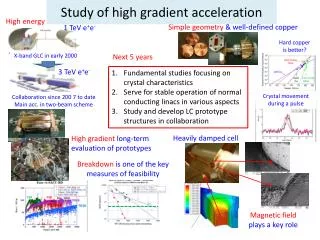
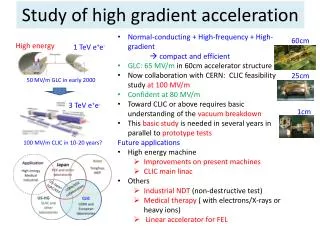
Study of high gradient acceleration • Normal-conducting + High-frequency + High-gradient • compact and efficient • GLC: 65 MV/m in 60cm accelerator structure • Now collaboration with CERN: CLIC feasibility study at 100 MV/m • Confident at 80 MV/m • Toward CLIC or above requires basic understanding of the vacuum breakdown • This basic study is needed in several years in parallel to prototype tests • Future applications • High energy machine • Improvements on present machines • CLIC main linac • Others • Industrial NDT (non-destructive test) • Medical therapy ( with electrons/X-rays or heavy ions) • Linear accelerator for FEL 60cm High energy 1 TeVe+e- 25cm 50 MV/m GLC in early 2000 3TeVe+e- 1cm 100 MV/m CLIC in 10-20 years?