
Floating point
E N D
Presentation Transcript
Floating point Today IEEE Floating Point Standard Rounding Floating Point Operations Mathematical properties Next time The machine model Fabián E. Bustamante, Spring 2007
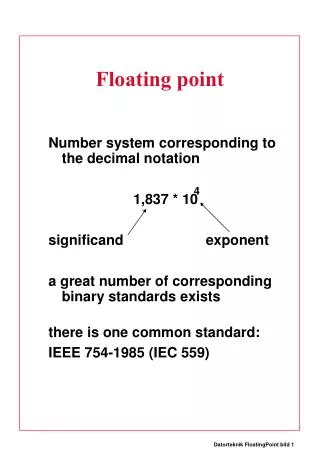
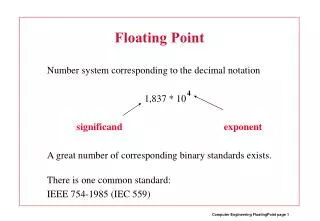
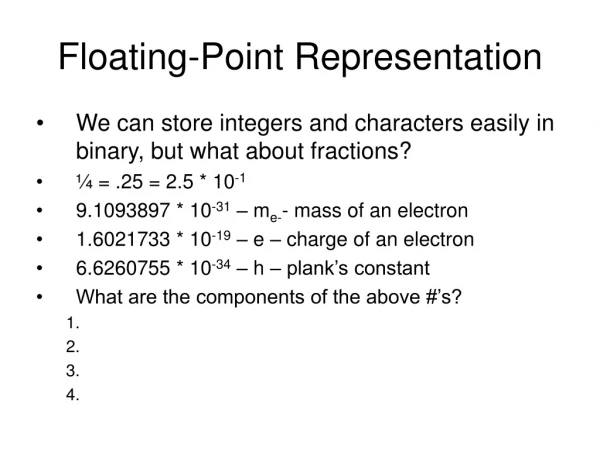
IEEE Floating point • Floating point representations • Encodes rational numbers of the form V=x*(2y) • Useful for very large numbers or numbers close to zero • IEEE Standard 754 (IEEE floating point) • Established in 1985 as uniform standard for floating point arithmetic (started as an Intel’s sponsored effort) • Before that, many idiosyncratic formats • Supported by all major CPUs • Driven by numerical concerns • Nice standards for rounding, overflow, underflow • Hard to make go fast • Numerical analysts predominated over hardware types in defining standard EECS 213 Introduction to Computer SystemsNorthwestern University
bi bi–1 • • • b2 b1 b0 . b–1 b–2 b–3 • • • b–j Fractional binary numbers • Representation • Bits to right of “binary point” represent fractional powers of 2 • Represents rational number: 2i 2i–1 4 • • • 2 1 1/2 • • • 1/4 1/8 2–j EECS 213 Introduction to Computer SystemsNorthwestern University
Fractional binary number examples • Value Representation • 5-3/4 101.112 • 2-7/8 10.1112 • 63/64 0.1111112 • Observations • Divide by 2 by shifting right (the point moves to the left) • Multiply by 2 by shifting left (the point moves to the right) • Numbers of form 0.111111…2 represent those just below 1.0 • 1/2 + 1/4 + 1/8 + … + 1/2i + … 1.0 • We use notation 1.0 – ε to represent them ???? ???? ???? EECS 213 Introduction to Computer SystemsNorthwestern University
Representable numbers • Limitation • Can only exactly represent numbers of the form x/2k • Other numbers have repeating bit representations • Value Representation • 1/3 0.0101010101[01]…2 • 1/5 0.001100110011[0011]…2 • 1/10 0.0001100110011[0011]…2 EECS 213 Introduction to Computer SystemsNorthwestern University
Floating point representation • Numerical form • V = (–1)s * M * 2E • Sign bit s determines whether number is negative or positive • Significand M normally a fractional value in range [1.0,2.0). • Exponent E weights value by power of two • Encoding • MSB is sign bit • exp field encodes E (note: encode != is) • frac field encodes M s exp frac EECS 213 Introduction to Computer SystemsNorthwestern University
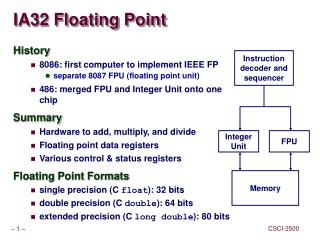
s exp frac Floating point precisions • Encoding • Sign bit; exp (encodes E): k-bit; frac (encodes M): n-bit • Sizes • Single precision: k = 8 exp bits, n= 23 frac bits • 32 bits total • Double precision: k = 11 exp bits, n = 52 frac bits • 64 bits total • Extended precision: k = 15 exp bits, n = 63 frac bits • Only found in Intel-compatible machines • Stored in 80 bits • 1 bit wasted • Value encoded – three different cases, depending on value of exp EECS 213 Introduction to Computer SystemsNorthwestern University
Normalized numeric values • Condition • exp 000…0 and exp 111…1 • Exponent coded as biased value • E = Exp – Bias • Exp : unsigned value denoted by exp • Bias : Bias value • Single precision: 127 (Exp: 1…254, E: -126…127) • Double precision: 1023 (Exp: 1…2046, E: -1022…1023) • in general: Bias = 2k-1 - 1, where k is number of exponent bits • Significand coded with implied leading 1 • M = 1.xxx…x2 (1+f & f = 0.xxx2) • xxx…x: bits of frac • Minimum when 000…0 (M = 1.0) • Maximum when 111…1 (M = 2.0 – ε) • Get extra leading bit for “free” EECS 213 Introduction to Computer SystemsNorthwestern University
Normalized encoding example • Value • Float F = 15213.0; • 1521310 = 111011011011012 = 1.11011011011012 X 213 • Significand • M = 1.11011011011012 • frac = 11011011011010000000000 • Exponent • E = 13 • Bias = 127 • exp = 140 =100011002 Floating Point Representation: Hex: 4 6 6 D B 4 0 0 Binary: 0100 0110 0110 1101 1011 0100 0000 0000 140: 100 0110 0 15213:110 1101 1011 01 EECS 213 Introduction to Computer SystemsNorthwestern University
Denormalized values • Condition • exp = 000…0 • Value • Exponent value E = 1 - Bias • Note: not simply E= – Bias • Significand value M = 0.xxx…x2 (0.f) • xxx…x: bits of frac • Cases • exp = 000…0, frac = 000…0 • Represents value 0 • Note that have distinct values +0 and –0 • exp = 000…0, frac 000…0 • Numbers very close to 0.0 EECS 213 Introduction to Computer SystemsNorthwestern University
Special values • Condition • exp = 111…1 • Cases • exp = 111…1, frac = 000…0 • Represents value ∞(infinity) • Operation that overflows • Both positive and negative • E.g., 1.0/0.0 = -1.0/-0.0 = +∞, 1.0/-0.0 = -∞ • exp = 111…1, frac 000…0 • Not-a-Number (NaN) • Represents case when no numeric value can be determined • E.g., sqrt(-1), (∞-∞) EECS 213 Introduction to Computer SystemsNorthwestern University
Summary of FP real number encodings + -Normalized +Denorm +Normalized -Denorm NaN NaN 0 +0 EECS 213 Introduction to Computer SystemsNorthwestern University
Tiny floating point example • 8-bit Floating Point Representation • the sign bit is in the most significant bit. • the next four (k) bits are the exponent, with a bias of 7 (2k-1-1) • the last three (n) bits are the frac • Same General Form as IEEE Format • normalized, denormalized • representation of 0, NaN, infinity 0 7 6 3 2 s exp frac EECS 213 Introduction to Computer SystemsNorthwestern University
Values related to the exponent Exp exp E 2E 0 0000 -6 1/64 (denorms) 1 0001 -6 1/64 2 0010 -5 1/32 3 0011 -4 1/16 4 0100 -3 1/8 5 0101 -2 1/4 6 0110 -1 1/2 7 0111 0 1 8 1000 +1 2 9 1001 +2 4 10 1010 +3 8 11 1011 +4 16 12 1100 +5 32 13 1101 +6 64 14 1110 +7 128 15 1111 n/a (inf, NaN) Normalized E = e - Bias Denormalized E = 1 - Bias EECS 213 Introduction to Computer SystemsNorthwestern University
Dynamic range s exp frac EValue 0 0000 000 -6 0 0 0000 001 -6 1/8*1/64 = 1/512 0 0000 010 -6 2/8*1/64 = 2/512 … 0 0000 110 -6 6/8*1/64 = 6/512 0 0000 111 -6 7/8*1/64 = 7/512 0 0001 000 -6 8/8*1/64 = 8/512 0 0001 001 -6 9/8*1/64 = 9/512 … 0 0110 110 -1 14/8*1/2 = 14/16 0 0110 111 -1 15/8*1/2 = 15/16 0 0111 000 0 8/8*1 = 1 0 0111 001 0 9/8*1 = 9/8 0 0111 010 0 10/8*1 = 10/8 … 0 1110 110 7 14/8*128 = 224 0 1110 111 7 15/8*128 = 240 0 1111 000 n/a inf closest to zero Denormalized numbers largest denorm smallest norm closest to 1 below closest to 1 above Normalized numbers largest norm EECS 213 Introduction to Computer SystemsNorthwestern University
Distribution of values • 6-bit IEEE-like format • e = 3 exponent bits • f = 2 fraction bits • Bias is 3 • Notice how the distribution gets denser toward zero. EECS 213 Introduction to Computer SystemsNorthwestern University
Distribution of values (close-up view) • 6-bit IEEE-like format • e = 3 exponent bits • f = 2 fraction bits • Bias is 3 • Note: Smooth transition between normalized and de-normalized numbers due to definition E = 1 - Bias for denormalized values EECS 213 Introduction to Computer SystemsNorthwestern University
Interesting numbers Description exp frac Numeric Value Zero 00…00 00…00 0.0 Smallest Pos. Denorm. 00…00 00…01 2– {23,52} X 2– {126,1022} • Single ~ 1.4 X 10–45 • Double ~ 4.9 X 10–324 Largest Denormalized 00…00 11…11 (1.0 – ε) X 2– {126,1022} • Single ~ 1.18 X 10–38 • Double ~ 2.2 X 10–308 Smallest Pos. Normalized 00…01 00…00 1.0 X 2– {126,1022} • Just larger than largest denormalized One 01…11 00…00 1.0 Largest Normalized 11…10 11…11 (2.0 – ε) X 2 {127,1023} • Single ~ 3.4 X 1038 • Double ~ 1.8 X 10308 EECS 213 Introduction to Computer SystemsNorthwestern University
Floating point operations • Conceptual view • First compute exact result • Make it fit into desired precision • Possibly overflow if exponent too large • Possibly round to fit into frac • Rounding modes (illustrate with $ rounding) $1.40 $1.60 $1.50 $2.50 –$1.50 Zero $1 $1 $1 $2 –$1 Round down (-∞) $1 $1 $1 $2 –$2 Round up (+∞) $2 $2 $2 $3 –$1 Nearest Even (default) $1 $2 $2 $2 –$2 Note: 1. Round down: rounded result is close to but no greater than true result. 2. Round up: rounded result is close to but no less than true result. EECS 213 Introduction to Computer SystemsNorthwestern University
Closer look at round-to-even • Default rounding mode • All others are statistically biased • Sum of set of positive numbers will consistently be over- or under- estimated • Applying to other decimal places / bit positions • When exactly halfway between two possible values • Round so that least significant digit is even • E.g., round to nearest hundredth • 1.2349999 1.23 (Less than half way) • 1.2350001 1.24 (Greater than half way) • 1.2350000 1.24 (Half way—round up) • 1.2450000 1.24 (Half way—round down) EECS 213 Introduction to Computer SystemsNorthwestern University
Rounding binary numbers • Binary fractional numbers • “Even” when least significant bit is 0 • Half way when bits to right of rounding position = 100…2 • Examples • Round to nearest 1/4 (2 bits right of binary point) Value Binary Rounded Action Rounded Value 2 3/32 10.000112 10.002 (<1/2—down) 2 2 3/16 10.001102 10.012 (>1/2—up) 2 1/4 2 7/8 10.111002 11.002 (1/2—up) 3 2 5/8 10.101002 10.102 (1/2—down) 2 1/2 EECS 213 Introduction to Computer SystemsNorthwestern University
FP multiplication • Operands • (–1)s1 M1 2E1 * (–1)s2 M2 2E2 • Exact result • (–1)s M 2E • Sign s: s1 ^ s2 • Significand M: M1 * M2 • Exponent E: E1 + E2 • Fixing • If M ≥ 2, shift M right, increment E • If E out of range, overflow • Round M to fit frac precision • Implementation • Biggest chore is multiplying significands EECS 213 Introduction to Computer SystemsNorthwestern University
E1–E2 • (–1)s1 M1 • (–1)s2 M2 + • (–1)s M FP addition • Operands • (–1)s1 M1 2E1 • (–1)s2 M2 2E2 • Assume E1 > E2 • Exact Result • (–1)s M 2E • Sign s, significand M: • Result of signed align & add • Exponent E: E1 • Fixing • If M ≥ 2, shift M right, increment E • if M < 1, shift M left k positions, decrement E by k • Overflow if E out of range • Round M to fit frac precision EECS 213 Introduction to Computer SystemsNorthwestern University
Mathematical properties of FP add • Compare to those of Abelian Group • Closed under addition? YES • But may generate infinity or NaN • Commutative? YES • Associative? NO • Overflow and inexactness of rounding • (3.14+1e10)-1e10=0 (rounding) • 3.14+(1e10-1e10)=3.14 • 0 is additive identity? YES • Every element has additive inverse ALMOST • Except for infinities & NaNs • Monotonicity • a ≥ b a+c ≥ b+c? ALMOST • Except for NaNs EECS 213 Introduction to Computer SystemsNorthwestern University
Math. properties of FP multiplication • Compare to commutative ring • Closed under multiplication? YES • But may generate infinity or NaN • Multiplication Commutative? YES • Multiplication is Associative? NO • Possibility of overflow, inexactness of rounding • 1 is multiplicative identity? YES • Multiplication distributes over addition? NO • Possibility of overflow, inexactness of rounding • Monotonicity • a ≥ b & c ≥ 0 a *c ≥ b *c? ALMOST • Except for NaNs EECS 213 Introduction to Computer SystemsNorthwestern University
Floating point in C • C guarantees two levels • float single precision • double double precision • Conversions • int → float : maybe rounded • int → double : exact value preserved (double has greater range and higher precision) • float → double : exact value preserved (double has greater range and higher precision) • double → float : may overflow or be rounded • double → int : truncated toward zero (-1.999 → -1) • float → int : truncated toward zero EECS 213 Introduction to Computer SystemsNorthwestern University
Floating point puzzles • For each of the following C expressions, either: • Argue that it is true for all argument values • Explain why not true • x == (int)(float) x • x == (int)(double) x • f == (float)(double) f • d == (float) d • f == -(-f); • 2/3 == 2/3.0 • d < 0.0 ((d*2) < 0.0) • (d+f)-d == f int x = …; float f = …; double d = …; Assume neither d nor f is NaN EECS 213 Introduction to Computer SystemsNorthwestern University
Summary • IEEE Floating point has clear mathematical properties • Represents numbers of form M X 2E • Not the same as real arithmetic • Violates associativity/distributivity • Makes life difficult for compilers & serious numerical applications programmers EECS 213 Introduction to Computer SystemsNorthwestern University