
SlideServe
Menu
Préférences
© SlideServe · v2026

Stress and Relaxation Measurement in Thin Films: A Comprehensive Study

elaine avatar
26 diapositives · 412 Views · Jun 27, 2013

Development and application of an apparatus designed to measure stress and relaxation in thin film samples at high temperatures. The study, conducted by Cynthia Macht, Nick Svencer, and Heather Stern from Tufts University, explores various thin film materials, including polymers and silicon wafers. Key experiments highlight the challenges of measuring curvature and stress, as well as the results obtained from testing polystyrene samples and silicon nitride. Important conclusions include relaxation time constants and thermal expansion properties.
Stress and Relaxation Measurement in Thin Films: A Comprehensive Study - slide 1
01 / 26Stress and Relaxation Measurement in Thin Films: A Comprehensive Study
1 / 17

Télécharger la présentation

Stress and Relaxation Measurement in Thin Films: A Comprehensive Study
Une image / un lien ci-dessous est fourni (tel quel) pour télécharger la présentation

Politique de téléchargement : le contenu du site vous est fourni TEL QUEL pour votre information et votre usage personnel ; il ne peut être vendu, concédé sous licence ni partagé sur d’autres sites sans l’accord de son auteur.Le contenu vous est fourni TEL QUEL, pour votre information et votre usage personnel uniquement. Téléchargez la présentation en cliquant sur ce lien. Lors du téléchargement, si vous ne parvenez pas à télécharger une présentation, l’éditeur a peut-être supprimé le fichier de son serveur.Pendant le téléchargement, si vous ne parvenez pas à obtenir une présentation, le fichier a peut-être été supprimé par l’éditeur.

F I N

Plus de contenu associé

Transcription de la présentation
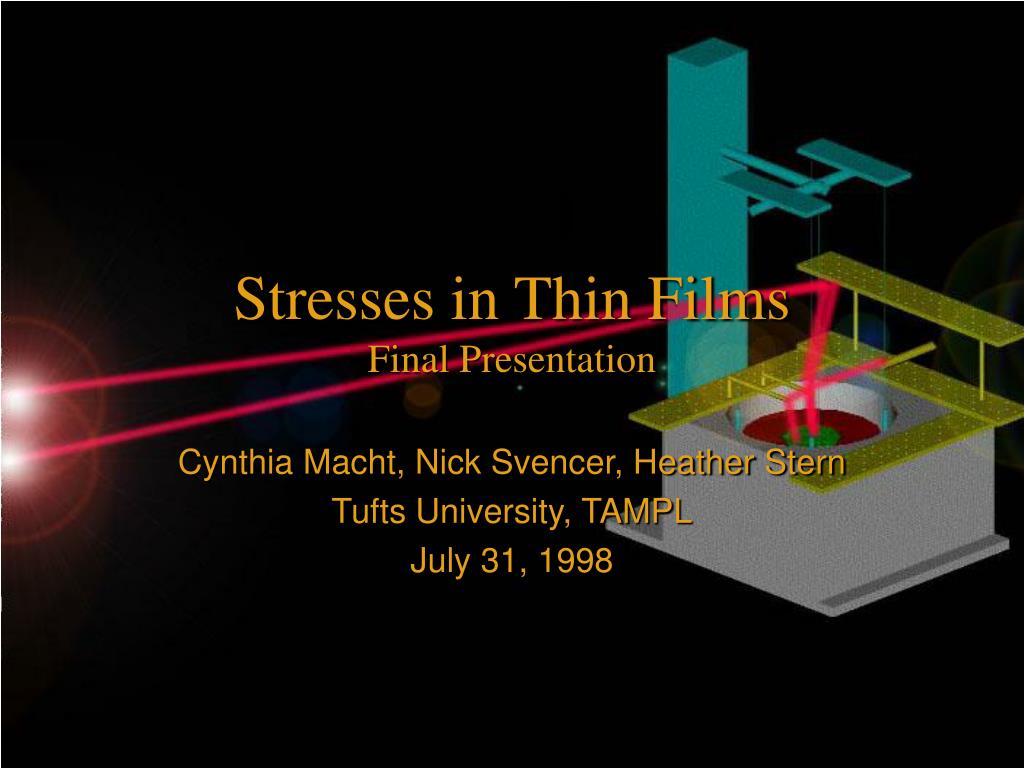
  1. Stresses in Thin FilmsFinal Presentation Cynthia Macht, Nick Svencer, Heather Stern Tufts University, TAMPL July 31, 1998 TAMPL

  2. Overview • Initial Goals • Setup Modifications • Samples • Data • Conclusions TAMPL

  3. Initial Goals • Design and Construct Apparatus • Fabricate Samples • Test Thin Film Samples for Stress and Relaxation at High Temperatures • Polymers • Silicon Wafers • Analyze Data TAMPL

  4. Final Apparatus • Split-Beam Laser Technique • Heater Raised Around Sample • Stainless Steel Sample Holder • Quartz Plate • Two Fans • Thermocouples TAMPL

  5. Quartz Plate TAMPL

  6. Final Apparatus Continued New Sample Holder -Stainless Steel Higher Temperatures -58% Open Space Fans in Place on Heater -Reduces Convection Currents Above Quartz Plate TAMPL

  7. Laser Schematic Large Mirror Wall x laser Beam Splitter Mirror S Sample R TAMPL

  8. Obstacles to Dot Measurement • Extremely Slight Bending of Silicon Wafers • Difficult to Detect Change in Dot Distance • Dots Change Shape During Experiment • Loss of Reference Point Human Error CCD Camera TAMPL

  9. Polystyrene Samples • Brass Substrate • Thickness .010-.031” • Polystyrene Film • Thickness .006-.007” +/- .001” • Polymer Sold by Polaroid TAMPL

  10. Formulas to Determine Stress of Thin Films Curvature Where, K=curvature, R=radius of curvature, x=distance between laser dots on wall, S=distance between dots on sample L=total length traveled by laser beam Stoney Formula Where =stress of the film, =Young’s modulus of the substrate =thickness of substrate =Poisson’s Ratio of the substrate =thickness of the film TAMPL

  11. Polystyrene Relaxation curve, average temp = 344.45°K, time constant = 1/.013244=75.51s Time vs. Change in Curvature of .010”Brass/.006±.001”Polystyrene Change in Curvature (1/m) Time (s) TAMPL

  12. Polystyrene Relaxation Curve, average temperature = 330.75°K time constant =1/.03199=31.26s Time vs. Change in Curvature of .010”Brass/.007±.001”Polystyrene Change in Curvature (1/m) Time (s) TAMPL

  13. Polystyrene Relaxation Curve, average temperature = 351.19°K time constant =1/.01739=57.50s Time vs. Change in Curvature of .031”Brass/.006±.001”Polystyrene Change in Curvature (1/m) Time (s) TAMPL

  14. Polystyrene Conclusions • Relaxation time constant range of polystyrene 31-76 s TAMPL

  15. Silicon WafersFabricated by Northeastern University • Silicon Nitride on Silicon Wafer (SiNx) • Silicon Nitride Thickness 840 Å • Silicon Substrate Thickness .37 mm • Silicon Dioxide on Silicon Wafer (SiO2) • Silicon Dioxide Thickness 1970 Å • Silicon Substrate Thickness .37 mm TAMPL

  16. TAMPL

  17. Formulas for Thin Film Curvature1 1Townsend, Barnett, & Brunner, 1987. TAMPL

  18. Silicon: Coefficient of Thermal Expansion = ~3.58E-6/ºC Young’s Modulus = 1.30E11 Pa TAMPL

  19. Silicon Oxide Conclusions • Coefficient of thermal expansion of Silicon Oxide is slightly smaller than that of Silicon which is ~3.58E-6 TAMPL

  20. TAMPL

  21. Silicon: Coefficient of Thermal Expansion = ~3.58E-6/ºC Young’s Modulus = 1.30E11 Pa TAMPL

  22. Silicon Nitride Wafer at Young’s Modulus 2.00E12 Pa TAMPL

  23. TAMPL

  24. Silicon Nitride Conclusions • Coefficient of thermal expansion of SiNx is slightly smaller than that of Silicon which is ~3.58E-6 • SiNx relaxes at 773ºK TAMPL

  25. Final Conclusions • Developed an instrument to measure curvature in a variety of thin film materials, from polymers to semiconductors TAMPL

  26. Visit Our Web Site At: http://www.tufts.edu/~nsvencer/stressmain.html TAMPL