Understanding Taxonomy and Classification in Organismal Science
Taxonomy is the systematic grouping of organisms based on their evolutionary and structural relationships. It involves classifying living things into categories: Kingdom, Phylum, Class, Order, Family, Genus, and Species. The roots of classification trace back to Aristotle, who attempted to categorize organisms by their habitats. In contrast, Carl Linnaeus revolutionized this field by introducing binomial nomenclature, a two-name system still in use today, utilizing Latin to create universally accepted scientific names, ensuring clarity and consistency in the naming of species.

Understanding Taxonomy and Classification in Organismal Science
E N D
Presentation Transcript
The classification of organisms in an ordered system that indicates natural relationships. Taxonomy is
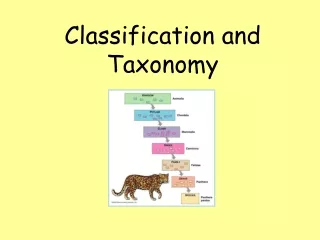
The systematic grouping of organisms into categories on the basis of evolutionary or structural relationships between them Classification is 1. Kingdom 2. Phylum 3. Class 4. Order 5. Family 6. Genus 7. Species
Some History • Aristotle: Greek philosopher (384 – 322 BC) • Began classifying organisms into 3 distinct groups: Of the air flying Of the water swimming Of the land walking • What’s wrong with this system?
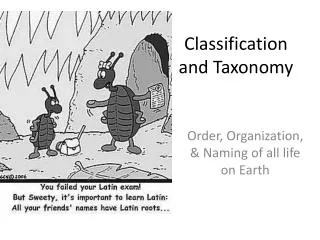
Carolus Linnaeus • Swedish botanist • 1707 – 1778 • Developed system of • binomial nomenclature • Bi = two • Nomial= name • Nomenclature = system of assigning names • Two-name system still in use today • Consists of 7 categories • Latin-based -- Why Latin? • Universally accepted language • Language that’s not used anymore
Mountain lion Puma Cougar Catamount Panther Ghost Cat Name this Animal
The Scientific or Latin Name for this species is Felis concolor (Always italics or underlined) Felis = Genus (always capitalized) concolor = Species (Always lower case) Name this Animal