SlideServe
Menu
Préférences
© SlideServe · v2026

Classification and Taxonomy

dante avatar
38 diapositives · 889 Views · Jul 21, 2014

Classification and Taxonomy. Classifying Organisms. Taxonomy : the science of describing, naming, and classifying organisms. Ways to Classify Organisms. Unicellular vs. multicellular Prokaryote vs. eukaryote Autotroph vs. heterotroph Linnean system and binomial nomenclature (today).
Classification and Taxonomy - slide 1
01 / 38Classification and Taxonomy
1 / 17

Télécharger la présentation

Classification and Taxonomy
Une image / un lien ci-dessous est fourni (tel quel) pour télécharger la présentation

Politique de téléchargement : le contenu du site vous est fourni TEL QUEL pour votre information et votre usage personnel ; il ne peut être vendu, concédé sous licence ni partagé sur d’autres sites sans l’accord de son auteur.Le contenu vous est fourni TEL QUEL, pour votre information et votre usage personnel uniquement. Téléchargez la présentation en cliquant sur ce lien. Lors du téléchargement, si vous ne parvenez pas à télécharger une présentation, l’éditeur a peut-être supprimé le fichier de son serveur.Pendant le téléchargement, si vous ne parvenez pas à obtenir une présentation, le fichier a peut-être été supprimé par l’éditeur.

F I N

Plus de contenu associé

Transcription de la présentation
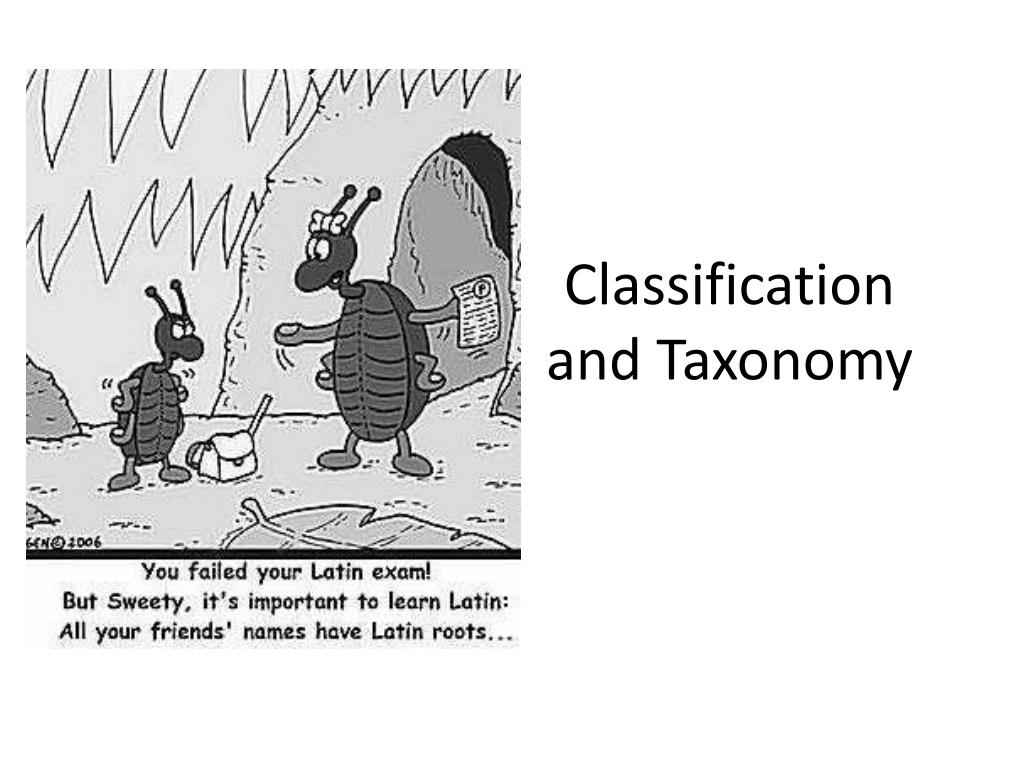
  1. Classification and Taxonomy

  2. Classifying Organisms • Taxonomy: the science of describing, naming, and classifying organisms

  3. Ways to Classify Organisms • Unicellular vs. multicellular • Prokaryote vs. eukaryote • Autotroph vs. heterotroph • Linnean system and binomial nomenclature (today)

  4. Old Systems of Classification • Aristotle (Greek, 2400 years ago): classified only as plant or animal

  5. …but where does this stuff go? 

  6. A better system • Carolus Linnaeus (1707-1778) • “Father of Taxonomy” • His work is the basis of classification systems used today

  7. Modern Classification • Can classify all life into 3 main domains • Most general/most inclusive category • Bacteria, archaea, eukarya (written in chart)

  8. Characteristics of Domain Bacteria • Prokayote • Small • Unicellular • Have cell wall • Example: E. coli

  9. Characteristics of Domain Archaea Some of the first Archaea were found in the hot springs of Yellowstone Park • Prokayote • Small • Unicellular • Have cell wall • Live in harsh environments • Example: Pyrococcusabyssi

  10. Characteristics of Domain Eukarya • Eukaryote • Small or large • Uni. or multi. • Some have cell walls • Ex: protists, fungi, plants, animals

  11. Be ready to answer! • How did Aristotle classify organisms? • Who came along and improved Aristotle’s method? • Which domain of life has organisms that live in very harsh environments? • Which domain are humans contained in? • Which 2 domains have prokaryotes?

  12. Domains can be broken into 6 kingdoms

  13. The 6 kingdoms: • Kingdom Eubacteria (“true” bacteria) • Prokayote • Unicellular • Includes autotrophs and heterotrophs

  14. The 6 kingdoms: • Kingdom Archaebacteria (“ancient” bacteria) • Prokayote • Unicellular • Autotrophs (chemosynthesis), heterotophs

  15. The 6 kingdoms: • Kingdom Protista (protists) • Eukaryote • Majority are unicellular • Autotrophs, heterotophs

  16. The 6 kingdoms: • Kingdom Fungi • Eukaryote • Majority are multicellular • Heterotrophs

  17. The 6 kingdoms: • Kingdom Plantae (plants) • Eukaryote • Multicellular • Autotrophs

  18. The 6 kingdoms: • Kingdom Animalia (animals) • Eukaryote • Multicellular • Heterotrophs

  19. “Domain” and “kingdom” are still too broad. We continue to break organisms into more and more specific categories. Same information, just presented in a different way

  20. Classification of Humans Domain: Eukarya Kingdom: Animalia Phylum: Chordata Class: Mammalia Order: Primates Family: Hominidae Genus: Homo Species: Homo sapeins

  21. Guess the organism!

  22. To remember the order: • Domain Dear • Kingdom King • Phylum Phillip • Class came • Order over • Family for • Genus great • Species spaghetti

  23. Classifying organisms • Taxon: any particular group within a taxonomic system • “Taxa” is plural • Examples of taxa: • Kingdom • Phylum • Class • etc.

  24. In order, the taxa go from general to specific. General • Domain • Kingdom • Phylum • Class • Order • Family • Genus • Species Specific

  25. Same genus- very closely related Species- the most unique

  26. Be ready to answer! • Which kingdom has “true” bacteria? • Which kingdom has organisms like Volvox, a protist? • Which kingdom has mushrooms? • Which kingdom has organisms that are ALL autotrophs? • Which kingdom has “ancient” bacteria? • Which kingdom has ants?

  27. Why do scientists use Latin to classify and name organisms?

  28. What is this?  Here’s an example why.

  29. This organism can be called a: • Cougar • Mexican lion • Mountain lion • Deer tiger • Mountain screamer • Puma • Florida panther • Catamount • Panther • Silver lion • Devil cat • Indian devil • Sneak cat • King cat • Mountain devil • Red tiger • Deercat • Fire cat • Plain lion • Grey lion • Caracajou • Klandagi • Catawampus • Quinquajou • Long Tail • Swamp lion

  30. Problem! • There are at least 50 common names for the cougar. The same issue arises with many other organisms!

  31. Why classify with a scientific name? • Since common names vary, scientific names ensure you’re talking about the correct organism • Some names are misleading (“jellyfish”)

  32. Scientific naming system • Binomial nomenclature- a two-part name system for writing scientific names. Based on Latin.

  33. Rules • Genus name written first • ALWAYS capitalized • Species name is written second • NEVER capitalized • NEVER by itself • Both words are italicized if typed, underlined if handwritten

  34. Find the errors! • TaxideaTaxus • procyonlotor • DelphinidaeDelphis

  35. Sidenote with an example: • Cannisvulpesis a fox • Writing C. vulpes is acceptable. • Writing Cannis v. is not. • Writing vulpes (by itself) is BAD…need genus + species.