Exploring Semiotics in Media: Understanding Signifiers, Codes, and Conventions
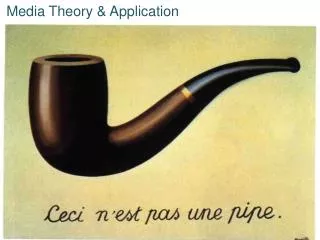
This analysis delves into the intricate world of semiotics as illustrated in René Magritte's "The Treachery of Images." It explores key concepts such as signifier and signified, denotation, and connotation, presenting a framework for understanding the deeper socio-cultural implications of media. By examining how media communicates messages through established codes and conventions, we aim to intentionally shape the meanings conveyed to various audiences. Group discussions will enhance our understanding of media's role in shaping perceptions, values, and myths.

Exploring Semiotics in Media: Understanding Signifiers, Codes, and Conventions
E N D
Presentation Transcript
This is not a pipe. • What is René getting at? • Hint: The painting is somethings called The Treachery of Images
Semiotics specifics signifier + signified = sign city word, sound, image, etc. mental concept
Aspects of what is "Signified" 1st order: Denotation 2nd order: Connotation The "deeper" meaning, socio-cultural and personal associations. Analog <--------> The literal meaning of a thing or sign. Digital (bonus level) 3rd order: Myth Major culturally-variable concepts underpinning a particular worldview – e.g. masculinity, femininity, freedom, individualism, colonialism, etc. The Matrix
Aspects of what is "Signified" Denotation Dinner + place setting Connation We're open tonight, selling sit-down meals, including dinner [Mass produced, inexpensive] homey food after hours 50's-flavored diner restaurant (waitresses + gruff male cooks?) Highway and driving culture Myth WASP Americana nostalgia -> warmth & authenticity
Code – definitions & examples • A set of practices familiar to users of the medium operating within a broad cultural framework • An ever-evolving system of explicit social conventions A few codes of the moving picture medium: • Genre (narrative, characterization, themes, setting, iconography) • Camerawork (shot size, focus, lens movement, camera movement, angle, lens choice, composition) • Editing (cuts & fades, cutting rate & rhythm) • Manipulation of time (compression, flashbacks, flashforwards, slow motion) • Lighting • Color • Sound (soundtrack, music) • Graphics • Acting technique • Narrative style • Authorial style
Signs Codes Syntagms* * syntaxes, grammars,structures repeated over time become Conventions
Why is any of this relevant? Intentionally or not… • Every scrap of media you will create has denotations, connotations, & even myths • Every scrap of media you will create follows/uses/twists/breaks codes and conventions In this class, let's be intentional about what we're communicating to whom with our creations.
For the following media samples, think connotations, conventions used/borrowed, values displayed, myths conjured, for some [which?] audience. What is it saying to whom?
Wicked Witch, 2013 Wicked Witch, 1939
ICE: Media Theory Analysis In small groups, discuss a favorite/memorable game or website in terms of: Audience Conventions of any kind (technical and socio-cultural) Connotations Myths
Homework • Media Theory Analysis